

Categorías
Artículos

Beyond popular religiosity: Mary, queen of Poland

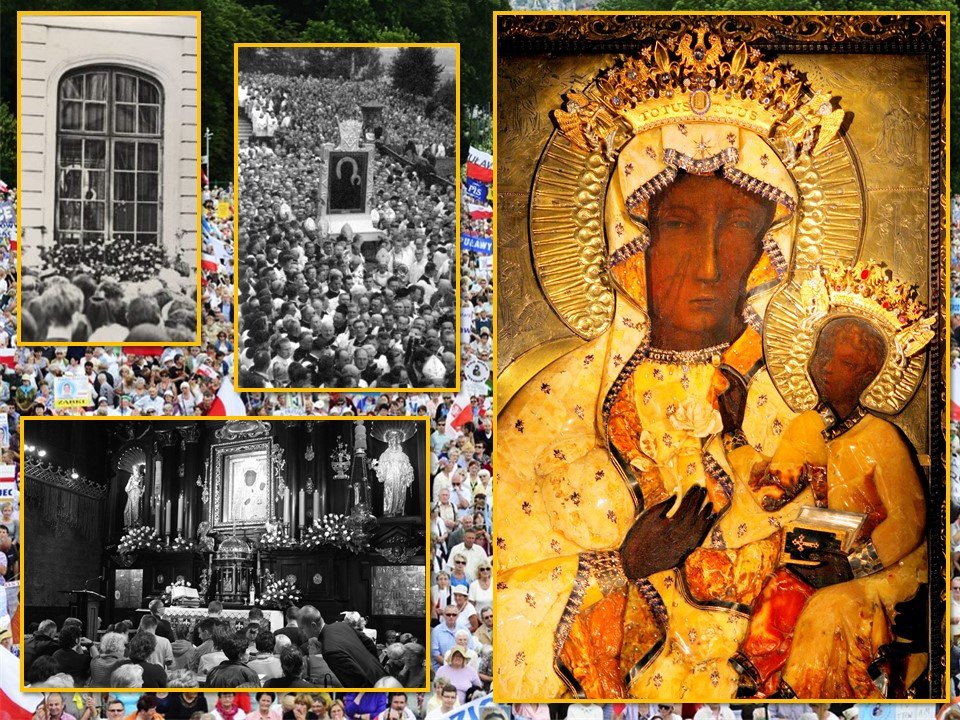
When I reflect about my experience of God, my first memories are the traditional Sunday Eucharist with my parents and brothers. Once the Mass was over, my father led us by the hand in front of the image of the Mother of God (in Poland we call Mary  so, rather than «the Virgin»), the Black Madonna, Mother of God of Częstochowa, Queen of Poland, with her serious face and two wounds on her cheek. I remember that, as a child, I did not know why we were kneeling before this somber and majestic image, but it seems that this was not bothering Maria: she does always know why she looks at us pointing to her Son. I am Sr. Alicja Grzywocz, Tertiary Capuchin, Polish, and I have the pleasure to share with you some “brush strokes” about Mary’s experience as Queen of Poland.

Even though from Rome to Gniezno – the first Poland capital – there are a little more than 1500 km, the Christian faith took almost a thousand years to reach these Slavic lands. Our prince Mieszko I was baptized in the year 966 and the first church he ordered to build was dedicated to the Assumption of the Virgin Mary. To this day, the Gniezno Cathedral – that below its walls hides the ruins of that first church – is called «mother of the churches of Poland». A very fruitful mother from whom her children have inherited a very special veneration for the Mother of God.

The first hymn of our country was a prayer sung to the Virgin Mary. With her and with the name of Mary on their lips, the Polish army began its battles that – among other reasons, due to its geographical location in the center of Europe – have been very numerous  throughout our history. It was in the XVII century –  lso in the context of a war – that the King of Poland crowned the Mother of God, naming her Queen of Poland. The curious thing is that almost 50 years before, the Virgin herself requested to be called so. The story tells that an Italian Jesuit praying in Naples, saw Mary dressed as a Queen and holding the Child Jesus in her arms. The Jesuit wanted to hail the Virgin with a title with which she had not yet been venerated by anyone. Our Lady took the initiative and told him: “Why don’t you call me Queen of Poland? I love this kingdom and I am going to do great things for it, because a peculiar love for me burns within its children». The Jesuits – after carefully examining this apparition and having received from the Church the confirmation of its authenticity – informed our king, who liked to welcome the before mentioned Jesuit, that walked to Poland, the Kingdom of the Virgin Mary. At the top of the tower of the Church of the Assumption, in the main square of Krakow (at that time, the capital of Poland), it was placed a crown as a sign of acceptance of this request of the Virgin.

The most desired moment of the coronation did not occur until after the invasion of Poland by Sweden and Russia (known as the «Swedish flood»). A key moment in this war was the miraculous defense of the Jasna Góra (Clear Mountain) monastery in Częstochowa, where the icon of the Black Madonna was worshiped. The chronicles tell that a very limited group of soldiers, after having spent the night in prayer before the icon of the Mother of God, defended Jasna Góra because She was fighting with them against a much stronger army. Other cities, after hearing the news, went back to the battle with a renewed spirit, well knowing that the Virgin was on their side. The victory in Jasna Góra and finally in the whole Poland, inspired King John Casimir to crown the Virgin as Queen of Poland and to pronounce her vows on behalf of his entire kingdom. The celebration took place in Lviv (now belonging to Ukraine, but then to Poland) in the year 1656.

This one was not the only time that Mary has been crowned Queen of Poland: this fact has been repeated more than 50 times, renewing, in different historical moments, the commitment that that entails. A few years after Poland had regained independence (1918) and once ended the II World War II, two very significant jubilees took place: in the year 1956 the 300th anniversary of the vows of John Casimir and of the coronation of the Virgin as Queen of Poland and, in the year 1966, the 1000 years of the baptism of Poland. Cardinal Stefan Wyszynski (a close friend of John Paul II and whose beatification will be next June) proclaimed novenas in preparation for these jubilees. In 1956 the whole nation renewed its vows before the image of the Mother of God of Czestochowa and began the preparation for the Millennium Jubilee of Baptism: one of the realized initiatives was the pilgrimage of a copy of the image of the Black Madonna of Czestochowa through the parishes of Poland.

I have heard many people speaking about that pilgrimage and although I did not live it because of my age, I can perceive the importance of this event in Poland. The context was very unfavorable since the communist government was striving to make all the possible to stifle the faith in Poland. During 9 years they observed the pilgrimage of the icon of the Virgin that every 24 hours changed parish. People were decorating their houses and streets to welcome the Black Madonna, the crowd was praying day and night before the image … The communists saw that all their efforts to weaken the faith were in vain, since the pilgrimage of the Mother of God of Częstochowa was awaking a very special strength in everyone. Finally, they decided to arrest the Virgin … In the 1966, a few days before the celebration of the millennium of the baptism of Poland, under the pretext of controlling the vehicle where the icon was transported, they seized it and took the image to the Warsaw Cathedral, preventing its passage through the parishes that were still waiting to receive their Queen.  After the jubilee they put the image at the window of the sacristy, secured with bars, and forbade to continue the pilgrimage; although that, people tried again to continue the pilgrimage but, once again, the communists took the image and brought it to Częstochowa, where it remained during 8 years strongly protected behind bars and under military surveillance.

Surprisingly, during these 8 years the pilgrimage took an even greater strength: what was carried from one parish to another was … an empty frame. People continued to decorate the houses and streets of their villages, the churches were full of people and everyone was praying before the empty frame of the image of their “imprisoned” and safeguarded Queen. The message is very clear: faith makes us free and there is no way to imprison it; the Polish people gathered before the empty frame of the icon of the Black Madonna, pointed out whom they wanted to serve and to whom their heart was belonging.

The Czestochowa monastery is still one of the most important places in Poland. Every year something like 250,000 people leave their towns and cities and walk to the Black Madonna. The oldest pilgrimage will soon turn 400 years of tradition. For some of them, it is more than 600 km on foot. For those who live «on the way» to Czestochowa it is a pilgrimage of hospitality: during the months of July and August they keep the doors of their houses open to host free pilgrims who come to present their intentions and to ask the blessing of the Queen and others, in front of their houses, set tables with water, sweets, bread … to comfort the pilgrims.

Why is it so popular the Virgin of Częstochowa and not any other else image among many other miraculous representations of Mary that are in Poland? Perhaps, the people so many times wounded by wars and other evils, see in the sad face and scared face of the Black Madonna, a Queen able to of understand and share their suffering … Perhaps, looking at this icon, they remember the victorious battle despite the magnitude of the enemy and regain hope in their daily fights Or perhaps, the Mother of God holding the Child Jesus in her arms, inspires them a most simple and trusting prayer: “Madonna, Black Madonna, how it is good to be your son; let me, Black Madonna, hide in your arms ”, as one of the songs says.

Every day at 9:00 p.m. before the icon of the Queen of Poland in Częstochowa, but also in thousands of families who spiritually join with Jasna Góra from their homes, people pray «Apel Jasnogórski» – «Appeal of the Clear Mountain ”. It is a prayer to present to the Queen what they have lived during the day and to beg her blessing upon the night and the following day; it usually ends with a sung prayer: «Mary, Queen of Poland, I am with you, I remember, I watch over». The last time in which I was able to experience that in Czestochowa, after a walk of 100 km from my birth parish to Jasna Góra I understood that, may be, more than saying we: «I am with you, I remember, I watch over», as polish people, it is our Queen who tells us that. Her presence in Poland is “breathed” at every step and at no time She has forgotten this people that she herself chose to be her Queen and, like every Mother, day and night, she keeps watch and cares for her sons and daughters.

Wherever you are, sooner or later, you will surely come across the image of the Black Madonna, Queen of Poland, since her people have always carried her with them… Pray to her also like us: “Madonna, Black Madonna, how good it is to be your son Let me, Black Madonna, hide myself in your arms”. And I hope you hear in your heart her response: «I am with you, I remember, I watch over….»

ALICJA GRZYWOCZ, TC
Categorías
Artículos

In the family … Joyful in the Lord

Two months have already passed since the beginning of the “Amoris laetitia family” Year, an initiative accepted with enthusiasm everywhere in the world and we like to turn our gaze to our family life experiences. We discover that we have lived very happy moments allowing us to enjoy the work, the rest and the meetings … we have learned also to be cheerful in the midst of difficulties. One to the other, we pass that joy and our open heart as source of happiness because “there is more joy in giving than in receiving” (cf. Acts 20,35). That is exactly what the Year of the Family intends: to help us to grow in the joy of loving and to be missionaries of joy; that at the end of this Year dedicated to the family, may we be grown in the joy that is fruit of the true love.

We also recognize that, in some moments, sadness has invaded us and we have transmitted in the environment our negativism and lack of integrity and we have almost caused family breakups. “Conflict cannot be ignored or concealed. It has to be faced. But if we remain trapped in conflict, we lose our perspective, our horizons shrink and reality itself begins to fall apart” (cf. EG 226).

Let us today enter barefoot into our reality, because it is sacred land (cf. Ex 3,5), always keeping our gaze fixed on God who is joyful. This joyful God dwells in us.

God makes happy our hearts: «You have given to my heart more joy than when they abound with wheat and new wine» (cf. Ps 4,7). Joy is born in the heart of God; He is neither sad nor melancholic and therefore, those who love God experience his same feelings and rejoice with Him , “But joy for all who take refuge in you, endless songs of gladness! You shelter them, they rejoice in you, those who love your name” (cf. Ps. 5,11).

God rejoices in his creation and God’s creation reflects the joy of its Creator: “Desert pastures blossom, and mountains celebrate” (cf. Ps. 65,12). The Word of God invites us to join and rejoice with it and to sing joyfully, raising our voices and clapping: «Sing joyfully to the Lord, all the earth» (cf. Ps 95,1).

As a part of that creation, we also rejoice: “With all my heart, I will praise the Lord; let all those who are helpless, listen and be glad.” (cf. Ps 34,2), “Praise the mighty rock where we are safe” (Ps 95,1). With Jesus, joy is always born and reborn in us and we are set free from sin, sorrow, inner emptiness and loneliness (cf. EG 1). Saint Paul VI told us: “No one is excluded from the joy brought by the Lord” (cf. Exhort. Apost. Gaudete in Domino 22).

The great danger in today’s world, pervaded as it is by consumerism, is the desolation and anguish born of a complacent yet covetous heart, […] where there is no longer room for others […]  God’s voice is no longer heard, the quiet joy of his love is no longer felt”(cf. EG 2).

“Shout praises to the Lord, everyone on this earth” (Ps. 100,1). That is a personal and family matter.

In our common home the wounded and abused nature, lives the human family, the family of humanity, a family of a broader level that also within itself, receives wounds that tear and disjoin it. That is why “The urgent challenge to protect our common home includes a concern to bring the whole human family together to seek a sustainable and integral development” (cf. LS 13).

The best ecological practices require the cooperation of all and of each member of the family. The excessive consumerism affecting us today is an important cause of the high environmental pollution we all are complaining of, without thinking that each one of us contaminates individually himself and does not take into consideration the family, group and social consequences of our personal and common choices.

Every year, the UN invites us, on the International Family Day, May 15th, to deepen one of the sustainable development goals. This year 2021 the theme is goal no. 13: “Take urgent action to combat climate change, focusing on families and family policies to adopt urgent measures to combat climate change and its effects”.

The UN invites us to pay attention, among others, to the following goals:

  • To improve education, awareness and human and institutional capacity, in order to mitigate the effects of this climate change.
  • To strengthen resilience and adaptive capacity to risks related to climate and natural disasters, in the different countries.

Our assignments could be: To consume only what is necessary, to enjoy the outdoors, free spaces and ornamental plants, to keep clean and welcoming the spaces of our house since we deserve clean places where we like to stay, to use what is necessary because, maybe, we have things that someone else needs.

In short, let’s keep what we have in such a way that it may be useful and delighting to us; at the same time, let us make the others feeling well. Do you like to be up for it?  I am up for it and I invite you to do the same.

What is left to us, is to carry out actions in order to face this challenge as a family, dragging our neighbors to do the same; through that, we’ll build families happy in their daily love and enjoying the space where we live. Neighbors too will feel well; Pope Francis invites us to be good neighbors “[…] the sense of neighborhood [where] each person quite spontaneously perceives a duty to accompany and help his or her neighbor […] where these community values are maintained, people experience a closeness marked by gratitude, solidarity and reciprocity. The neighborhood gives them a sense of shared identity” (cf. FT 152).

This same month of May we celebrate Pentecost. We need the Holy Spirit’s warmth and fire for the transformation of families. He works in us and helps us to carry out our tasks and this is the experience of many praying people in whom a different life pulsates and whose gaze sees beyond; that could be granted to us too.

The first task of Christians is precisely to keep alive the flame that Jesus brought to the earth (cf. Lk 12:49); and what is this flame? It is love. Without the fire of the Spirit, sorrow supplants joy, routine substitutes love, service turns into slavery. The Holy Spirit makes us to experience the moving joy of being loved by God (Pope Francis Catechesis, March 17, 2021). And whoever feels loved, loves and loves with joy.

HNA. BERTA MARÍA PORRAS FALLAS, TC

Categorías
Artículos

Biodiversity

Origin of the concept of «Biodiversity» and its commemoration on May 22nd

“The care of creation is not only due to practical reasons such as a responsibility towards the future generations;  its deepest reasons are theological. The creation is a  work of the Holy Spirit and cannot be destroyed without offending its Author” (P. Raniero Cantalamessa OFMCap)

The topic that concerns us today is «Biodiversity«, an expression originated in a scientific environment, but that quickly awakens interest in philosophical, social, political, economic and religious fields and in people interested in the conservation of biological diversity because they fear the irreversible harm of natural environments, endangering the basis of the human existence.

The UN seeks solutions and in the United Nations Scientific Conference in New York (1949); it  deals with the theme «Conservation and use of resources» but its interest is focused on the adaptation of natural resources to the requirements of the economic and social development, without taking care of its conservation.

The first summit about the earth takes place at the «Stockholm Conference on the human environment» (1972). It sets out the need to preserve the land, flora, fauna, and natural ecosystems, avoiding their depletion and taking into account the benefit of present and future generations. In its statement, it exposes the principles for the conservation of the human surroundings, makes recommendations for international environmental action, and warns governments that they must take the necessary actions to control activities that may cause an atmospheric damage and their consequences on the climate. To fulfill its declaration, it creates the United Nations Environment Program UNEP, the largest environmental authority in the world.

The concept of biodiversity is the result of several studies carried out by Thomas Lovejoy (1980) President of the Biodiversity Centro of Amazonia, university professor and principal member of the UN Foundation and Norse and McManus (1996); in their studies they use the expression “biological diversity” referring to the variety of species, including genetic and ecosystem diversity. In the National Forum on Biological Diversity, held in Washington, Walter G. Rosen (1985), is the person who, for the first time, when he is talking about the variety of life on earth, at all levels, from genetics to different biomes, he uses the expression “biodiversity”. So, this expression becomes popular in the report of the event, published by Edward O. Wilson, professor at Harvard University.

The Convention on Biological Diversity held in Rio (1992) is based on these studies and deepens in the problems related with the production of toxic and polluting materials as well as of clean energy and of the drinking water. He synthesizes the concept of «Biological Diversity» as the variability of living organisms from any source, including terrestrial and marine ecosystems, other aquatic ecosystems and the ecological complexes they are part of. One of its greatest achievements is the Convention on biological diversity, which makes the issue of biodiversity becoming part of the political agendas of the signatory countries and not only concerning development but also in the environmental care, considering that the biodiversity future depends on both biological and sociocultural processes. This Convention is an international and juridical binding treaty, whose text is approved on May the 22nd 1992.

On the other hand, the Millennium Summit, gathers in September 2000, at the UN headquarters in New York, to approve the Millennium Declaration and eight objectives to work out until the year 2015 as UN values: peace, security, and disarmament; eradication of poverty; protection of the common environment; human rights; democracy and good government; protection of vulnerable people; attention to the needs of Africa and UN strengthening.

At this summit, to commemorate the day when the Convention on Biological Diversity was approved, the United Nations, on December 20th 2000, declares May 22, the World Biodiversity Day; its purpose is to propagate the meaning and value of biological diversity (species and ecosystems) in human life. This date is designated as an opportunity to sensitize governments, media and people in general, about problems of common interest that are still unresolved and to require the implementation of concrete political actions.

Many are the achievements of the Convention on Biological Diversity, in the different summits: in Nagoya (2015), the Strategic Plan for the Decade 2011-2020, in Cancun (2016) the United Nations Environment Program, in Kunmimg (2021) the Summit of climate adaptation and its efforts to end COVID 19.

There are still outstanding debts with the planet; since if the ecosystem is damaged, it cannot offer the expected well-being and zoonotic epidemics related to some ecosystem diseases, appear. Biodiversity is in danger and it is everyone’s obligation to protect it, making an aware use of its resources and generating protection measures well knowing that, every day, we received from it innumerable and often unperceived benefits. Among them we mention the following ones.

Bees and hummingbirds pollinate the planet: plant plants that produce flowers for their food. Forests regulate temperature and plants generate oxygen: plant trees that will generate oxygen and your environment will be cooler. Reefs are home to a quarter of the marine species and protect the coasts from waves, storms and tsunamis; take care of the coasts and beaches, avoid disposable products of polystyrene or plastic. Mangroves capture carbon dioxide: protect them if you have the privilege of living near them.

Thank you.

LIGIA INÉS PÉREZ ARANGO, TC

Categorías
Últimas Noticias

May the 11th: a day of memory and to renew life

On May 11th, 1885 in the Shrine «Our Lady of Montiel» (Valencia – Spain), a small group of women promised to live according to the Form of life drawn up by the young Capuchin, Father Luis de Massamagrell; it was born in the Church the religious Family of the Capuchin Tertiary Sisters of the Holy Family.

Since then, on this date and every year, the Sisters remember this event and they joyfully celebrate it because, what happened on that day, continues along the time.

A religious congregation foundation is something similar to a child birth that requires a patient waiting and care by the person who will give birth and, as we know very well, Father Luis Amigó prepared this moment, not only following his dreams and personal projects, but remaining attentive to the signs that the Lord was sending him in his daily life and ministry and discerning them in prayer.

May 11th is a birthday celebration gathering all the Sisters, but it cannot be only a feast day to remember with emotion our foundation and to thank the Lord for what we have lived through and for the witnessing of life we discover in the congregational history, but it is an opportunity to reaffirm our personal and community commitment that allows our history to continue through the engagement of the Sisters walking every day along the roads of the world, faithfully reflecting in their lives the light of the Charism received from Father Luis Amigó.

Undoubtedly, the community renewal of Religious Profession that we make on this day, expresses our will to be faithful to our commitment but, at the same time, entails for us a “renovation” of our consecrated lives. The time and our lives continue their course, continually presenting us new challenges and the renovation of our religious vows means not only to reaffirm what we promised years ago, but to commit ourselves to “make new” our vocational response since our experience and well knowing that the One who called us one day, will not retract his promise (cf. 2Pt 3,9) and, as the Risen One, will always be with us, in the moments of light and in those of darkness, sustaining us along the path and giving peace to our heart.

The Saint Francis’ Little Flowers narrate that, during the Chapter of the Withes, Brother Francis talked to more than five thousand friars gathered there and told them: “My sons, great things have we promised unto God, but greater are the promises of God to us-ward; let us observe the promises we have made unto Him and let us await with confidence those things which he promised unto us” (cf. Lit Fl.  XVIII). May these words of the seraphic Father Saint Francis bring a further touch of joy and hope to our celebration and may the blessing of Father Luis, humble protagonist of May 11th 1885 in Montiel, continue accompanying our personal and fraternal journey and as Capuchin Tertiary Sisters of the Holy Family.

Categorías
Últimas Noticias

The mother’s day

During the month of May, in many countries of the world, the feast of the mother is celebrated. The origin of this feast day dates back to the distant past, since in the history of ancient pagan and monotheistic civilizations, there are signs of a feast in honor of the mother. It is meaningful that, in most of places, this fest day is celebrated in this month that, in the northern hemisphere of the planet, coincides with the peak of spring and, after a long and cold winter, a new life springs up from the earth adorning trees and gardens with beauty and a colorful variety of flowers and early fruits.

The feast of the mother, which in the Catholic tradition is also associated with the month of Mary, the Mother for excellence, rekindles in each one of us feelings of affection and gratitude for the woman who gave birth to us and cared for us with love and an undoubted sacrifice. Mother plays an important role in the child’s growth process and even when the child has achieved a full personal autonomy, she continues to be an important reference point for him.

Each culture instills in people love and great respect towards the mother and the Word of God itself is rich in texts inviting to cultivate these values towards her. “Honour your father and your mother so that you may live long in the land that the Lord your God is giving you” (Ex 20,12), is one of the Decalogue commandments and as such, it guides the social and religious life of the people of Israel and, furthermore  it is the only one promising a reward. Other texts also exhort us to observe the parents’ teaching (cf. Prov. 6,20), to obey them (cf. Eph 6,1-2) and to be sure that they will never lack the care they deserve (cf. 1Tim 5,4.8).

But the most endearing biblical texts speaking about the mother are surely those presenting her as an  image of God himself: “Could a mother forget a child .. Could she fail to love him? Even if a mother could forget, I will never forget you” (Is 49,15).

The Mother day always rekindles thousands of memories full of affection, gratitude and may be nostalgia for those whose mummy is already in heaven. May this day in honor of mothers confirm the certainty of the love of God that we always call “father”, but whose tenderness and deep love is like that of a “mother”.

The Mother’s Day is the proper time to thank your mummy for all the efforts she has made throughout her life, only for you and for your dear ones. What a nice! Here we offer you a beautiful poem that can help us to celebrate this day but the best one is the one that springs from the heart of each son and daughter. Happy feast day to all the mothers!


Guiding Light Mom

Mom, from the time I was really young,

I realized I had someone…you,

who always cared,

who always protected me,

who was always there for me no matter what.

You taught me right from wrong,

and pushed me to do the right thing,

even when it was hard to do.

You took care of me when I was sick,

and your love helped make me well.

You had rules,

and I learned that when I obeyed them,

my life was simpler, better, richer.

You were and are

the guiding light of my life.

My heart is filled with love for you,

my teacher, my friend, my mother.    

By Karl and Joanna Fuchs


Categorías
Últimas Noticias

Ramadan and easter time: waklking together as messengers of hope

April 13th, for Muslims, was the beginning of the holy month of Ramadan, which will end on May 12th with the Id al Fitr, the second great feast day of the Islamic religion. Ramadan is the name of the ninth month of the year of the Muslim lunar calendar during which, according to Islamic tradition, Muhammad received the revelation of the Qur’an.

In the spirit of fraternity blowing throughout the world that Pope Francis has rekindled with his Encyclical “Fratelli tutti”, the Christian community likes to join spiritually the followers of Muhammad and, through the Pontifical Council for Interreligious Dialogue, has sent «fraternal  good wishes» to the «dear brothers and sisters» in Abraham, their common father in the faith.

Muslims live Ramadan as a time to search and meet God through the prayer, the sacrifice of fasting and the almsgiving in favor of the poorest and all that is quite similar to the spirit of the Lenten season that, for Christian , is as well a strong time for conversion.

As members of the Church and even more as Franciscan sisters, we are invited to get closer to our Muslim brothers and to ask God that their religious commitment contribute to promote and strengthen peace and brotherhood in the world. Franciscan history records that, at a time of a great tension between Christians and Muslims, whose the Crusades were one of the most violent expressions, Francis of Assisi decided to approach the followers of Muhammad through dialogue and a sincere attitude and humbly presenting himself to the Sultan, as a God’s messenger, he produced a strong impact on him and immediately earned his veneration and esteem. Biographical sources, when narrating this fact, emphasize that the Sultan perceived the fervor of spirit and the holiness of Brother Francis who had no word of contempt for the person of Muhammad or for the Qu’ran and had respect for people, recognizing in everything the action of God (cf. LMj IX, 8).

The Ramadan as a time for conversion and the 50 days of the Easter season as a time of joy and hope for the Resurrection of the Lord, are propitious terms calling upon the believers of these two great religions to return to God and to their brothers and sisters and to be messengers of peace and hope. The message of the Pontifical Council for Interreligious Dialogue, referring to the historical moment that we all live being «in the same boat» and rowing together in the storm, takes up this idea and affirms that «during these long months of suffering, anguish and sorrow”, people have perceived their «need for divine assistance but also for expressions and gestures of fraternal solidarity» and that «we, Christians and Muslims, are called to be bearers of hope for the present and for the life to come and to be witnesses, restorers and builders of this hope, especially for those experiencing difficulties and despair ”. As adverse factors to hope, the Message mentions: lack of faith in God’s love, loss of trust in our brothers, pessimism, despair and presumption, and taking up the words of Pope Francis in «Fratelli tutti» recalls that hope is something “deeply rooted in the human heart, independently of the circumstances and historical conditioning … it is a longing for a life of fulfillment and a desire to achieve great things, like truth, goodness and beauty, justice and love” (cf. FT 55).

With joy and faith in the Risen One, we join our Muslim brothers who make Ramadan, asking the same God in whom we believe, to help us to open ourselves to the Father of all, to strengthen our call to brotherhood and to live in peace among us (cf. FT 272).