

Categorías
Artículos

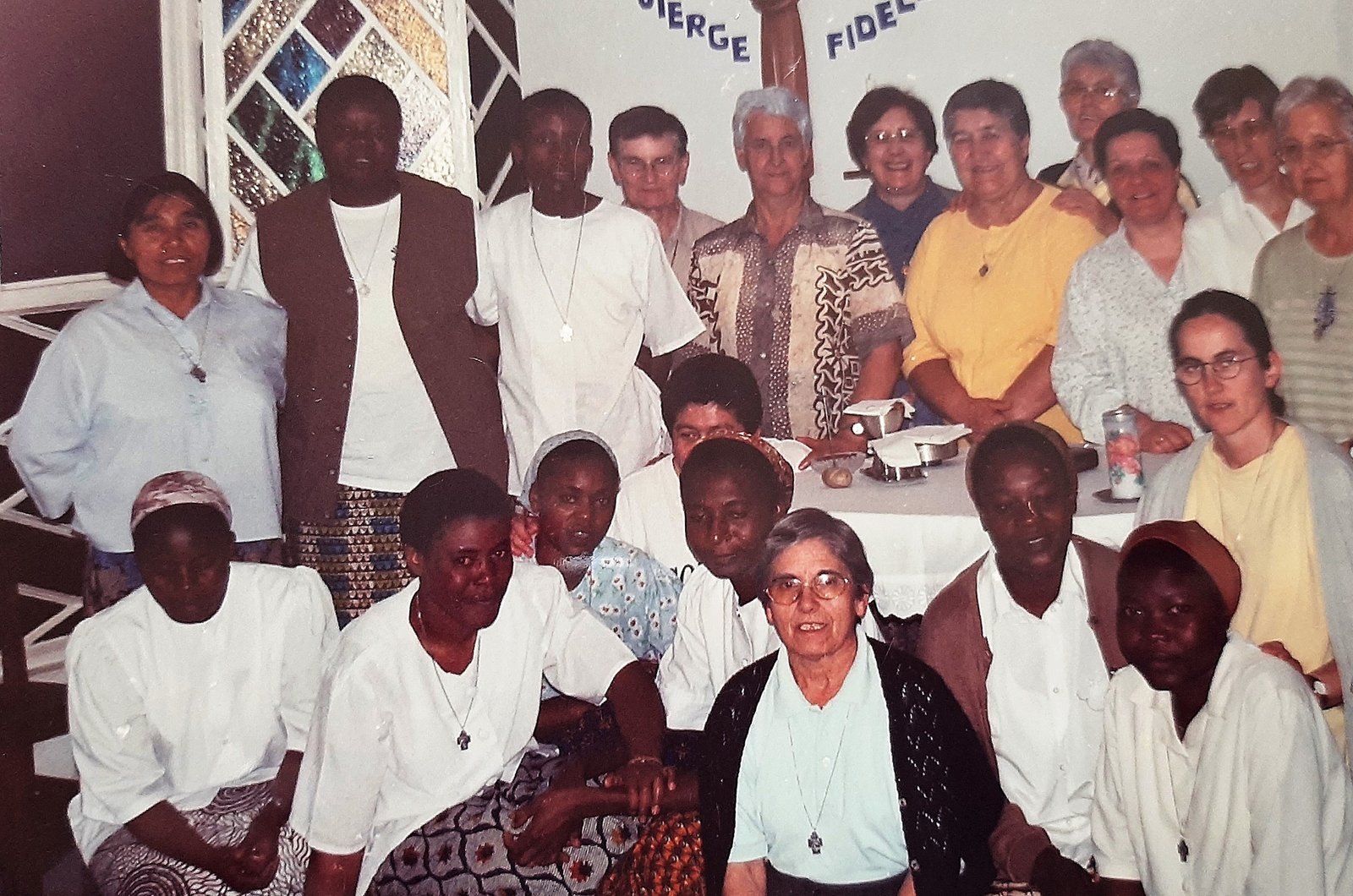
50 years of simple presence accompanying the Congolese people

Our Congregation, founded in Spain in 1885 and spread in some European countries, but especially in Latin America, since the year 1905 when we arrived in Colombia, was not yet present in Africa until 1971 when, the former «Immaculate» Province, received two insistent requests to go to the black continent. One of them was from Mons. Eugenio Kabanga, Archbishop of Lubumbashi in Congo and the other from a White Father (Missionary of Africa) inviting the sisters to Rwanda. The Provincial Superior at that time, Sr. María Pilar Burillo, accompanied by Sr. Margarita Ros, travelled to visit both places and finally they opted to go to Congo (whose name, from 1971 to 1997 was Zaire).
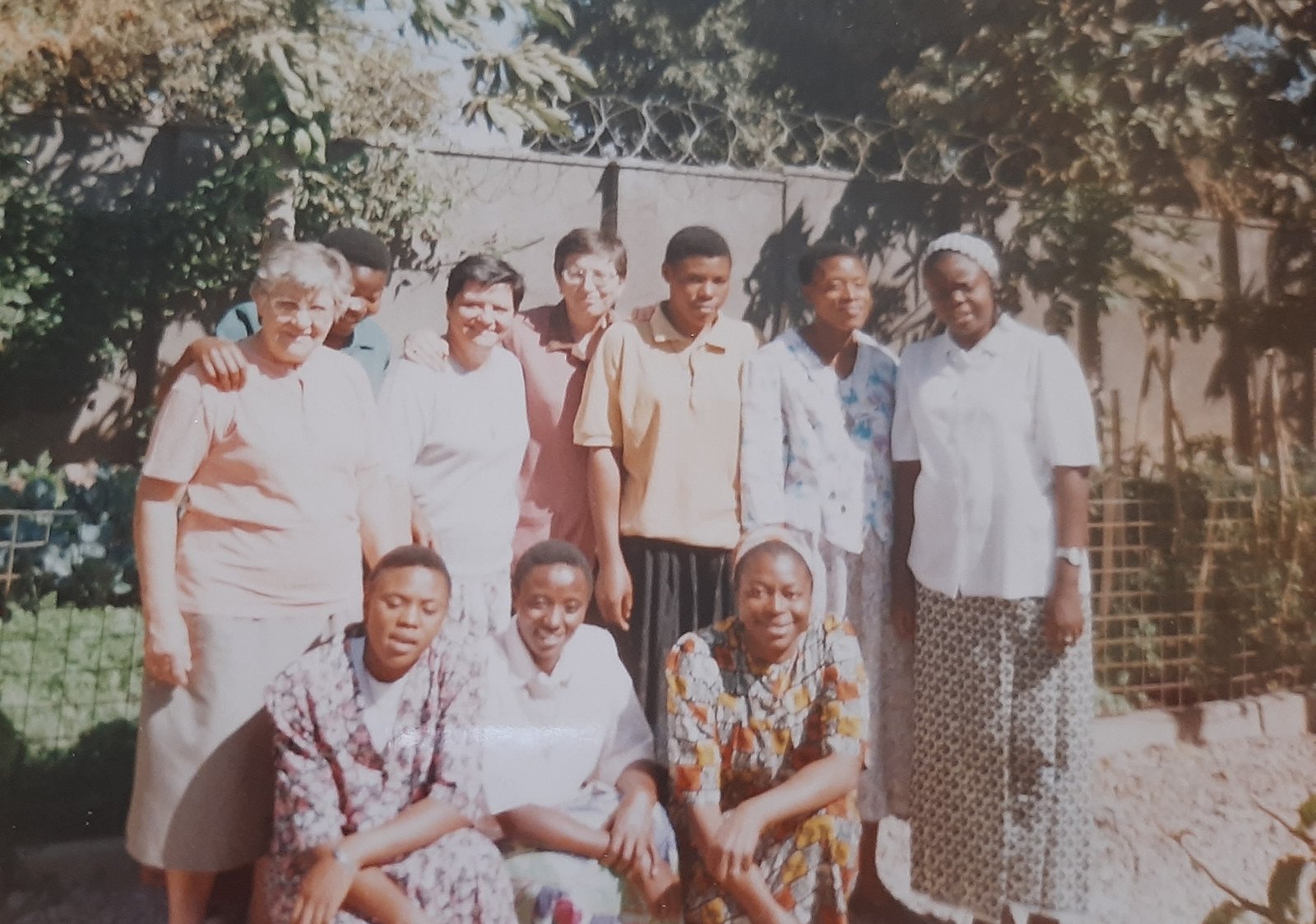
On August 20th, 1971, just 50 years ago, the first five Capuchin Tertiary Sisters who were going to settle in the Democratic Republic of Congo, arrived in Lubumbashi (capital town of the province of Katanga). Their final destination was the Mission of Kansenia, where the Benedictine Monks of Saint André (Belgians), were present since 1912; the Benedictine Sisters withdrew from the place because of lack of sisters and remained there only Sr. Marie Gregoire and another religious, a Saint Augustine’s Canoness, that were carrying on pastoral work in the small villages.  

Five days before our departure from Spain to the African continent, during the missionary sending ceremony in our chapel in Burlada (Navarra – Spain), full of people to overflowing, we told our sisters, family members and the Christian community accompanying us, that we were happy with their presence because, like us, they were eager to communicate to the others the joy of knowing Jesus and they were feeling encouraged by the Spirit of God. In a community, each one has his mission and our mission was to express the Church universality, being a sign of communion, friendship and collaboration with the still young Church of the Congo. On August 21st we arrived at our mission, Kansenia, about 300 km far from Lubumbashi that was attending 35 villages spread over an area of ​​about 2,700 km2 where we would deal with the Hospital (which was in an indescribable situation) and the boarding for the Secondary school girls, we would open a home for girls who had given up the school and we would give classes of religion in Primary and Secondary schools.
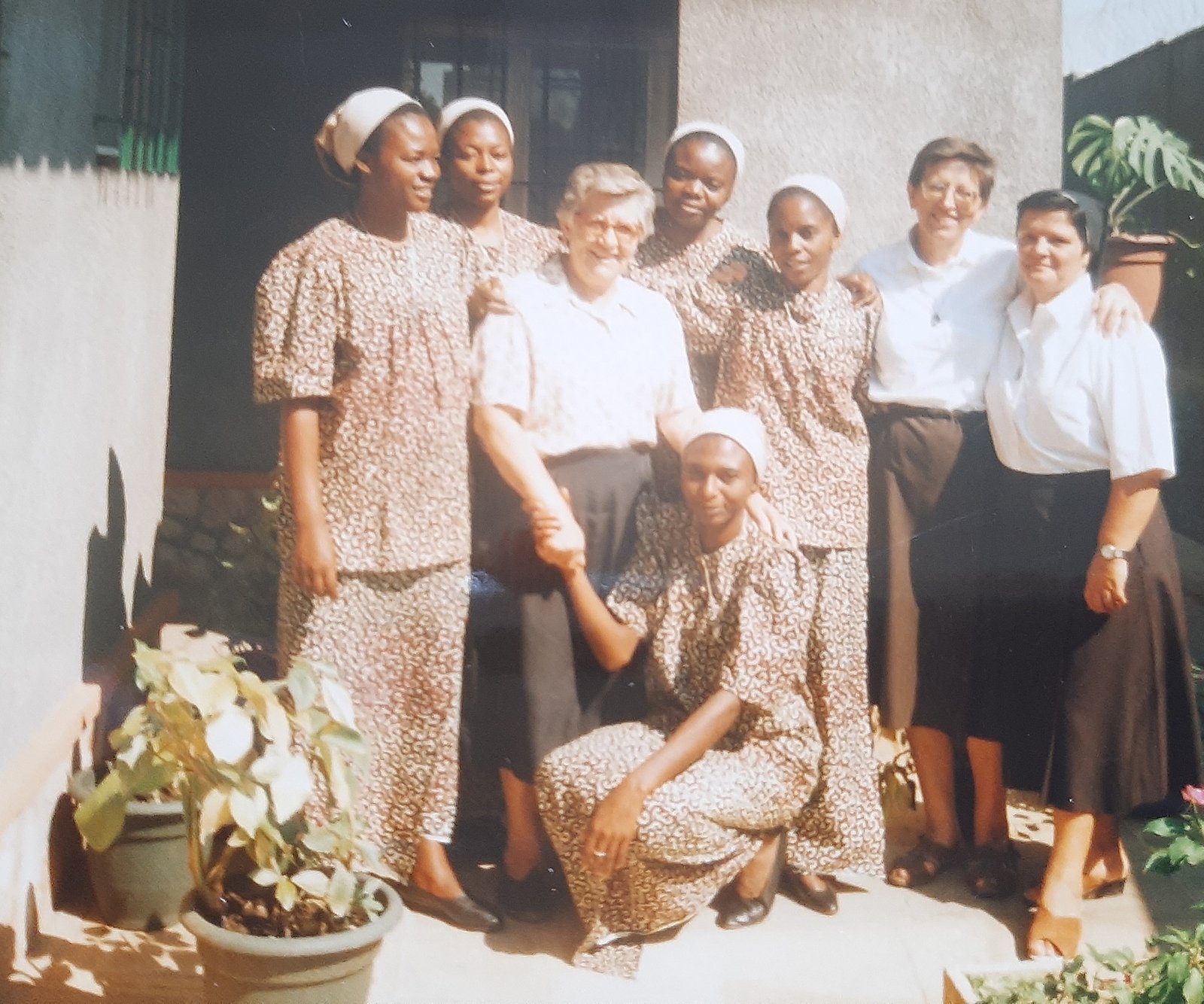
When in our community we became six sisters, two sisters, from Monday to Friday, were going to the villages of the Mission to live and share with the people, especially at night, around the bonfire.

In 1981 another community was opened in the provincial capital, Lubumbashi, since the Archbishop asked the collaboration of one sister in the diocesan store that was providing services to the poor and missionaries At the beginning the Diocese accommodated us in a part of the building of the Diocesan Offices and later in a house near the Cathedral. The other three sisters were performing different tasks: one in a clinic, another in a suburban neighborhood and another coordinating the religion classes in the Primary schools.

When our work in the diocesan store ended, we the sisters preferred to live in a suburban neighborhood and the Salesians offered us to go to Kasungami, a parish they were pastorally attending but where they were not living. And we settled there on January 20th, 1989, taking care of education, health, abandoned elderly, street children, mentally ill people wandering aimlessly, students without means to continue their studies and undernourished people, especially children … And it was there the where we began to receive the first postulants and novices.

It was the moment to think about the formation of the young women who were starting their journey with us and we considered convenient to open a new house, a formation house, in the city, where it was easier to attend courses and seminars organized by the Union of Major Superiors, at an intercongregational level.

The opportunity was provided us by a Belgian priest, parish priest in the Ruashi neighborhood. The formation community settled there on August 19th 1993. They were the last days of President Mobutu and the political situation was complex, reining everywhere a great disorder and insecurity. On three occasions our house was looted and robbed and, due to the seriousness of the situation, we discerned about the convenience of leaving that place. The novices and their Mistress traveled to Benin and joined the Novitiate in that country, at that time belonging to a General Delegation, to complete the canonical year. Meanwhile, we began the construction of a new formation house located near the Lubumbashi university campus and it was inaugurated in October 1998. And on the 30th of that same month, when our first Congolese sister made her Perpetual Profession, the four novices who had already come back from Benin, made their First Profession.

Open to the arising needs and welcoming the signs that God’s Providence placed on our way, we opened a new community to attend, at first, street children. Later, in 2009, the mission of this community expanded and we inaugurated a dormitory for young girls studying in the university: subsequently, due to various circumstances, the girls at risk that were living in this house, were transferred to Kasungami, and welcomed in the home operating there for this mission and managed by the sisters of that community. And in Lubumbashi, instead of the girls’ home, we opened a nursery school whose educational service we are at present completing with Primary School.

Since 2014, as a result of the process of congregational restructuring, the four existing communities in the Democratic Republic of Congo became part of the General Delegation «Our Lady of Africa»: Kansenia, in the heart of the savannah; Kasungami, in the suburbs of Lubumbashi; the formation house and the school complex with the student Dormitory in the city of Lubumbashi.
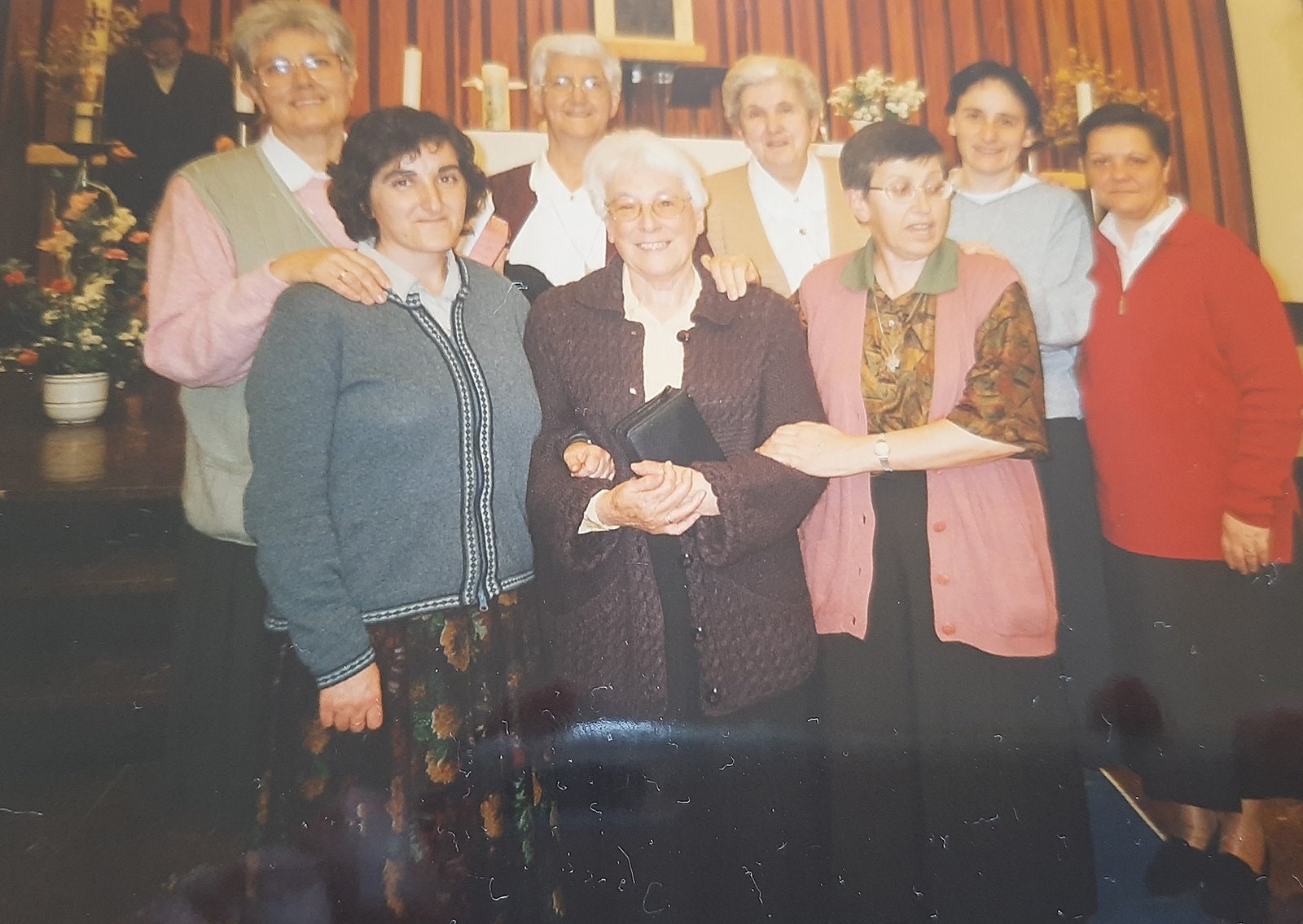
Personally, my life in Congo has been a great gift. I was feeling in my place. The people were simple and very welcoming; young people eager to learn… it was a joy! I was also happy to see that many people without means could be welcomed and cared with interest and affection in the Hospital …, in fact, nobody had health insurance, except those who, were working in the mining centers for a company. Our life was a life of full insertion in the mission.

I never cease to be grateful for everything I have experienced and for all the love received and offered by all the Capuchin Tertiary Sisters who had the grace to work and serve in the Democratic Republic of Congo.

Hna. María Carmen Sanz Lorente, Tc


(Sr. María Carmen, author of this article, was a member of the founding group of the Congo in 1971; she remained in this country during 46 years and she returned to Spain in 2017).
Categorías
Artículos

The amigonian in my life

It is impossible to imagine that, after my retirement, I would also get the opportunity to expand my «Life Project».

First contact

I received the invitation to collaborate in the School «Nuestra Señora de los Desamparados», in San José (Costa Rica), from the Academic Coordination and the Subdirection. That seemed interesting to me and, from the beginning, I could not see any difficulty: I could count on a sufficient academic support and experience for such work and so I accepted. But, oh my God, I did not know what the Lord had prepared for me: to accompany the teachers and administrators in the noble task of education, but “with a surname”… Amigonians.

About Father Luis Amigó y Ferrer I knew that he was a Capuchin Brother and the Founder of the Congregation to which belongs my sister Damaris and I had got some material that she had given to me but that was “standing in line” to be read. I like collecting holy cards and medals (I have always liked the holy objects).

Self-learning

Something that began out of necessity, professional pride and responsibility, became a passion, an enjoyment and a fundamental part of my life project.

My work in an Amigonian Educational Center was for me a constant challenge and learning experience. The “Amigonian Chair” and the civic and religious events were getting a different nuance for me and it was amazing the opportunity to evangelize since the teaching subject, as well as the environment closeness, fraternity and solidarity that were always accompanying my daily life.

Amigonian Lay Movement (MLA)

By the hand of Sr. Ana Jessie Castillo, Capuchin Tertiary Sister, I started my «Amigonian itinerary” in the MLA group gathering in the Provincial House in Córdoba neighborhood (San José – Costa Rica). Its behavior was excellent, and it was a group responsible in the formation in the human, christian and charismatic dimensions, according to what is contemplated in the Form of Life. I made my own the objective that the MLA – Adults agenda proposes: «To value the following of Jesus from Father Luis Amigó’s proposal and his preferential love for the needy, with an attitudes of mercy, in one’s own family and in the environment«. I am far from the fulfilment of this goal, but as long as I live …

Four years after beginning my MLA itinerary, I made my commitment no less than in the Holy Family Chapel of the Sisters in Massamagrell (Valencia – Spain), next to the altar of God and very close to Father Luis’ sepulcher…

Gratitude

Several experiences allowed me to deepen in the Amigonian mission: the Amigonian way, in Assisi, in Colombia, Guatemala… just to mention some few experiences that I consider gifts of pure mercy, as well as the visit to reeducation institutions, listening to young people and knowing their life process, the appreciation for the fraternity and the value of living together in the family homes for girls at risk and the health and nutrition centers were for me a real teaching of Amigonian Pedagogy in action.

It has no price the experience of sharing, for example, the Liturgy of the Hours, in the community of the aged sisters and brothers, and I appreciate how their voices, ordinarily almost muffled, become joy and life when singing hymns and thanking the Lord. … How wonderful is this charisma and to see that even in sickness or, at the life sunset, it builds brotherhood!

My experience as a member of the Luis Amigó Intercongregational Commission, was another great teaching, and I like mention especially three of the tasks assigned to me, that, although simple, contributed to enrich me a lot. The first one was to inquire, in the different “Hoja informativa” of the life and work of Father Luis”, how people where feeling and were expressing their gratitude for his intercession: it was wonderful to see the devotion and gratitude for the received favors. The second one was to review the material about the Founding Father’s life and work existing on the social networks. The third one consisted in reading the prolific production of MLA material sent by the different communities of the world where our Congregation of Capuchin Tertiary Sisters of the Holy Family is present and it is stored, with a special zeal, in the Secretary of the Sisters General House, in Rome.

Our Congregation? Yes, my dear lay colleagues you read well… We, as MLA, are one of the deeds of the Congregation, of our Congregation. Therefore, as members of the MLA we must know, love and share the life and work of Father Luis, since we share with the Sisters their mission and spirituality.

At present my health is not the same … but the Amigonian “eaves” are very wide … I participate in the MLA Adults group Saint Isabel of Hungary gathering in the House of Postulancy and of the aged sisters in La Ribera (Heredia – Costa Rica), led by Sr. Flora Virginia Garbanzo. The pandemic connected me also to the virtual Mother of the Rosary prayer group, where every day at five in the afternoon, we join MLA members, Amigonian Cooperators, Brothers and Sisters. During the pandemic, “it was born” also the “Amigonian Way” at the provincial level. All is grace!

What I have learned

God does not allow himself to be won in generosity and Father Luis is «the man who trusted in God.» Therefore: let everything be «for God’s glory and the good of the minor», whatever be the circumstances. I am almost always, that «minor» … Thank you, Father Luis! Thank you Lord for calling me!

María Teresa Araya Chavarría, Mla

(La Ribera de Belén, Heredia. Costa Rica)

Categorías
Artículos

Clare’s light beaconed inside and out!

«How powerful was the illumination of this light and how strong the brightness of this source of light. Truly this light was kept hidden in the cloistered life; and outside them shone with gleaming rays; Clare in fact lay hidden, but her life was revealed to all. Clare was silent, but her fame was shouted out» (FF, 3284).

As St. Clare of Assisi’s (1194-1253) feast day approaches on August 11, I’ve been reflecting on the relevance of her spirituality in this present time.

Clare of Assisi is one of the great women of the Christian and Franciscan tradition. Within the context of the medieval world of the 13th century, Clare lived and struggled with many of the issues that are present in our day. In the life, spirituality and work of Clare of Assisi we can still find an answer to many questions and challenges in today’s world.

In our day of so much fear, uncertainty, violence, sickness and death caused by the pandemic, selfish distinctions and hostility between rich and poor, political conflicts, war, and environmental crisis – Clare has much to teach us about living together on our planet earth as sisters and brothers, all children of the one God. As the first Franciscan woman, she led the way in giving us a shining example of the feminine response to the challenge of Gospel values. Placing all her unique gifts at the service of others, she modeled a stance of complementary – leadershipWhile St. Francis moved the world with his extroverted charismatic leadership, St. Clare quietly built “stronger structures” behind the walls of the cloister.

“On Palm Sunday, 1212, Clare took a bold step on her spiritual journey. She renounced her privileged position in the nobility and received the garb of the followers of Francis. Eventually, she made her home at San Damiano in a small church repaired by Francis, just below the city of Assisi. Under God’s guidance, Clare created a new path for women, embracing poverty, humility, and charity as companions on their journey”.

Clare’s life of absolute poverty cuts through all the lures of our consumerist culture. She knew the One in Whom she believed and that One was all-sufficient for her. “Clare’s sole desire was to ground herself as a branch to the Divine vine; to be the Mirror of Eternity in the way she lived her life with her sisters and in the depths of her prayer and contemplation of the Crucified Christ and the Risen Lord. In this way, she allowed herself to be transformed into the image — the mirror — of the Godhead Itself”.

She is also teaching us how it is to build a true community based on the obedience of love.  Her example of servant-leadership was remarkably evident. In the Testament she wrote, the grace of sisterhood is being highlighted.  She said: “careful attention must be given to the establishing of relationships, it is precisely because she envisioned a cloistered life that the dynamic of human relationships is of such importance.  We create relationships by doing things together.   Our relationships with other sisters must be one of support”.  For Clare the “sister in office” (she did not use Abbess) must be a good listener, seeing in each person the one whom Jesus has looked at and called.  She desired that her sisters will be nurtured, spiritually, emotionally and physically. For it is in the nature of motherhood to give life. 

 “The mirror image was a favourite image in Clare’s writings.  The mirror is a vision and a symbol.  She was talking about the depths of reality in Christ reflected in the human person.  In her letter to Agnes she advised her to look into that mirror meaning Christ and behold therein the poverty, humility and, centrally, the sacrificial love of our Lord.  This mirror is not only there to reflect  the redeeming love of our Lord; but for her in the community there is no place for class distinctions or any other form of discrimination: everybody was accepted who felt called to her way of life.  For according to her, acceptance of others is the first poverty. She admonished her sisters to show the love they bear for each other by their deeds so that the sisters are able to love God and each other with greater intensity”.

Today, we face such terrible consequences because of our lack of reverence for creation. The environmental crisis results from a lack of appreciation for the good things that our God has given us for our benefit. The very existence of the life of our planet needs new vision. We, human beings so often fail to realize our interconnectedness with our mother earth.  We lose sight of our great responsibility to care for our common home.  Clare saw the reflection of a loving Creator of all these created wonders. In the words of Clare herself: “Always and in all things God must be praised.” 

Clare was a woman of prayer, strength and courage, of wisdom and insight.  She is teaching us the primacy of God and the great importance of prayer. Her light beacons to the outside because her inner life was deeply anchored in God, her loving Father.  As St. John Paul II said: “Her whole was a Eucharist because from her cloister she raised up a continual “thanksgiving” to God…”

Clare’s passionate spirituality continues to inspire us today: “We become what we love, and who we love shapes what we become”.

 “Look into that mirror daily… and ever study your face therein”.  (Clare, 4th Letter to Blessed Agnes of Prague, 1245)

Clare had a deep gratitude for the abundant kindness of God, she considered herself privileged to have been called to such a life.  Profound gratitude that made her exclaim as her last words, “ Blessed be You, O God, for having created me. ”Francis himself called her ‘Cristiana’, the Christian woman. She is indeed true to her baptismal name.  Clare –  which means light, clear and Illustrious light-.  A true Christian who gave a strong witness to the Light of Christ even from her cloister. Her shining light emanating from Christ Himself beacons and continues to shed rays of peace and hope to all corners of the world.

 SR. Mapin M. Pineda, Tc