


Categorías
Artículos

Connected and Committed: «Youth Communication through Social Networks»

In the bustling environment of a high school classroom, I often observe a phenomenon as subtle as it is revealing: young people, each seemingly immersed in the screen of their mobile phone. While checking their latest notifications, commenting on a new post, or quickly responding to a message, they await my first instruction of the class, «put away your devices.» And in that unsettling dynamic, a spontaneous conversation arises with a young person who manages to shift my preconceived ideas before they can settle into my repertoire of recurrent complaints. “Sister, there is something in the consecrated life that attracts me: it’s seeing them live fully!” Her words allowed me to discern two certainties that become a prelude to this article: on the one hand, young people see beyond the apparent, and on the other, they are in search of depth, not superficiality as we often believe. Each class makes me think that, in the face of youth communication through social networks, there are barriers we need to overcome together with them:

Moving from «surfing» interactivity to the depth of words: Social networks are a wide-open window to the most populated continent in the world, where responses are instant, attractive, anonymous, interactive, and addictive, catering to all our appetites, even the darkest and most harmful ones. Faced with this reality, today’s youth question with greater awareness that commitment cannot arise from content that disappears with a scroll, but rather from the beauty of building their inner world, inspired by the Spirit, which moves the heart, guides to full truth, and when known, makes one wiser, firmer, and more human. But, as the saints teach us, an inner life is not understood if it does not lead to commitment: «not in saying many prayers, but in much loving» (St. Teresa). Therefore, it is necessary to create a culture of digital silence as an attractive path to reach others, through the depth of words and not through superficial interactivity.

Moving from the «myopia» of pragmatism to the insight of utopia: From a pragmatic perspective, what is tangible and immediate is more «pleasing.» «What works,» what produces practical and concrete results, and from this point of view, young people traversing the digital continent might disappoint us. Hence, it is worth finely highlighting the beauty of the utopian, of not getting trapped in the here and now to the point of losing sight of what we could be. Therefore, we need to learn to dream with young people, just as Christ did, launching into utopian visions of life. The insight of utopia is not about living in naiveties but about that capacity to dream, create, and aspire to much for ourselves and others as a first step that allows for a committed life that can restore to the Gospel that provocative force often lost in daily living. A utopia that moves us from the immediate, the useful, and tangible to evangelical ideals pointing toward a more humane future, and from there, the words of writer Eduardo Galeano make sense: “Utopia is on the horizon. I walk two steps, it moves two steps away and the horizon shifts ten steps further. So, what is the purpose of utopia? That’s it, it serves to walk.”

Moving from cyber hedonism to the proposal of asceticism: Young people daily receive a very deceptive “good news”: You can have it all, you can live it all, you can try it all, and there is always a way back! The happiness they receive is very much associated with success and pleasure (as a hedonistic imperative), and even the contemporary image of beauty is tremendously reduced to the physical, it is somehow the tyranny of Instagram. Therefore, it is worth announcing the Good News that does not stop putting the cross at the center of its proposal; in evangelical happiness, suffering and the capacity to renounce are included not as a limit but as a liberating force. It is not about saying that life is only suffering, but that in life there is suffering, and people who suffer are also happy, and there will be moments where delaying satisfaction will be healthy even for the soul, because we cannot abandon the idea that anything we want to last and take root will involve effort and sacrifice, and that is not bad, it is human. Therefore, we need to recover the value of asceticism as a way to order everything that disorders the good, beautiful, and true in us. This must be a valid proposal for the youth of our time because, unlike the world’s attractive «good news,» you can’t have it all! And whoever wants to sell us another idea will make us very unhappy because real life demands doses of sacrifice, renunciation, and only when we understand this dynamic will we live less frustrated, less incomplete, and certainly much more committed to ourselves and others. In the words of José María Rodríguez Olaizola (2014), we would say: The Gospel must be understood from its polarities. If you stick to one part, you mutilate it. An evangelical polarity is «death and resurrection»; the Gospel is not a mere cross. But, at the same time, the triumphalist discourse of resurrection without going through the concrete passion and the cross is a bucolic evasion. It’s both things. Let us not stop believing that young people are capable of overcoming these barriers and moving from the media attraction of social networks to a more connected and committed life.

Sr. Beatriz Iliana Quintero Pérez
Categorías
Artículos

“Ukraine. The scars of war and the road to recovery ”

When I was asked to write this article and share my experience about the war in Ukraine, my heart shrank and many memories flooded into my mind. To tell the truth, until a few years ago, I didn’t even know where Ukraine was on the European map. Today, this country is familiar to me, because of the many people I met during the moving experience I had in Poland, welcoming refugee families into our community; it is dear to me because I came to know it through its stories, which revealed to me a multiethnic people, having and cultivating linguistic and religious differences, united, however, by a single dream of independence; and, finally, I feel it close because of its faithful quest to achieve its own identity, as did so many other countries, including my own.

The cry of the Ukrainian people is a cry to be heard, understood and welcomed. It is the voice of a country, seeking to raise its eyes, to look beyond to find confidence in change and to discover a horizon of freedom. Through the stories of so many people, I learned that Ukraine is a beautiful, rich land, with sumptuous baroque, Byzantine cathedrals and medieval castles, as well as having avant-garde architecture and being the homeland of renowned personalities such as the famous engineer Igor Sikorskji, the brilliant computer scientist Max Levchin and many others such as the extraordinary pianist Vladimir Horowitz, Taras Shevchenco, Ukrainian hero and poet, etc.

Ukraine, as its own name defines it (U-craina), a borderland, between two worlds, an intermediate land, a country between the West and the East. In its name is written its history, its present and its future, which struggles to take shape, due to this senseless and intolerable war. A people that seeks to realize the desire to differentiate itself from its roots that have become chains and to realize the dream of fully living its national and identity feeling.

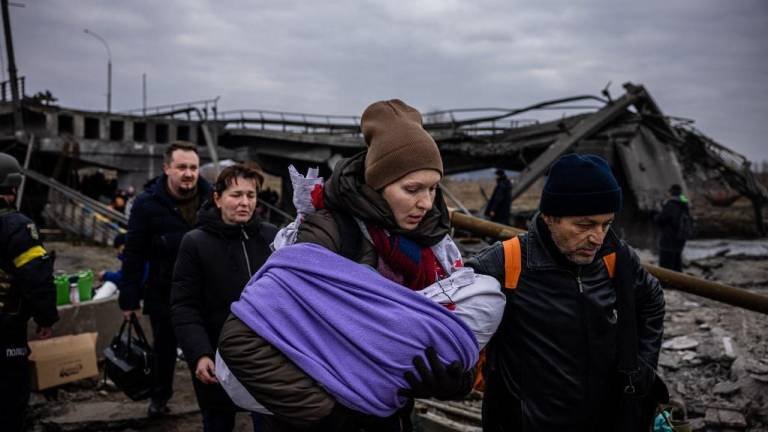
Today, after all this time, after the beginning of the war, which has not yet ended, we cannot speak of scars, but of wounds that continue to bleed with long-term negative effects on all aspects of life, health, environment, economy, work and development of the country. But there are invisible wounds, such as the traumas caused by the conflict, by living in the darkness of a shelter, the precariousness due to lack of food, water, heating, the fear of the sound of a siren or the wake left by a passing plane.

Waves of fear and terror that pierce the soul like daggers and seriously compromise the psycho-physical health, especially of children, the most vulnerable, leading them to withdraw into themselves and into social isolation, to have nightmares and panic attacks, to live in fear of losing their parents, friends and perhaps their future, as well as to grow up with the feeling of how fragile they may be.

The war has robbed them not only of their childhood, but also of the magic of dreaming and believing in dreams; it has opened chasms in their school careers, weakening their prospects for a bright future.

The conflict has also had a strong impact on the elderly, increasing the phenomenon of poverty and social isolation. A state of vulnerability further aggravated by the effect of immigration and the recruitment of young people. The war has been extremely violent for Ukraine, disrupting the labor market and causing a massive exodus, forcing more than a third of the population to move, taking refuge either within the country itself (about 7 million) or, as women and children, (about 8 million) abroad. The negative impact of the conflict has affected the financial situation of each and every family left without a livelihood.

In addition, the war has left deep wounds on the country’s natural landscape, with farmland particularly affected, contaminated and littered with mines, as well as burned forests and destroyed national parks. Important installations and industries were bombed, causing heavy air, water and soil pollution and exposing the inhabitants to toxic chemicals. Not to mention the electricity restrictions that have hampered the provision and delivery of health services, leading to an increase in pneumonia and respiratory diseases, also due to the country’s harsh winters.

But Ukraine is not just a wounded country, but a people that is finding the strength to heal even from something as ugly as war, because it carries in its heart the desire for freedom and the conviction that it can contribute to restoring a dignified life for all its inhabitants and dreams of a country in which no one’s dignity is discriminated against and trampled upon and in full respect for human rights and democracy, always and only the common good is sought, which guarantees security and the necessary conditions for dialogue and peaceful coexistence. It has many reasons to seek a solid and lasting renewal because it thirsts for fraternity and peace.

But with war we are all defeated, even those who do not participate in it. And a path of recovery is born from the depths of each person, who desires a peaceful coexistence and is committed to build it from the «battles» of every day. In fact, as Msgr. Vincenzo Paglia says in his book «Sperare dentro un mondo a pezzi» (Hope in a broken world), that to get out of the «broken world» it is necessary to know how to dialogue with everyone, to start from the last ones, to favor the encounter between different peoples to build a peaceful coexistence, opposing the tensions that lead to conflict. He writes that we must live by building fraternity, which is perhaps the word that best honors the art of gratuitousness and freedom; it can truly help us to be convinced that our responsibility to be builders of peace lies within ourselves. It speaks of peace, of war, of the last, of the elderly and immigrants, but above all, it makes us reflect on a new humanism that concerns globalized man.

For this reason, we are all involved in this path of recovery, from the leaders of nations, to the baker and the children, all involved in a path of mutual trust: trust between individuals, peoples and nations, to overcome conflicts and divisions. As Pope Francis exhorts, «let us hasten along paths of peace and fraternity.

Let us rejoice in the concrete signs of hope that come to us from so many countries, beginning with those who offer assistance and welcome to those fleeing war and poverty». In fact, we have all been protagonists of small or large gestures of solidarity towards the Ukrainian people, experiencing how the only antidote to war and despair is to unite people around good deeds and works towards those in need, above all, towards the most vulnerable, since this is precisely the criterion for the development of a society. Even if at this moment there seems to be no glimmer of hope for possible negotiations, we must never lose hope and we must keep alive the ideal of peace and trust in God. Courage!


Sr. Milena Prete, TC