

Categorías
Últimas Noticias

Lights of Love and Compassion: Celebrating 75 Years of service and religious surrender in Argentina

What are we celebrating ?

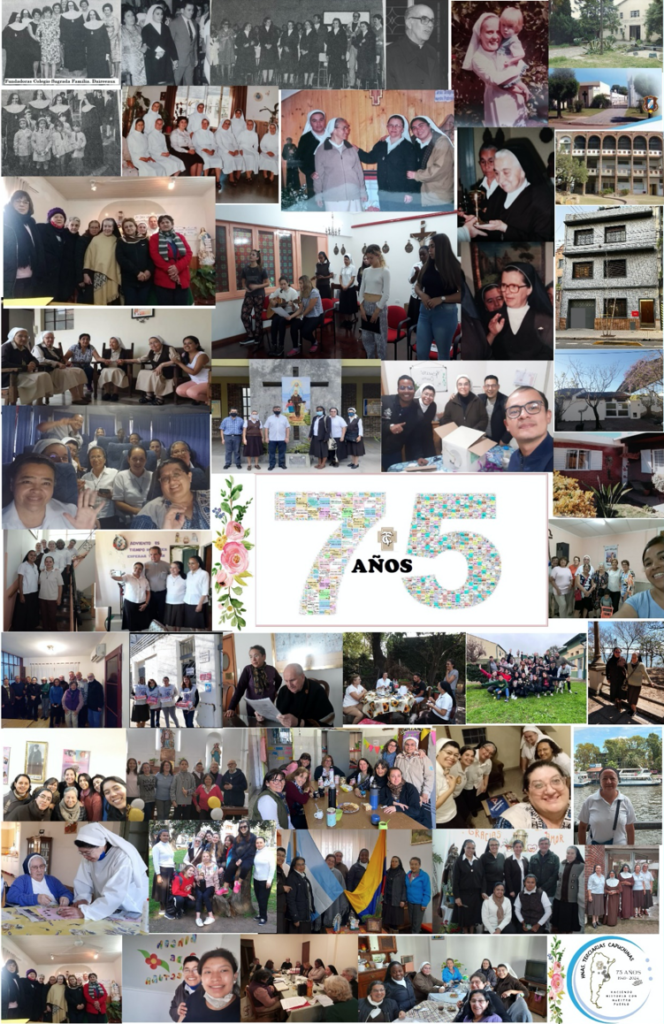
«Here we are Lord… bringing to your presence 75 years of life, history and mission of the Congregation of the Capuchin Tertiary Sisters of the Holy Family, in our land Argentina.

It was in June 1949 when Sisters Concepción de Linares, María Jesús de Elzaburu, Juliana Azcárate, Catalina Lizoain, Julia Fernández and María Luisa Antón… flooded the landscape of Santa María de los Buenos Aires with Amigonian light and assumed the first mission in our country.  So much courage, so much bravery, so much ardor could only come from the strength of your Spirit, from the maternal impulse of the Mother, Our Lady of Luján and from the missionary dynamism that they had imbibed from Father Luis Amigó» (Br. Dora Arboleda TC).


As we commemorate 75 years of religious presence in Argentina, we celebrate the legacy of the first sisters who impregnated every corner of this land with their Franciscan Amigonian charism. Throughout these seven and a half decades, the apostolic works carried out have been truly historic, marking the lives of countless people and leaving an indelible mark on society.

Every page of this history has been written with the unwavering love of those sisters who have given their lives in service to the proclamation of God’s love. Every work, every gesture of kindness, every word of comfort has been like ink imprinted in the hearts of those who have been touched by their tireless work and unwavering devotion.

The places that have been blessed with the presence of different Sisters and those that continue today are full of living testimonies, people whose lives have been transformed by the love and dedication of those who have been instruments of divine grace. Every smile, every hug, every act of compassion has been a seed of hope sown in fertile ground, bearing fruits of love and solidarity.

On this anniversary, we raise our voices in gratitude for the sacrifice and dedication of each sister who has been light in the midst of darkness, hope in the midst of despair and love in the midst of pain. May their legacy live on for generations to come, inspiring others to follow their example of selfless service and unconditional love.

May the flame of faith and charity lit by our Congregation continue to burn brightly, illuminating the path of those who seek comfort, hope and redemption. May the history of these 75 years of religious presence in Argentina be an eternal reminder of the transforming power of God’s love manifested through his son Jesus.

May the legacy of the Capuchin Tertiary Sisters of the Holy Family, whose love and dedication have deeply marked the history and soul of this country, live forever! May their example guide and inspire us to continue building a better world, full of compassion and fraternal love!

S. Cristher Arianny Mosquera M.
Categorías
Artículos

«Sowing Seeds of Change: Boy Scouts as Guardians of the Environment.»

Three loud whistles and to the cheerful cry of “Manada, manada”! And to the response of «Scouts be prepared!» the boys who make up the group of swains get ready to begin the afternoon program.

The Scout movement by nature emphasizes the values of our spirituality «Franciscan – Amigonian» since the patron of the movement is «Francis of Assisi» and a very important emblem for the «Pack» of Cub Scouts, is the metaphor that arises from the little flower of St. Francis and the wolf. While I was in Chiquimula I had the opportunity to activate the Scout Group #62 «Father Luis Amigó»; the movement provides the opportunity to give the formation of “Zagales” and Scout skills, making this a very meaningful experience for children and young people who participated in it.

A particularity of the movement is that it is a space where technologies are not used and where you can connect with nature and with you brothers and sisters , through games, challenges and adventure; a principle of the movement is that as a  leader of the movement you have to get involved in everything the children do, not as an onlooker or someone «who commands» but following the example of Jesus, someone who serves and gets involved, an aspect that is quite significant for the children; it is evident that it is a valuable experience for them in expressions such as: This is the best thing that has happened to my life! The sisters go first so I am encouraged to continue follow them! The children understand and internalize that the leader is the one who serves, the one who goes first and the one who makes an impact by giving  example.

The members of the scout movement, as well as those who are not part of it, receive touches of the movement’s philosophy, since the fact of activating a group like this impacts the entire educational community, making the students in general be fascinated by their natural environment, «fall in love with it», this through participation in the scouting activities. This is achieved through participation in camps, reforestation days, days of contemplation of nature in rural environments, and convivial gatherings where enjoyment and joy are undeniable, sowing in them the awareness that in nature the different dimensions of God are revealed to us.

To the children of the movement as to the young people of the school, we sow the seed and the conscience of the «change of chip» not doing activities for the sake of doing them but starting from the small, making them aware that all, scouts and non-scouts «We are called to leave the world better than how we found it» and convincing them from concrete and small actions as for example «I am the change I put down the garbage in its place» and when achieving this small but important action to continue with more complex actions as separating the types of waste.By organizing the students by grades to help the maintenance staff to check how the waste is separated and finding out how unpleasant it can be when it is not properly separated, they generate the awareness that every small or large action has a positive or negative impact on the common house.

With the significant learning that comes from the Scout philosophy combined with the Amigonian pedagogy, «ecological conversion» is progressively achieved and young people and children are able to export this knowledge at home and replicate the change.

I am currently in Totonicapán and i am making my way to reactivate the movement. I am in charge of JUVAM and while it is true that I encourage this spirit of encounter with nature and to raise awareness of the values of “Laudato Si”, little by little the ground is being prepared so that young people and children, together with teachers and the community of sisters, can go down the path of the process of «ecological conversion» and the progressive experience of an «Integral Ecology».

It is worth mentioning that both, the Colegio Sagrada Familia of Chiquimula City (where I had the opportunity to develop this experience) and the Colegio Pedro de Bethancourt in Totonicapán City ,have been recognized with the “Bandera Verde Ecológica” award granted by the Municipality of Guatemala City and the Chamber of Commerce of Guatemala, Both institutions are also working together with the Human Rights Office of the Archdiocese of Guatemala to deepen the «Laudato Si» and provide experiences that support and motivate this mission of «Sowing seeds of change in children and young people who become environment  keepers».

S. Sheny María Fajardo Méndez


Categorías
Artículos

“In Search of a Home: Challenges and Opportunities for Migrant Minorities”.

With a hopeful outlook, we contemplate the hopes and struggles of migrants who, since ancient times, throughout the length and breadth of planet Earth, have moved in search of new ways to live with dignity, overcoming scarcity and the social or political pressure they have had to face, achieving the meeting of peoples where new civilizations have arisen.

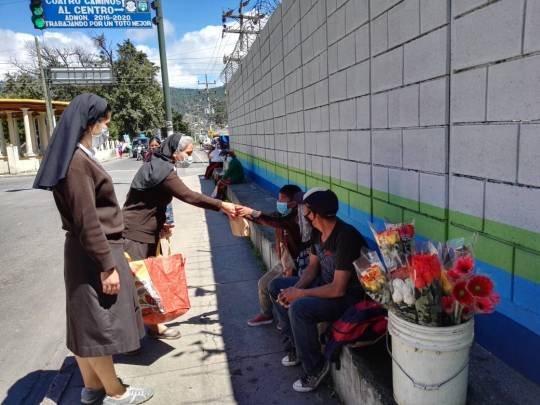
A very general overview of the statistics on migration in the world should serve to raise personal and social awareness of this phenomenon, which is not new but which is now becoming a social problem, and governments are debating whether to implement laws or close borders. There are more than 281 million migrants, including children, adolescents, women and men. Of these, 169 million are workers, according to statistics. In addition, 206 thousand people are trafficked, 43 million are refugees seeking asylum, 60 thousand are resettled refugees, 61 million are displaced by disasters, 71 million are displaced by conflict and violence, and 64 thousand have disappeared in their search for a home.

“Have mercy, God”, and the most admirable thing is that, despite their struggles and efforts, the remittances they send to their countries of origin, expanding the profits of national banks, are the largest in recent times: 860 billion dollars last year. This last figure demonstrates the courage, sacrifice and resilience of these people, who assume the consequences for love of life and home (Luis Donaldo González Pacheco, Mexico).

The search for safety and a better life drives every person to move. However, migrants face significant challenges, such as differences in land, language, idiosyncrasies and laws. Despite these difficulties, they find opportunities for work, food, shelter and, most importantly, security for themselves and their families. This reality affects all of humanity and should not lead to labor exploitation, slavery or the violation of their rights. Instead, it is essential to recognize and value the contributions that migrants make to the nations that welcome them, regardless of their origin.

González expands, in the context of salvation history, by reminding us of the displacements of God’s chosen people. Abraham and Jacob left their lands and died far from them, following what God had asked of them, and thus forged a history in motion as part of the divine project. In the New Testament, Jesus and his parents also had to migrate to Egypt to protect their lives, facing circumstances similar to those of many people migrating today.

No human being moves for no reason; behind every person there is a story that begins the moment he or she decides to seek a better life. This is the principle that drives every man or woman to leave their homeland. The challenges mentioned above become obstacles, but the love of life gives them the power to face them. These challenges form their heart in humility, fortitude and perseverance, reminding us that only those who love are capable of enduring rejection, mistreatment, insults and abandonment in order to reach their goal.

Numerous experiences are shared in social networks and magazines that are dedicated to not forgetting the stories of empowerment that many migrants around the world have achieved. Their socio-cultural contributions to host communities include increasing food diversity, creating new music and sporting achievements. A Honduran migrant opened a restaurant, bringing the cuisine of his home country to the Mexican culinary scene. A Venezuelan migrant created an orchestra in the Dominican Republic to share his music with the youth of his community. In 2019, Emmanuel Iwe, an 18-year-old Nigerian soccer player, signed a contract with Deportivo Saprissa, a Costa Rican soccer club. These are just a few of the many stories that represent the diverse contributions of migrants (IOM, regional office for migrants).

Every search implies leaving, leaving, moving forward, taking on and facing the new that adventure brings. As the biblical text says: “He who seeks, finds”. But to get there, it is necessary to face and overcome challenges, with the hope and illusion of settling down and starting a new life. Migrants express their desire to return to their land of origin, facing new challenges with the security of a job, a house and daily bread, and always with an eye on those who stayed behind.

S. Edelma Toruño Reyes