



What is holiness, or what is perfection? Why do they matter?
God commanded: “For I am the Lord your God. Consecrate yourselves and be holy, because I am holy” (Leviticus 11).
Jesus emphasized: “Be perfect, therefore, as your heavenly Father is perfect” (Matthew 5:48).
Peter reiterated: “But just as he who called you is holy, so be holy in all you do; for it is written: ‘Be holy, because I am holy.’”
In our present generation, holiness may seem like a thing of the past. Perfection is often defined as flawless skin, a perfectly shaped body, outstanding intelligence, talents and abilities superior to those of others, astronomical savings, popularity—as measured by the number of followers, hearts, and likes on digital media—living in comfort and ease, taking luxurious trips…
People today tend to pursue success rather than holiness, unaware that true success goes beyond what our eyes can see, feel, or understand. Success means having one’s name written in heaven. This should be our goal, more than wealth or fame. Jesus asked: “What good will it be for someone to gain the whole world, yet forfeit their soul?” (Matthew 16:26).
I remember that during my childhood catechism classes, the catechist told us that we cannot enter heaven unless we are holy. We may never be canonized, but holiness is certainly indispensable. In vocation promotion, we always say that God’s first call to everyone is to live a holy life, whether as a priest, a religious, a married person, or a single person. I cannot forget a homily in which the priest said: “The greatest tragedy in life is not having cancer or suffering a fatal accident; it is knowing that we come from God and, in the end, cannot return to Him because we have strayed from the path or have chosen not to believe.”
In today’s merciless world, marked by exhaustion, stress, and mental health crises, people have stopped considering a life of holiness. As Father Mike Schmitz observes, “people like to be happy apart from God…,” which ultimately leaves them unhappy and restless. These are clear signs of an undeniable truth: however much we deny it, we need Him, and only in Him do we find our fulfillment.
We know that a life of holiness is not the exclusive preserve of religious and priests, nor of those select people who are always in church praying every novena, knowing all the saints, memorizing the litanies, and attending every prayer group; we know it is something much deeper. Many people find it difficult to identify with this kind of life, but saddest of all is when an apparently pious way of life drives people away from the Lord because holiness is conspicuously absent among religious, priests, and Christians themselves. Christ must be reflected in us. Beyond rituals and religious practices, we need a life that bears witness to the Lord.
We are called to live a holy life, and this is not beyond our reach. We are blessed to have saints to admire, for they are proof that ordinary people, too, can attain holiness. Mother Angelica, the founder of EWTN, said in one of her videos that living a holy life is possible. It is simply a matter of doing the right thing, at the right time, with Him and for Him. For example, when it is time to eat, we should eat well and with gratitude; when it is time to sleep, we should rest peacefully, without staying up into the early hours browsing the internet or fiddling with electronic devices; as students, when it is time to study, we should do so diligently; when it is time to play, we should play well… Saint John Bosco used to say: “Jump, shout, do whatever you like, but do not sin.” If you work, do so diligently; if you see a pile of dirty dishes, take care of them…
Our own Father Luis Amigó said: “Holiness is attained by following an arduous path of virtue and union with God through active mercy, redemptive love, and following the example of Jesus, the Good Shepherd.”
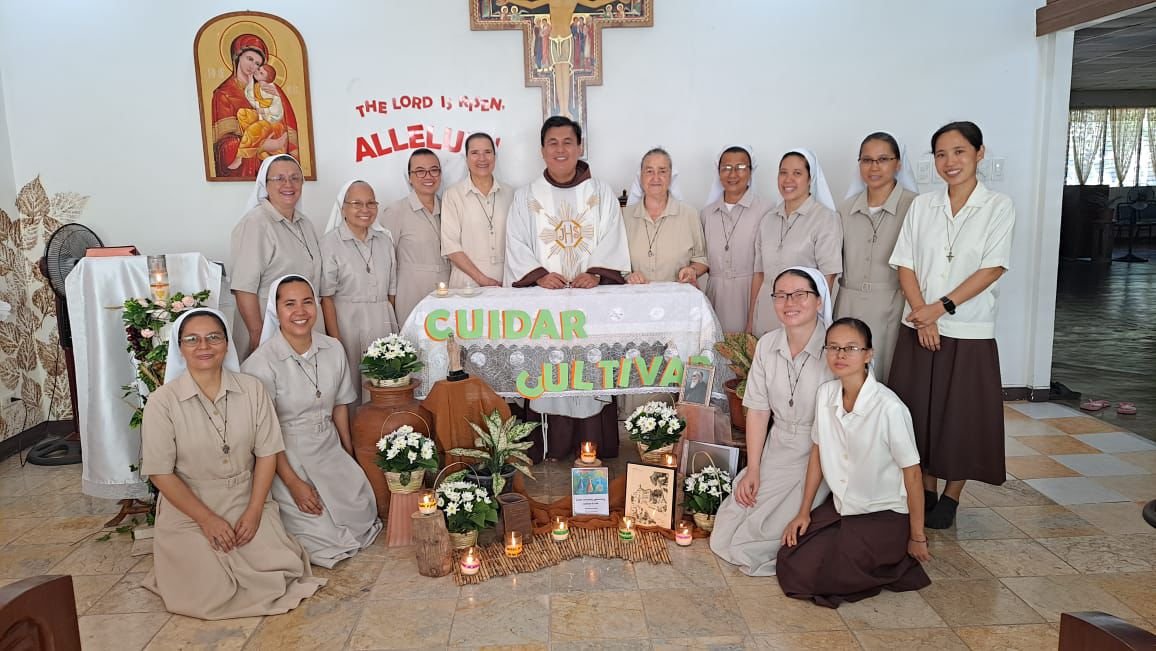
As a Capuchin Tertiary Sister and missionary, it has always been a challenge to live up to the charism of our founding father: to live a life of holiness and virtue, rooted in God and directed toward Him, embodying His mercy and redemptive love. The example of Jesus as the Good Shepherd—who does not wait for the sheep to come to Him but goes even to the precipices to seek the lost sheep—must also become my own path. I must not forget that we have the mission of being collaborators of the Good Shepherd, of being young shepherds of the Good Shepherd. Jesus freely embraced His mission. He was the first missionary: He left the glory of heaven to be with us, to become one with us; He took on our humanity and taught us how to be truly human, that is, creatures capable of loving, understanding love not merely as a feeling but as the capacity to deny oneself for the good of the beloved. Jesus showed us His love in all its perfection, giving His life even unto death. It may seem a titanic task, but should I give up? The example of Jesus has led our models of faith—our saints—to embody in their own lives God’s missionary path of love and to pass it on to us, reminding us, in language we can understand, that we must love without measure. As Saint Francis de Sales would succinctly say: “The measure of love is to love without measure.” This is what is asked of us; this is His will for us. Therefore, giving up is not an option. There may be setbacks, but with His grace and our cooperation, nothing is impossible. Let us be certain that He will always be there to strengthen us.
Another exhortation comes from Saint Teresa of Calcutta, who said: “Not all of us can do great things, but each of us can do small things with great love.” Likewise, Saint Thérèse of Lisieux, through her “Little Way,” teaches us that even picking up a small piece of paper out of love can be an offering pleasing to God, for the salvation of souls and for the sins of the world and our own. It is a matter of living in His presence, doing everything “for the glory of God” (1 Corinthians 10:31).
Fulfilling the mission knows no limits of time or space; we do not need to go far to work for His Kingdom. To participate in holiness in the life of Christ—the first and last missionary—the best time is now, the best place is here, and the best person to reach is the one beside us.
Sharon Garzon, tc