

Categorías
Artículos

Challenges and opportunities of interculturality in 21st century

INTRODUCTION

With the current economic globalization, many individuals from many nations
and cultural backgrounds reside in the same city, either permanently or
temporarily, with local people causing the emergence of Multiculturalism as a result of the blending of many cultures forming a multicultural society.

Primarily this multicultural society is caused by the worldwide labor, international students and refugee flow. With the intent of promoting peace and harmony, respect of human rights within a multicultural society UNESCO have addressed this issue proposing principles that will help the young generation to cope with the multicultural society develop peaceful relations and friendship among the peoples and bring about a better understanding of each other’s way of life, and enable everyone to have access to knowledge and contribute to the enrichment of cultural life. The Educational working principles recommended to all countries are as follows:

Principle I Intercultural Education respects the cultural identity of the learner through the provision of culturally appropriate and responsive quality education for all.

 Principle II Intercultural Education provides every learner with the cultural knowledge, attitudes and skills necessary to achieve active and full participation in society.

Principle III Intercultural Education provides all learners with cultural knowledge, attitudes and skills that enable them to contribute to respect, understanding and solidarity among individuals, ethnic, social, cultural and religious groups and nations.   

Furthermore the Intercultural dialogue is being encouraged across the globe through holding many conferences from UN different International agencies. Along with the Intercultural dialogue Interculturality is also being promoted as way of interacting with the people in a multicultural society.

INTERCULTURALITY: DEFINITION

Interculturality is a dynamic concept and refers to evolving relations between cultural groups. It has been defined as “the existence and equitable interaction of diverse cultures and the possibility of generating shared cultural expressions through dialogue and mutual respect. Interculturality presupposes multiculturalism and results from ‘intercultural’ exchange and dialogue on the local, regional, national or international level.

The practice of Interculturality goes along with challenges and opportunities in different areas of concerns such as in Education, Employment/Business, Digital Milieu and in the Church with its missionary and evangelizing activities.

Focusing in the missionary and evangelizing activities of the Catholic Church, without any omission and additions I have taken as reference Church of England, with its diverse congregations, communities, traditions, and theologies, that faces unique dynamics and prospects when engaging in intercultural mission work have identified the challenges and opportunities on interculturality.

It is worth taking the following formulation as an example on how to succeed in practicing Interculturality in our church.

HERE ARE SOME OF THE KEY CHALLENGES AND OPPORTUNITIES:

CHALLENGES:

  • Cultural Sensitivity: Being culturally sensitive and avoiding unintentional cultural insensitivity or bias can be challenging. Effective intercultural mission requires a deep understanding of the diverse cultures within the Church of England.
  • Language Barriers: Language diversity within congregations can be a barrier to effective communication and understanding, hindering the sharing of the gospel and fostering unity.
  • Theological Differences: Different cultural backgrounds may bring various theological perspectives and practices. Balancing these differences while maintaining the core tenets of the Christian faith can be challenging.
  • Leadership and Representation: Ensuring leadership roles reflect the diversity of the congregation and maintaining representation from various cultural backgrounds is crucial but may be challenging to achieve.
  • Community Integration: Building strong relationships with local communities, especially in culturally diverse urban areas, can be challenging as it requires a deep commitment to community engagement and cultural understanding.
  • Worship Styles: Finding a balance between maintaining traditional forms of worship and incorporating elements from diverse cultural traditions can be a challenge in maintaining the identity of the Church of England.

Opportunities:

  • Rich Cultural Diversity: The Church of England’s diverse congregations offer a unique opportunity for cross-cultural learning and understanding, fostering tolerance and respect for different cultures.
  • Mission to Immigrant Communities: Many Church of England congregations are in areas with significant immigrant populations. This provides a natural opportunity for mission work and outreach to these communities.
  • Global Network: The Church of England is part of the worldwide Anglican Communion, which spans diverse cultural contexts. This global network can facilitate cross-cultural learning and collaboration in mission work.
  • Interfaith Dialogue: Various faiths in the UK provide opportunities for interfaith dialogue and engagement, promoting religious tolerance and understanding.
  • Cultural Exchange: Intercultural mission allows for a dynamic exchange of cultural practices, music, art, and traditions within the church, enriching the worship experience.
  • Youth Engagement: Younger generations often have a more inclusive and intercultural perspective. Engaging youth in intercultural mission work can be particularly fruitful.
  • Community Impact: By embracing intercultural mission, the Church of England can have a positive impact on local communities by promoting unity, social cohesion, and mutual respect.
  • Inclusivity: Demonstrating a commitment to diversity and inclusivity in mission work can attract individuals and families seeking a welcoming and inclusive worshipping community.

To succeed in its intercultural mission, we in the Church of England must intentionally address the challenges while seizing the opportunities. This includes ongoing cultural training and education, adapting worship styles where appropriate, actively involving individuals from diverse backgrounds in leadership roles, and fostering an atmosphere of acceptance, respect, and understanding among congregants. By doing so, the Church of England can fulfil its mission to share the love and teachings of Jesus Christ in an increasingly multicultural and globalised society.

CONCLUSION:

The Challenges and Opportunities of Interculturality In 21st Century is a complex topic and it is not easy to paraphrase nor develop more reflection since it’s already being dealt in different sectors worldwide. After reading a lot of references I am left with the with the principle that living in a multicultural society brings a lot of challenges yet it remains an opportunity to widen our personal and communal perspective that God’s creation is rich shown in different cultures and its wonderful to discover and appreciate differences and live with it peaceably under the light of the Evangelical Values taught and lived by our Lord Jesus Christ: The way, the Truth and the Life.

References

  1. UNESCO,2006 Guidleines on Intercultural Education, p.17; P.33-38
  2. https://stpaulsslough.org.uk/challenges-and-opportunities-for-intercultural-mission/

By: Sr. Nida B. Galera

Categorías
Artículos

Compassion: The face of God in the amigonian charism: an invitation to conversion and forgiveness

Jesus Christ is the face of the father’s mercy. Mercy has become the living and visible in Jesus of Nazareth. The father rich in mercy (Eph.2:4) Mercy: the word reveals the very mystery of the Most Holy Trinity. Mercy: the ultimate and supreme act by which God comes to meet us. Mercy: the bridge that connects God and man, opening our hearts to hope of being loved forever despite our sinfulness. His being merciful is concretely demonstrated in his many actions throughout the history of salvation where his goodness prevails over punishment and destruction. In short the mercy of God is not an abstract idea, but a concrete reality through which he reveals his love as that of a father or a mother, moved to the very depths out of love for their child.

The signs he works. Especially in the face of sinners, the poor, the marginalized, the sick, and the suffering, are all meant to teach mercy. Everything in him speaks of mercy, nothing in him is devoid of compassion. Mercy and compassion play an important role in today’s world, everywhere we look, there seems to be too much misery. Somewhere someone is hungry and thirsty. There is someone who is fighting for his life or someone pleads for help.

Both mercy and compassion refer to the concern towards people in need. Compassion it is an empathetic consciousness of other people’s suffering, coupled with the longing to alleviate it. It came from two Latin words, com (with) and pati (to suffer).Literally, it translates to “to suffer with”.  It is compassion that compels us to feel the pain of someone else and by doing so, we join their journey. When Jesus was crucified, his mother Mary at the foot of the cross and suffering with her son was the face of compassion.

The face of the merciful and compassionate God seen in Jesus by healing the sick, raising the dead, giving sight to the blind and above all he offered his life for the salvation of us all. When JESUS says, “be merciful as your father is merciful,” (Lk 6:36-42) he is not only telling us what to do but also how to do it. His example and ministry links the internal (what we feel) and the external (our actions) Jesus urges us to forgive our enemies (show mercy) but he also encourage us to love and pray for them (compassion).The catholic tradition introduces the virtue of solidarity. This bridges mercy and compassion. It is not merely the vague feeling of compassion but a compassion that leads one to action. It compels one not just to show mercy and feel compassion but most importantly, to do something that will alleviate the suffering of others.

In the Bible we encounter a God who is compassionate towards his people, he sees and acts. When God sees the people of Israel suffering under Pharaoh in Egypt and He came down to deliver them from the slavery and led them to the promised land (Exodus 3:7). When God sees the suffering humanity from the slavery of sin and comes down in person to deliver us through the life, death and resurrection of our Lord Jesus Christ.

 The entire ministry of Jesus Christ was marked by mercy, compassion, call to conversion and forgiveness. In His  public ministry  when he sees people wondering like sheep without a shepherd burden by hunger and sickness, he fed and healed them and quenched their thirst with the Word of God, he taught them and offered restoration. In short, the distinctive character of Jesus Christ was Mercy and compassion that he showed for the people that he encountered more especially, the suffering and marginalized, those in the peripheral of the society.

The true compassion means suffering with someone, feeling as another person. In other words, the deep motivating power of empathy. In this way, compassion can lead to a change of heart, to conversion, repentance and forgiveness.

From the book “Father Luis Amigo the friend of the outcast” we read that” Father Luis was known for his helpfulness and desire to do good for others, sensitive to other people’s needs. On Sundays he visited the sick to the hospital, he attended to their cleanness, taking care of the victims of discrimination, to the prison to console and instructs the prisoners especially those sentenced to life imprisonment. Again during the cholera epidemic in Spain, He narrates “the government of Masamagrell asked me for help from the newly born congregation, of the Capuchin tertiary sisters, to send the sisters to help and attend to the sick afflicted by the pestilence. It was an act of heroism defying dangers and disregarding their own life for love, as the result three youngest sisters died after being contaminated by the disease. In so doing they won the hearts of the people by their action of sacrificing love.”(Fortitude and tenderness pg18) After the epidemic, Father Luis Amigo’ narrates with words that remind us of the good Samaritan,’ many children were left without refuge after having lost their parents, Moved with compassion, I thought  that we could take care of them.( OCLA 86)

Biblically, compassion is to show pity, love and mercy as the Lord Jesus says, «I have compassion for these people, they have already been with me for three days and have nothing to eat. I do not want to send them away hungry, or they may collapse on the way» (Mt. 15:32). The Compassion of God comes first as He has shown in the entire history of our Salvation. In the very mystery of creation is the revelation of our God who is characterized by loving kindness, mercy, compassion and forgiveness. He is a God who is the source of our creation who sustains our very breath and brings it to fulfilment, as witnessed by the very gift of life we have been given freely. The divine omnipotence shows itself clearly in the exercise of divine mercy. Gods’ mercy is abundant and infinite. As Christians, we are called to imitate and reproduce the mercy and compassion of God towards our fellow brothers and sisters. To say that someone is full of mercy is like saying that person’s heart is full of love. In other words, the compassion and mercy of God compels us to act when we see our brothers and sisters in need of support and assistance. Making the best effort to remedy the challenge because eventually it has become our problem. This is the effect of mercy, since making known the presence of God who is the Father, full of love and forgiveness. Jesus makes forgiveness one of the principal theme of his teaching. It is also important to note that in revealing the loving forgiveness of God, Jesus lays bare before us the need that the life of every Christian must be guided by forgiveness.

Forgiveness is the fundamental aspect of Christian faith, as it is emphasized in both old and new testament, God is portrayed as merciful and forgiving, calling us to seek forgiveness and  extend it to others., as reminded  in the Lord’s prayer. The parable of the unforgiving servant underscores the reciprocal nature of forgiveness. Jesus high lighting the expectation  for  us  to show  mercy  to others  just as  we receive from God. Forgiveness is a true path to conversion. The Lord replied to Peter’s question” Lord ,how often will my brother sin against me, and I forgive Him? As many as seven times?” “I do not say to you seven times, but seventy-seven times” (  Math18: 21-22) , in this we understand that Christ proclaims by his action, even more than by his words that call to mercy and compassion ,forgiveness and eventually conversion are  the essential elements of any proclamation of the Gospel. 

In other words, Conversion is that process which takes place for a Christian to go back to God after confessing one’s sins to God. This is the process that demands and involves not only the change in actions but also the change of heart. It is important to stress that this process will not be possible without God’s acceptance and forgiveness. It is through the healing and forgiveness of our Lord Jesus Christ that we can be redeemed. In short there is a strong relationship between conversion and forgiveness because conversion is impossible without forgiveness and conversely, without conversion there will never be full process of forgiveness. In the paschal Mystery of Christ, God shows his gratuitous forgiveness and offers universal salvation and each person is called to commit oneself to a personal journey of conversion as a response to God’s invitation (Lk 23:26-56).

 A clear example of this is the parable of the prodigal son (Lk 15:11-32) which expresses the essence of the mercy and loving forgiveness of God in the loving drama of the Father’s love and the prodigality and sinfulness of the younger son. The parable touches upon every aspect of the covenant of love, every loss of grace and every sin. The parable shows God’s merciful love for each person and personal attentiveness towards entire humanity. We see in this parable the gracious compassion of the Father overshadowing the sinfulness of the son, as is the remembrance of the Fathers goodness that motives the prodigal son to repentance. What a picture of God’s compassionate love and mercy! God’s heart is full of compassion for us his children. He is always stands ready with open arms to welcome the returning sinner back home with joyous celebration.

In conclusion, the challenge of the mercy of God makes the demand on our generosity which only the purified and love can hope to meet. For every person that appeals for God’s forgiveness is required to move towards God’s side through conversion, and share God’s compassion, understanding the unmeasured mercy, with which God looks on human frailty and sin. So radical and difficult is the Christian call to conversion, repentance and forgiveness especially when there has been real and deep injury to forgive that only takes place through the work of the Spirit, in union with the risen Lord.

 Forgiveness is central to the biblical message, promoting reconciliation, compassion and the transformative power of God’s grace. It is not a sign of weakness, instead it is the sign of strength that truly is, as Jesus powerfully demonstrated on the cross.

Our seraphic father saint Francis of Assisi calls us for the same thing by saying” There should be  no friar in the whole world who has  fallen into sin, no matter  how far  he  has fallen, who will ever fail to find your forgiveness for the asking,  if he will only look into your eyes. And if he does not ask forgiveness, you should ask him if he wants it. And should he appear before you again a thousand times, you should love him more than you love me, so that you may draw him to God.

May I also forgive myself and open my heart to those I need to ask forgiveness of. May I be quick to forgive in all circumstance. May forgiveness teach me compassion.

Sr. Diana Kayetan Mhule

Categorías
Artículos

Digital Literacy: A Challenge for Parents and Caregivers

In today’s society, digital literacy is a fundamental competence. In a world where young people handle digital tools from a very early age, parents and caregivers must know and master these resources, not only to guide the youngest in the proper use of technology, but also to protect them from the dangers of the digital environment. This literacy is a crucial challenge that, from a Catholic perspective, calls for forming critical and ethical users, capable of living their faith also in the virtual world.

Why is digital literacy so urgent?

Technology is advancing rapidly and young people are immersed in digital environments almost naturally. However, adults face difficulties in understanding this constantly changing ecosystem, which hampers their ability to accompany minors. Digital literacy thus becomes an urgent necessity:

  1. Allows accompanying digital learning: Parents can offer guidance and useful resources so that digital learning and entertainment are carried out in a safe and constructive way.
  2. Facilitates protection against risks: With the right knowledge, parents can detect threats such as cyberbullying or access to inappropriate content, preventing children from falling into risky situations.

In this context, specialists in education and digital ethics stress the importance not only of teaching practical skills, but also of instilling principles and values that enable young people to act responsibly and carefully in the digital world.

The Church’s Position and Evangelization in the Digital Environment

The Catholic Church sees digital media as an opportunity for the evangelizing mission. Pope Francis, in his messages on communication and technology, has insisted on the need to use these media with charity and truth, and that we are all responsible for generating a communication environment that reflects Christian values. In one of his messages on social communication, he stressed the importance of digital communication “being truly human” and communion-oriented.

At the same time, initiatives such as those of digital evangelizers have taken advantage of platforms such as YouTube, Instagram and TikTok to transmit messages of faith, bringing evangelization to the networks where young people are found.

The two pillars of digital literacy: practical knowledge and ethical discernment.

For digital literacy to be truly effective, it is critical that parents and caregivers develop both practical skills and a sense of ethical discernment.

  1. Practical knowledge: This involves becoming familiar with the tools and platforms that young people use, from social networks to entertainment applications. Learning how to configure parental controls and understand the privacy policies of each platform is basic to accompany them in the safe use of technology.
  2. Ethical discernment: From a Catholic perspective, it is essential that parents guide their children in making responsible digital decisions, encouraging respectful communication and an authentic presence on networks.

Parents seeking to improve their digital literacy can find support from specialized organizations and Catholic digital evangelization projects, such as online courses, tutorials and awareness programs.

Digital literacy is an imperative for today’s parents and caregivers. Knowing and understanding the digital environment, from its opportunities to its risks, will enable adults to better accompany young people as they grow. As Pope Francis expresses, “let us walk together in a network of true relationships,” where each person feels heard and valued. Thus, this responsibility becomes a true mission of love and service, helping young people live their faith and values in all aspects of their lives, including the digital world.

S. Iria Natalia Agreda Abreu

Categorías
Artículos

“A Safe Haven: The Importance of of child protection in foster care”.

KNOWING WHAT WE ARE TALKING ABOUT

From our charismatic origins, our visionary Father and Founder, moved by the Spirit, welcomed the Lord’s motion, as expressed in issue 86 of OCLA, “…. after the epidemic it was seen that many children were left without shelter because their parents had died, and moved with compassion I thought that we could take them in; and to that effect, I asked Mother Angela, who was still very weak, if she felt up to taking care of those children if we took them into a house; and, full of zeal and moved with charity, she offered to do so very willingly. I consulted the matter to the Boards of the Third Order, who approved it very willingly; and without wasting any time we rented the house called the Castle in Masamagrell to convert it into an Asylum where we could take in the orphaned children…”, this experience opens the way to one of the greatest apostolic works for the Capuchin Tertiaries, the ‘Protection and Reeducation’ of children and adolescents at high social risk.

Luis Amigó, foreseeing the situation of helplessness of children at that time, looked for alternatives to protect, welcome and keep children safe, anticipating and preventing adverse events that damage the physical, psychological and moral integrity of children, thus initiating the work of prevention. Our Homes are an alternative pastoral response in anticipation of safeguarding the rights of children and for those who have been victims of violence at a young age, our institutions become safe places by providing quality care from the culture of good treatment. The institution is made up of areas of human, spiritual, psychological, academic, medical care in collaboration with the interdisciplinary team with the method of Amigonian Pedagogy, a preventive method, “reflective for the solution of difficulties through a dialogical system, fraternal correction, participation, construction of knowledge” which guarantees responsibility in the care of dignity.

WHAT IS A SAFE ENVIRONMENT SYSTEM?

Good practices in institutions in favor of protection must cultivate safety in environmental spaces and in personal circumstances in which there is an opportunity to reduce or avoid actions that threaten the dignity or life of a person. For this it is necessary to take measures, to create strategies that guarantee the integrity and the personal and common care of all children. Among these actions, it is urgent to include good treatment in all environments as a transversal line, which is systemic and integrally encompasses the family, religious, social, cultural, labor and institutional spheres.

In the context of children’s homes, potential strategies for prevention and protection would be the guarantee of safe spaces such as:

– PREVENTION AND ACTION PROTOCOL FOR CHILDREN

     IN SITUATION OF VULNERABILITY: a guide to follow in order to deal with solve risk situations inside or outside the institution.

– CONTINUOUS TRAINING: in which tools are acquired to update and learn about to update and learn strategies in the preventive field.

– The SINODALITY perspective in the common good, where we all have something to contribute, in co-responsibility we all have something to contribute, in co-responsibility.

– NETWORKING articulation of work groups as support and contact with other institutions that promote and contact with other institutions that promote the integral protection of children and adolescents.

– EVALUATION” as a practice of continuous improvement with the collaborators with the collaborators, in order to eradicate risk factors and promote protective protective factors in the environment.

In this way, it is confirmed that the environment is safe and protective when children and adolescents develop all their capacities in a healthy and harmonious way, and feel happy and at ease in the institution.

Sr. Priscila Brenes Granados

Categorías
Artículos

The hope of peace: dialogue, reconciliation and ecological conversion in franciscan spirituality.

How great it is to be small!

This exclamation could perfectly be a phrase of St. Francis of Assisi and of his brothers and sisters of all times. You and I can also make it our own. Smallness is a way of being in life and before God, to which we urgently need to return today as well. Franciscan spirituality offers us a path of hope in the midst of our conflict-ridden reality and the environmental crisis we are going through.

Everything is connected. Everything affects us.

Our world is enduring too much. Just open our eyes and look around us: there are more than fifty armed conflicts going on right now. Everywhere we hear about the environmental problem (of which Pope Francis has spoken so much in recent encyclicals). And what about the politics of our countries with so much injustice and exploitation and the same families going through their own ordeal.

All this is affecting our homes and our religious communities. St. Francis of Assisi said that our convent is the world, that we cannot close ourselves in the four walls of our houses because the world needs to hear a different word. Do you really believe that you can continue to live on an island, without being affected by the suffering of others, of families, of the planet? Everything is connected and you cannot escape.

The ecological conversion we need

Franciscan spirituality invites us to live in harmony with nature and to recognize the interdependence of all living beings. St. Francis of Assisi, patron saint of ecology, showed us the way to a respectful collaboration with the environment, even though in his time, the planet was not threatened as it is today. His love for creation and his deep connection with nature inspire us and invite us to rethink our relationship with the world around us.

Technology and progress, which we all seek so much, is an ambiguous good. On the one hand, it allows us to live more comfortably on many levels; it brings us closer to each other, as it allows us to be connected to any place on earth, it helps us in the fields of health, education, communication and so many others. But, on the other hand, it is a great danger. In order to continue “progressing”, we need raw materials and these are being extracted from Mother Earth in an abusive way, exploiting indigenous peoples in many cases. Yes, we all, or almost all of us, have internet connection, but more than ever we suffer from loneliness. We can enjoy certain comforts, but at what cost to the planet?

The relationship between the abuse of our Common Home and the lack of peace in the world is evident. It is enough to see the conflicts caused by the exploitation of mines or monocultures, or the wars incited only because there is an interest in selling weapons, or the serious problem of the waste, the garbage, produced by the most developed countries and transported, sold to other continents and causing environmental disasters. Not to mention the situation in so many countries, where corrupt governments steal money dedicated to recycling or improving infrastructure. As a consequence, the garbage is flooding our rivers and fields and affecting the poorest.

Do not think that these things are the fault of the great ones of this land. It is everyone’s responsibility. There is such a thing as ecological sin, of which Pope Francis speaks in the Final Document of the Synod of the Amazon (DF 82): it is an action or omission against God, against one’s neighbor, the community and the environment; a sin against future generations, which manifests itself in acts and habits of pollution or destruction of the harmony of the environment. We urgently need a conversion!

The power of the small

Now the same question that St. Francis of Assisi once asked God arises: Lord, what do you want me to do? I invite you to reflect on the lifestyle you lead and its consequences for the environment. There is always something you can do: recycle, reuse, repair things instead of throwing them away, do not waste water or electricity, give your support to those who fight to protect the earth and the poor, denounce injustice, participate or give training to change our mentality and our bad habits, pray for ecological conversion and social justice.

Start with your own home, your neighborhood or your village: is there a step of closeness or reconciliation that I can take so that we can live a little better?

From our spirituality we believe that the small has a transformative power for the world. And we still harbor hope.

Sr. Marta Ulinska

Categorías
Artículos

Monsignor Alejandro Labaka and sister Inés Arango, missionaries who risked their lives for the gospel – 37 years of their generous dedication

We celebrate a new anniversary of their death and remember how Monsignor Alejandro Labaka, Capuchin Bishop and Sister Inés Arango, Capuchin Tertiary Sister, offered their lives for the love of the Tagaeri in the Amazon of Ecuador. They, two different people, born in different places, Spain and Colombia respectively, with different life processes, are united by the providence of God in a common project, the commitment to the care of life and the rights of the Amazonian peoples. Like all missionaries, they received a call, decided to follow Jesus and serve Him through the mission that took them to different places where they left traces of good. In 1987, they were part of the team of missionaries working in the Apostolic Vicariate of Aguarico, a church that has always been committed to the cause of the people that inhabited these lands since long ago, living in peace and freedom. However, they were not civilized, had no civil identity, did not speak our language and did not understand why they were displaced from their territories. Alejandro and Inés looked at them, they saw them with the eyes of God and felt they were «brothers in Christ», they believed them worthy of love, respect, help, accompaniment and defense of their rights. To them they dedicated several years of their life and missionary service.

And it was on July 21, 1987, when they were trying to enter the Tagaeri, an uncontacted indigenous tribe, to initiate a process that would favor their protection, that they offered their lives. The news caused pain and surprised everyone, inside and outside the country, but as a seed that falls into the ground and dies to bear fruit, it has also generated life. His surrender was not improvised, it was the consequence of his option for Christ and the mission, evidence of his commitment to the excluded Amazonian peoples.

 Since then, every year around their anniversary, a strong internal and external, personal, community and ecclesial movement is generated that brings us closer to their persons and testimonies. Those who knew them tell of their «passion for Christ and the mission». They longed for frontier places and were ready to give their lives for those they loved, as is recorded in the positio written about each of them, and which last June, in the discussion of the Theological Consultors of the Dicastery for the Causes of Saints, received positive votes with regard to the «Offering of life». What does this news mean for us today? The recognition that his life can inspire others, us in various ways, among others motivating us to:

-To discover and welcome the plan of God in our life

– To live to the full, that is, with passion and fidelity the vocation received

– To create inclusive fraternal bonds that allow us to generate and care for our own life and that of others

 – To opt in Christ for the poor and excluded of today, from love, joyful and generous service even at the risk of our own life

– To care for the common home Pope Francis in the apostolic exhortation Gaudete et exultate no. 5 notes: «In the processes of beatification and canonization, account is taken of signs of heroism in the exercise of virtues, the giving of one’s life in martyrdom and also cases in which an offering of one’s own life for others, sustained until death, has been verified. Such an offering expresses an exemplary imitation of Christ, and is worthy of the admiration of the faithful”.

We are also aware that Pope Francis in the document Motu proprio Maiorem Caritatem, July 11, 2017, opened the possibility of beatification and canonization by another way, the offering of life, he says: «are worthy of special consideration and honor those Christians who , following more closely the steps and teachings of the Lord Jesus, have voluntarily and freely offered their life for others, persevering until death in this purpose» and adds: «The offering of life, to be valid and effective for the beatification of a Servant of God, must meet several criteria, including the necessity of the miracle happened after the death of the Servant of God and through his intercession.» Now it is a matter of getting to know them better and entrusting our needs to them, asking with faith for their intercession. Link to access all that refers to the missionaries:

https://alejandroeines.org/ In case of receiving graces, favors or miracles, please communicate to: alejandroeines@gmail.com

 Sr. Bilma Narcisa Freire Chamorro, tc

Categorías
Artículos

«Sowing Seeds of Change: Boy Scouts as Guardians of the Environment.»

Three loud whistles and to the cheerful cry of “Manada, manada”! And to the response of «Scouts be prepared!» the boys who make up the group of swains get ready to begin the afternoon program.

The Scout movement by nature emphasizes the values of our spirituality «Franciscan – Amigonian» since the patron of the movement is «Francis of Assisi» and a very important emblem for the «Pack» of Cub Scouts, is the metaphor that arises from the little flower of St. Francis and the wolf. While I was in Chiquimula I had the opportunity to activate the Scout Group #62 «Father Luis Amigó»; the movement provides the opportunity to give the formation of “Zagales” and Scout skills, making this a very meaningful experience for children and young people who participated in it.

A particularity of the movement is that it is a space where technologies are not used and where you can connect with nature and with you brothers and sisters , through games, challenges and adventure; a principle of the movement is that as a  leader of the movement you have to get involved in everything the children do, not as an onlooker or someone «who commands» but following the example of Jesus, someone who serves and gets involved, an aspect that is quite significant for the children; it is evident that it is a valuable experience for them in expressions such as: This is the best thing that has happened to my life! The sisters go first so I am encouraged to continue follow them! The children understand and internalize that the leader is the one who serves, the one who goes first and the one who makes an impact by giving  example.

The members of the scout movement, as well as those who are not part of it, receive touches of the movement’s philosophy, since the fact of activating a group like this impacts the entire educational community, making the students in general be fascinated by their natural environment, «fall in love with it», this through participation in the scouting activities. This is achieved through participation in camps, reforestation days, days of contemplation of nature in rural environments, and convivial gatherings where enjoyment and joy are undeniable, sowing in them the awareness that in nature the different dimensions of God are revealed to us.

To the children of the movement as to the young people of the school, we sow the seed and the conscience of the «change of chip» not doing activities for the sake of doing them but starting from the small, making them aware that all, scouts and non-scouts «We are called to leave the world better than how we found it» and convincing them from concrete and small actions as for example «I am the change I put down the garbage in its place» and when achieving this small but important action to continue with more complex actions as separating the types of waste.By organizing the students by grades to help the maintenance staff to check how the waste is separated and finding out how unpleasant it can be when it is not properly separated, they generate the awareness that every small or large action has a positive or negative impact on the common house.

With the significant learning that comes from the Scout philosophy combined with the Amigonian pedagogy, «ecological conversion» is progressively achieved and young people and children are able to export this knowledge at home and replicate the change.

I am currently in Totonicapán and i am making my way to reactivate the movement. I am in charge of JUVAM and while it is true that I encourage this spirit of encounter with nature and to raise awareness of the values of “Laudato Si”, little by little the ground is being prepared so that young people and children, together with teachers and the community of sisters, can go down the path of the process of «ecological conversion» and the progressive experience of an «Integral Ecology».

It is worth mentioning that both, the Colegio Sagrada Familia of Chiquimula City (where I had the opportunity to develop this experience) and the Colegio Pedro de Bethancourt in Totonicapán City ,have been recognized with the “Bandera Verde Ecológica” award granted by the Municipality of Guatemala City and the Chamber of Commerce of Guatemala, Both institutions are also working together with the Human Rights Office of the Archdiocese of Guatemala to deepen the «Laudato Si» and provide experiences that support and motivate this mission of «Sowing seeds of change in children and young people who become environment  keepers».

S. Sheny María Fajardo Méndez


Categorías
Artículos

“In Search of a Home: Challenges and Opportunities for Migrant Minorities”.

With a hopeful outlook, we contemplate the hopes and struggles of migrants who, since ancient times, throughout the length and breadth of planet Earth, have moved in search of new ways to live with dignity, overcoming scarcity and the social or political pressure they have had to face, achieving the meeting of peoples where new civilizations have arisen.

A very general overview of the statistics on migration in the world should serve to raise personal and social awareness of this phenomenon, which is not new but which is now becoming a social problem, and governments are debating whether to implement laws or close borders. There are more than 281 million migrants, including children, adolescents, women and men. Of these, 169 million are workers, according to statistics. In addition, 206 thousand people are trafficked, 43 million are refugees seeking asylum, 60 thousand are resettled refugees, 61 million are displaced by disasters, 71 million are displaced by conflict and violence, and 64 thousand have disappeared in their search for a home.

“Have mercy, God”, and the most admirable thing is that, despite their struggles and efforts, the remittances they send to their countries of origin, expanding the profits of national banks, are the largest in recent times: 860 billion dollars last year. This last figure demonstrates the courage, sacrifice and resilience of these people, who assume the consequences for love of life and home (Luis Donaldo González Pacheco, Mexico).

The search for safety and a better life drives every person to move. However, migrants face significant challenges, such as differences in land, language, idiosyncrasies and laws. Despite these difficulties, they find opportunities for work, food, shelter and, most importantly, security for themselves and their families. This reality affects all of humanity and should not lead to labor exploitation, slavery or the violation of their rights. Instead, it is essential to recognize and value the contributions that migrants make to the nations that welcome them, regardless of their origin.

González expands, in the context of salvation history, by reminding us of the displacements of God’s chosen people. Abraham and Jacob left their lands and died far from them, following what God had asked of them, and thus forged a history in motion as part of the divine project. In the New Testament, Jesus and his parents also had to migrate to Egypt to protect their lives, facing circumstances similar to those of many people migrating today.

No human being moves for no reason; behind every person there is a story that begins the moment he or she decides to seek a better life. This is the principle that drives every man or woman to leave their homeland. The challenges mentioned above become obstacles, but the love of life gives them the power to face them. These challenges form their heart in humility, fortitude and perseverance, reminding us that only those who love are capable of enduring rejection, mistreatment, insults and abandonment in order to reach their goal.

Numerous experiences are shared in social networks and magazines that are dedicated to not forgetting the stories of empowerment that many migrants around the world have achieved. Their socio-cultural contributions to host communities include increasing food diversity, creating new music and sporting achievements. A Honduran migrant opened a restaurant, bringing the cuisine of his home country to the Mexican culinary scene. A Venezuelan migrant created an orchestra in the Dominican Republic to share his music with the youth of his community. In 2019, Emmanuel Iwe, an 18-year-old Nigerian soccer player, signed a contract with Deportivo Saprissa, a Costa Rican soccer club. These are just a few of the many stories that represent the diverse contributions of migrants (IOM, regional office for migrants).

Every search implies leaving, leaving, moving forward, taking on and facing the new that adventure brings. As the biblical text says: “He who seeks, finds”. But to get there, it is necessary to face and overcome challenges, with the hope and illusion of settling down and starting a new life. Migrants express their desire to return to their land of origin, facing new challenges with the security of a job, a house and daily bread, and always with an eye on those who stayed behind.

S. Edelma Toruño Reyes


Categorías
Artículos

Connected and Committed: «Youth Communication through Social Networks»

In the bustling environment of a high school classroom, I often observe a phenomenon as subtle as it is revealing: young people, each seemingly immersed in the screen of their mobile phone. While checking their latest notifications, commenting on a new post, or quickly responding to a message, they await my first instruction of the class, «put away your devices.» And in that unsettling dynamic, a spontaneous conversation arises with a young person who manages to shift my preconceived ideas before they can settle into my repertoire of recurrent complaints. “Sister, there is something in the consecrated life that attracts me: it’s seeing them live fully!” Her words allowed me to discern two certainties that become a prelude to this article: on the one hand, young people see beyond the apparent, and on the other, they are in search of depth, not superficiality as we often believe. Each class makes me think that, in the face of youth communication through social networks, there are barriers we need to overcome together with them:

Moving from «surfing» interactivity to the depth of words: Social networks are a wide-open window to the most populated continent in the world, where responses are instant, attractive, anonymous, interactive, and addictive, catering to all our appetites, even the darkest and most harmful ones. Faced with this reality, today’s youth question with greater awareness that commitment cannot arise from content that disappears with a scroll, but rather from the beauty of building their inner world, inspired by the Spirit, which moves the heart, guides to full truth, and when known, makes one wiser, firmer, and more human. But, as the saints teach us, an inner life is not understood if it does not lead to commitment: «not in saying many prayers, but in much loving» (St. Teresa). Therefore, it is necessary to create a culture of digital silence as an attractive path to reach others, through the depth of words and not through superficial interactivity.

Moving from the «myopia» of pragmatism to the insight of utopia: From a pragmatic perspective, what is tangible and immediate is more «pleasing.» «What works,» what produces practical and concrete results, and from this point of view, young people traversing the digital continent might disappoint us. Hence, it is worth finely highlighting the beauty of the utopian, of not getting trapped in the here and now to the point of losing sight of what we could be. Therefore, we need to learn to dream with young people, just as Christ did, launching into utopian visions of life. The insight of utopia is not about living in naiveties but about that capacity to dream, create, and aspire to much for ourselves and others as a first step that allows for a committed life that can restore to the Gospel that provocative force often lost in daily living. A utopia that moves us from the immediate, the useful, and tangible to evangelical ideals pointing toward a more humane future, and from there, the words of writer Eduardo Galeano make sense: “Utopia is on the horizon. I walk two steps, it moves two steps away and the horizon shifts ten steps further. So, what is the purpose of utopia? That’s it, it serves to walk.”

Moving from cyber hedonism to the proposal of asceticism: Young people daily receive a very deceptive “good news”: You can have it all, you can live it all, you can try it all, and there is always a way back! The happiness they receive is very much associated with success and pleasure (as a hedonistic imperative), and even the contemporary image of beauty is tremendously reduced to the physical, it is somehow the tyranny of Instagram. Therefore, it is worth announcing the Good News that does not stop putting the cross at the center of its proposal; in evangelical happiness, suffering and the capacity to renounce are included not as a limit but as a liberating force. It is not about saying that life is only suffering, but that in life there is suffering, and people who suffer are also happy, and there will be moments where delaying satisfaction will be healthy even for the soul, because we cannot abandon the idea that anything we want to last and take root will involve effort and sacrifice, and that is not bad, it is human. Therefore, we need to recover the value of asceticism as a way to order everything that disorders the good, beautiful, and true in us. This must be a valid proposal for the youth of our time because, unlike the world’s attractive «good news,» you can’t have it all! And whoever wants to sell us another idea will make us very unhappy because real life demands doses of sacrifice, renunciation, and only when we understand this dynamic will we live less frustrated, less incomplete, and certainly much more committed to ourselves and others. In the words of José María Rodríguez Olaizola (2014), we would say: The Gospel must be understood from its polarities. If you stick to one part, you mutilate it. An evangelical polarity is «death and resurrection»; the Gospel is not a mere cross. But, at the same time, the triumphalist discourse of resurrection without going through the concrete passion and the cross is a bucolic evasion. It’s both things. Let us not stop believing that young people are capable of overcoming these barriers and moving from the media attraction of social networks to a more connected and committed life.

Sr. Beatriz Iliana Quintero Pérez

Categorías
Artículos

“Ukraine. The scars of war and the road to recovery ”

When I was asked to write this article and share my experience about the war in Ukraine, my heart shrank and many memories flooded into my mind. To tell the truth, until a few years ago, I didn’t even know where Ukraine was on the European map. Today, this country is familiar to me, because of the many people I met during the moving experience I had in Poland, welcoming refugee families into our community; it is dear to me because I came to know it through its stories, which revealed to me a multiethnic people, having and cultivating linguistic and religious differences, united, however, by a single dream of independence; and, finally, I feel it close because of its faithful quest to achieve its own identity, as did so many other countries, including my own.

The cry of the Ukrainian people is a cry to be heard, understood and welcomed. It is the voice of a country, seeking to raise its eyes, to look beyond to find confidence in change and to discover a horizon of freedom. Through the stories of so many people, I learned that Ukraine is a beautiful, rich land, with sumptuous baroque, Byzantine cathedrals and medieval castles, as well as having avant-garde architecture and being the homeland of renowned personalities such as the famous engineer Igor Sikorskji, the brilliant computer scientist Max Levchin and many others such as the extraordinary pianist Vladimir Horowitz, Taras Shevchenco, Ukrainian hero and poet, etc.

Ukraine, as its own name defines it (U-craina), a borderland, between two worlds, an intermediate land, a country between the West and the East. In its name is written its history, its present and its future, which struggles to take shape, due to this senseless and intolerable war. A people that seeks to realize the desire to differentiate itself from its roots that have become chains and to realize the dream of fully living its national and identity feeling.

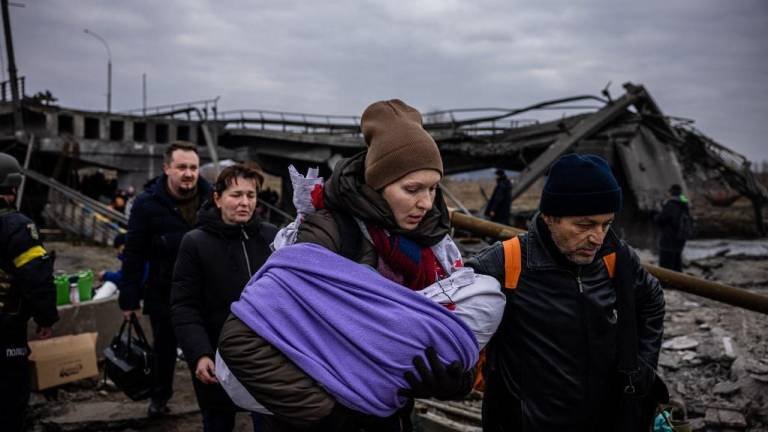
Today, after all this time, after the beginning of the war, which has not yet ended, we cannot speak of scars, but of wounds that continue to bleed with long-term negative effects on all aspects of life, health, environment, economy, work and development of the country. But there are invisible wounds, such as the traumas caused by the conflict, by living in the darkness of a shelter, the precariousness due to lack of food, water, heating, the fear of the sound of a siren or the wake left by a passing plane.

Waves of fear and terror that pierce the soul like daggers and seriously compromise the psycho-physical health, especially of children, the most vulnerable, leading them to withdraw into themselves and into social isolation, to have nightmares and panic attacks, to live in fear of losing their parents, friends and perhaps their future, as well as to grow up with the feeling of how fragile they may be.

The war has robbed them not only of their childhood, but also of the magic of dreaming and believing in dreams; it has opened chasms in their school careers, weakening their prospects for a bright future.

The conflict has also had a strong impact on the elderly, increasing the phenomenon of poverty and social isolation. A state of vulnerability further aggravated by the effect of immigration and the recruitment of young people. The war has been extremely violent for Ukraine, disrupting the labor market and causing a massive exodus, forcing more than a third of the population to move, taking refuge either within the country itself (about 7 million) or, as women and children, (about 8 million) abroad. The negative impact of the conflict has affected the financial situation of each and every family left without a livelihood.

In addition, the war has left deep wounds on the country’s natural landscape, with farmland particularly affected, contaminated and littered with mines, as well as burned forests and destroyed national parks. Important installations and industries were bombed, causing heavy air, water and soil pollution and exposing the inhabitants to toxic chemicals. Not to mention the electricity restrictions that have hampered the provision and delivery of health services, leading to an increase in pneumonia and respiratory diseases, also due to the country’s harsh winters.

But Ukraine is not just a wounded country, but a people that is finding the strength to heal even from something as ugly as war, because it carries in its heart the desire for freedom and the conviction that it can contribute to restoring a dignified life for all its inhabitants and dreams of a country in which no one’s dignity is discriminated against and trampled upon and in full respect for human rights and democracy, always and only the common good is sought, which guarantees security and the necessary conditions for dialogue and peaceful coexistence. It has many reasons to seek a solid and lasting renewal because it thirsts for fraternity and peace.

But with war we are all defeated, even those who do not participate in it. And a path of recovery is born from the depths of each person, who desires a peaceful coexistence and is committed to build it from the «battles» of every day. In fact, as Msgr. Vincenzo Paglia says in his book «Sperare dentro un mondo a pezzi» (Hope in a broken world), that to get out of the «broken world» it is necessary to know how to dialogue with everyone, to start from the last ones, to favor the encounter between different peoples to build a peaceful coexistence, opposing the tensions that lead to conflict. He writes that we must live by building fraternity, which is perhaps the word that best honors the art of gratuitousness and freedom; it can truly help us to be convinced that our responsibility to be builders of peace lies within ourselves. It speaks of peace, of war, of the last, of the elderly and immigrants, but above all, it makes us reflect on a new humanism that concerns globalized man.

For this reason, we are all involved in this path of recovery, from the leaders of nations, to the baker and the children, all involved in a path of mutual trust: trust between individuals, peoples and nations, to overcome conflicts and divisions. As Pope Francis exhorts, «let us hasten along paths of peace and fraternity.

Let us rejoice in the concrete signs of hope that come to us from so many countries, beginning with those who offer assistance and welcome to those fleeing war and poverty». In fact, we have all been protagonists of small or large gestures of solidarity towards the Ukrainian people, experiencing how the only antidote to war and despair is to unite people around good deeds and works towards those in need, above all, towards the most vulnerable, since this is precisely the criterion for the development of a society. Even if at this moment there seems to be no glimmer of hope for possible negotiations, we must never lose hope and we must keep alive the ideal of peace and trust in God. Courage!


Sr. Milena Prete, TC