

Categorías
Artículos

Unpublished letter on the death Of our Father Luis

A «jewel»… I had this in my «trunk» and because of those «inspirations of God» I had the idea of drawing back its veil, to give it light, to give it wings, to give it life. So many years with me, in my book «Liturgy of the Hours», like a «small piece of paper» with folds full of time and marks, with printing characters deteriorated to the maximum by the hidden running of silent years. Of an impressive fragility but docile to the caress, to a reading deciphered even with a magnifying glass to unravel the tenderness sheltered in the heart and fingers of a Sister distant in our present history, but alive in each one of her expressions, narrating with infinite affection, the last moments of the precious life of our Father and Founder. A deeply revealing testimony for these dates of such a pleasant memory.

An unexplored date: «October 7, 1934″… Still the echo of the bells and the smell of candles consumed in a reverent silence, let his presence be felt as squeezing between his cries the heart of a man with the perfume of God’s love. The Father rests in his tomb and begins his «eternal happiness». In the souls there are no memories, there are experiences, experiences of paternal embraces, of words full of desires and illusions about the future of his family, engendered in the fullness of his youthful years and strength. Male and female novices… promises of future in the footsteps of “that one of Assisi» are in the center of his spirit and in his visionary advice of time and history.

And there, in Masamagrell, in the House that he loved so much, in the Chapel that he himself invented, his body is deposited. And from this silent presence, from this «man of God’s will» emerges a reality that captivates and stimulates fidelity, authenticity, promptness in the face of the calls of the world, of the «common home» and of the Church, raising the flag of the compassionate and redemptive charism. Masamagrell, ALPHA AND OMEGA of the Father, beginning of his life and final rest of his corporal existence.

The fidelity of one who writes in obedience to a paternal command. «First of all, I receive a special blessing from you, as you entrusted me with paternal love and interest to write it on your behalf, which I do today with great pleasure».

We are about to «read» a sublime testament of love of our Father and Founder for his Sisters in America. I would like to publish it to the four winds of our geography and on our knees, pray, thank, share the filial echo of restless tears, silent sighs, cautious voices, fraternal glances, embraces of pain and strength, wishes of hope, faith and love in our future, promise of survival in the heart of God, of Mary and of the world that calls us to a total surrender for the Gospel.

Masamagrell, October 7, 1934

Most Reverend Mother Commissary Capitular

Yarumal

Dearest and unforgettable Mother Purificacion: May the Lord give you His peace.

With my heart torn by the sorrow and bitterness in which the death of our beloved and venerable Father Founder (R.I.P) has left us, I am writing these lines to communicate to you something of what we had opportunely gathered from his blessed lips during his last days.  First of all, please receive a special blessing from him, as he asked me with paternal love and interest to write to you on his behalf, which I do today with great pleasure.

He, sensing his death, did not omit details in all the moments of the last time that he was among us. We had the joy of having him in this holy house from August 20 until September 6, when he went to Valencia to bless the wedding of his nephew Luis Boada Amigó and that same day our Capuchin Tertiary Fathers and Brothers took him to their Convent in Godella to see if there he would be a relieved by the change of air, but everything was useless: he died there, and Rev. Mother Rosario de Soano and Rev. Mother Cruz de Beniarjó had the incomparable joy of being present on his side when he offered his last breath because it was their turn to watch over him that night.  He died at one o’clock in the morning of October 1, having the good fortune of R. P. Lauriano de Burriana, Tertiary Capuchin and Superior of the House of Godella, to give him the last absolution.

In vain did the doctors strive to combat the harms that weakened such a precious life, and so they were forced to exclaim: «The Bishop is dying without illness».  And how can this be explained? Ah…it is that his illness was more close.  The moral pain that devoured his heart was very great… and so he was slowly dying, praying and suffering in silence this ills that has taken him away from us: his Diocese, his poor priests in need… all this grieved him but he suffered it with the resignation of a saint! This is how he was venerated by all, as a true Servant of God.  His heart was devoured by bitterness at seeing his Diocese in extreme misery: his Priests without bread and almost homeless.  The sighs that choked his chest in his last days were continuous.  The tears in his eyes were also almost continuous.  In short… he has been a victim of circumstances which we have been lamenting for three years.  Lately, he had no appetite for anything.  He went five days without drinking or drinking water, only moistening his lips with it.

He received Viaticum sitting in an armchair, with the serenity and gratitude of a saint, on the feast of Our Lady of Mercy, from the hands of Bishop Lauzurica, Auxiliary of the Archbishop of Valencia, to whom he had recommended his two Congregations. His days of illness were of great edification to all those who visited him.  What gratitude he expressed, how he asked for forgiveness and what peace could be glimpsed in such a good Father. He died as the saints die: forgiving and blessing everyone.

Two days before his death, at one o’clock in the morning, he called all the novices and professed to his presence to bless them for the last time and give them his last advice.  Here, too, during the days he was there. He went, two or three times, to the Novitiate to give the novices exhortations that they will never forget.  He also spoke to us, Professed Sisters, about the life of our Seraphic Father St. Francis, encouraging us to have great confidence in Divine Providence, since God had promised the Poor Man of Assisi that if there were only two loaves of bread in the world, one would be for his children. He exhorted us to keep the Holy Rule and Constitutions as well as to try to preserve the spirit of Franciscan humility and poverty in which he always wished our beloved Congregation to be founded.

Let us pray to him, beloved Mother Commissary, to continue blessing us from heaven and to protect his work by pouring graces on his two beloved congregations so that the virtues that he always preached to us so much with his example may endure in the hearts of his sons and daughters: meekness, humility and gratitude to God and to all those who favor us in deed or word.

 On the 2nd day, the funeral was held in the Community of Godella and in the afternoon his venerated body was transferred to the Parish of Masamagrell.  I cannot explain to you how much the attendance, the veneration and the order was that there was… Well it has been seen how much they loved him!… On the 3rd day they were in the Parish officiating the Archbishop of Valencia, with attendance of the Chapter of Segorbe and other worthy authorities.  Then they took the corpse to our Chapel and on the appointed day, of N. P. San Francisco were the funeral and burial.  Everything has been orderly and devout as he was.

His memory will be recognized by all in general in this town where the Mayor and members of the City Council as well as all the other people and clergy of the neighboring towns have come to Godella as to this holy house to pay him the ultimate homage of their veneration and appreciation.

May our beloved Father, whose memory will always be blessed by his children, rest in peace.

The Most Reverend Mother General blesses her and through her all her beloved Colombian daughters.

Most affectionate and sorrowful Sister in the Seraphic Father who commends herself to your prayers.

Your Sister,

Josefa de Dabajuro

After enumerating such significant Sisters, what role do I play…? Simply a means to give flight to wings ready for a earthly and celestial journey since that October 7, 1934; to «take out of my chest», experiences, memories, existences more and more fascinating, to recognize in the shelves of our history the spiritual richness that underlies, in the prayerful silence of a tomb, pure tabernacle, where the genesis of our being of Capuchin Tertiary Brothers and Sisters of the Amigonian Family is….

Fraternally,

Dora Arboleda Hoyos t.c.

 Province «Our Lady of Divine Providence».
Categorías
Artículos

An icon that speaks

Francis’ encounter with the Crucifix of San Damiano

Introduction

The icon of San Damiano crucifix has had great diffusion in the Catholic piety, in any store or lithography it is easy to get it, surely its design and coloring make it especially attractive, simply from pious or aesthetic interests, and suddenly you find it in the office of a bank manager or in the waiting room of a doctor’s office.

I would like to share with you a short reflection on the encounter of St. Francis with the Christ of San Damiano at the beginning of our spiritual journey, a reflection that I have dared to call «An icon that speaks».

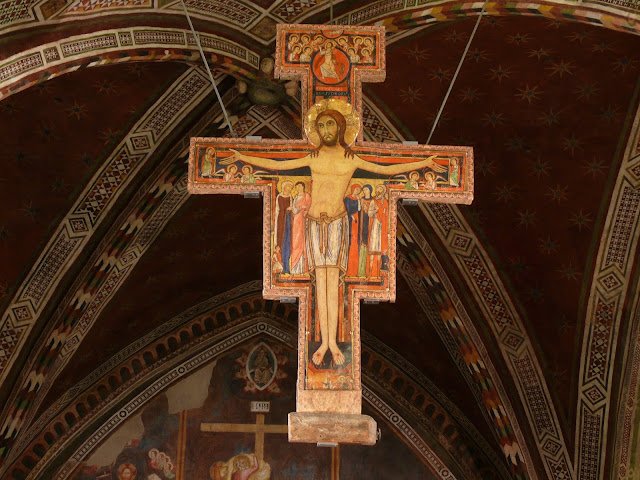
Scholars of the icon of San Damiano place its origin in the tenth or eleventh centuries, most likely painted by a monk who lived in the region of Umbria. Making an icon requires an infinite sense of contemplation, prayer and mysticism about the figure to be painted.

An icon is painted essentially to be contemplated, in this one of San Damiano, the first thing that jumps to the sight is the figure of a crucified and at the same time resurrected Christ, with enormous open eyes and great luminosity in the colors of the figures that accompany him; colors that contrast with the black background that in the iconography of the time means death, red that indicates divinity, gold that represents eternity, blue and green that refer to the world and the passing of human history.

This encounter of Francis with an icon that speaks to his heart from a church whose roof is collapsing is a foundational event of the Franciscan charism. He had already had two important encounters before, with himself in sickness and loneliness and with the leper, outside the city walls, on the road.

The order of the encounters reflects the evident centrality of the human being in Franciscan spirituality, situated in contexts of margination. With regard to encounters, it is worth noting the importance of the theme in the magisterium of Pope Francis when he speaks of the culture of encounter.

From Laudato Si’ and Fratelli Tutti there is no doubt, as the Pope says, that everything is related and that we are all brothers and sisters in this wonderful pilgrimage that is life, intertwined by the love that God has for each of his creatures, a love that unites with tender affection, the brother sun, the sister, and the brother and sister who are all brothers and sisters.,

to sister moon, to brother river and to mother earth» (LS, 92). Moreover, with the certainty that it is not possible to accentuate one encounter while neglecting or ignoring another, or what would be worse, blocking it, creating an internal fracture that can lead to death.

It is evident in Franciscan spirituality the relationship between encounter, reparation and care, three themes that reflect a maternal sense that sets tasks that can only be accomplished from a true integral, ecological and pastoral conversion.

In order to live the Franciscan vocation, in addition to a holistic conversion, it is necessary to walk towards a renewal of senses of understanding, towards a new understanding of relationships in the key of life of openness and availability of heart, of mind, an openness that goes beyond the narrow institutional walls, of the self-referentiality that impoverishes and immobilizes.

It is urgent to return to Jesus of the Gospel, the Jesus of Emmaus, the Jesus of the fishermen in the harbor, the Jesus of the wedding feast at Cana, the friend of those in Bethany. To the praying Jesus of the desert, tempted by Satan, to the Jesus who mourns his dead friend, who heals the sick woman. For a true encounter with Jesus of Nazareth to take place, we must follow the path taken by Clare, Francis, Anthony, Bonaventure, Friar Luis Amigó and many, many other men and women who dared to leave everything to open themselves to the world in such a way that the Culture of Encounter becomes possible.

This is the only way to repair the house that threatens ruins, the common home, hit by global warming, poverty and war. It is necessary that the Franciscan identity be known and truly assumed, from the initiatives promoted by the Franciscan Families in each country, the Justice, Peace and Integrity of Creation Commissions, the JPIC, the networks of Migrants and of human rights defenders of women, children, LGBTIQ+ populations, and ancestral communities. Daring to weave with others, opening institutions to those who wish to be peacemakers with justice and dignity.

It is necessary, as Pope Francis tirelessly says, to assume the duty that as Christians we have to get involved in politics because it is one of the highest forms of love, since it seeks the common good, Clare and Francis were conscious of being citizens and worked for a coexistence in peace and justice. In this way it is important that as Franciscans we make synergy in the United Nations from the office of Franciscans International that makes visible to the international community the state of ruin or repair of the house.

May we continue to build, encouraging the «Blessed common belonging» that makes us brothers and sisters, as Pope Francis says in the FT: «Fraternity and social friendship are expressed through acts of benevolence, with forms of help and generous actions in times of need. A selfless affection for other human beings, regardless of difference and belonging.»

Juan Rendón Herrera OFM

Categorías
Artículos

Defense of life

One day I was having fun with my cell phone while browsing through a magazine, when this article caught my attention: What is the most unbearable noise in the world? I clicked on the link already thinking about some noises that I find annoying and I was surprised to find out that «according to a scientific study, the most unbearable noise in the world is the cry of a child between two and a half and four years old, and it disturbs men and women, celibate and married, adults and children alike» (cf. Rosemarie Sokol Chang and Nicholas Thompson, psychologists).

In my own re-reading, I rejoiced that, as a species, we are concerned and disturbed by the cry of a child, that we have this instinct of protection that calls us to soothe or satisfy its needs, being part of the great family of humanity where all of us, of different race, language, people or nation, have the instinct to care for life as part of the gift of God the Father who has created us in his image and likeness (cf. Gen 1:27).

And in these times, when darkness and the shadows of death lurk in war, gratuitous violence, human trafficking, political, economic, energy and consumerist dictatorships, which together with climate change and lack of solidarity, mean that one out of every nine people in the world suffers from hunger (UN), it is God himself who comes out to meet us, who takes the initiative, arousing in the heart of each person attitudes that generate life. The Father sees the affliction of His people, the cry of their oppressors and knows their anguish and says to each one of us: «Go, therefore, I am sending you to bring my people out of oppression. I will be with you» (cf. Gen 3:7ff.).

In a simple and profound way, Pope Francis, with his merciful witness, affirms that life, a gift of God, is a gift that must always be defended and protected: «Men and women of prayer guard the fundamental truths: they repeat to everyone that this life, despite its fatigues, its trials and its difficult days, is full of a grace that amazes. And as such, it must always be defended and protected» (cf. Pope Francis (@Pontifex es) / Twitter).

It is up to each one of us to accept or reject this mission, cultivating the gaze with a grateful heart, to see with the eyes of Jesus the small and great gestures of so many people around us who care and generate life. Letting ourselves be touched and questioned by their witness as fathers and mothers, sons and daughters, professionals in health, education, social and public services, entrepreneurs… each one of us, united to the one who is the source of eternal Life, nourishing it by letting it flow around me with attitudes of service, care, kindness, respect, interest, listening, joy, generosity and forgiveness.

We well know that it is a drop of water in an immense ocean, insignificant in its individuality, but necessary «for this is the favorable time, this is the day of salvation» (cf. 2 Cor 6:2).

 Sr. Eva María Salvador Aspas, Tc

Categorías
Artículos

Amigonian school: «Going beyond»

Amigó’s school has its roots in the Gospel of Jesus, the Good News, which came preferentially to the last of the line, the excluded, those placed on the side of the road, or as Jesus himself expresses it: «As you did it to the least of my brethren, you did it to me…» (cf. Mt 25:31-46).

It would be daring to affirm the originality of a proposal that began to be built at the end of the 19th century, without taking into account what had happened in the previous 19 centuries, and that was made in different persons, currents and events of history. A School that was born among consecrated people, it is necessary to admit it, whose baggage is Christian spirituality, because it is born from it, and conceived in the discipline of asceticism that regulates, shapes, corrects and moderates, to make way towards the perfection of mysticism, as the dream of happiness as God’s will for men and women, especially for the little ones of the world, conceived in our time as violated, excluded, victims, whose rights and even their voice have been taken away.

The dream of the Amigonian School, takes shape in the life of a privileged man of history, who after living in the bosom of his family the maternal pain, together with the economic anguish of the father, in the human Christian dimension that he drank in his first home, and then in the Franciscan School of the Capuchin friars, he knew how to take flight to listen to God in his vital project and in the project that, conceived in his heart, involved consecrated men and women, who would carry out the evangelical proposal, contained in the testamentary amigonian mandate: «…You, my beloved sons and daughters, whom He has constituted as the shepherds of His flock, you are the ones who are to go after the stray sheep, until you return it to the fold of the Good Shepherd…» (OCLA 1831).

When Luis Amigó, moved by the Spirit, founded his two congregations of Capuchin Tertiary Brothers and Sisters, a dream that his young heart harbored (Cfr. Autobiography 8-9) while living in his home and in society, and feeling the needs; (Cfr. Autobiography 6-7) it was the Lord Himself who led him, so that, in the charismatic mission that he left to them, he let the compassionate feelings experienced in his family shine through: «dedicating himself with all solicitude and devotion to the relief of the spiritual and corporal needs of his neighbors…» (Cfr. OCLA 2293) and «to be more disposed to serve them in the ministries to which this congregation is especially consecrated, such as: the instruction of adults and infants in the arts and sciences; the service of the sick, especially at home, and the administration and direction of prisons and jails» (Cfr. OCLA 2361).

The Amigonian School could have as its beginning the year 1885, when Father Luis Amigó, in the midst of the cholera epidemic, says in his Autobiography: «In such an afflictive situation, and considering how much the ever-growing progress of the Third Order, recently increased with the foundation of the Congregation of Capuchin Tertiary Sisters, should please the Lord, I offered to the Lord, to appease his justice and that the cholera epidemic would cease, to redouble my efforts and work to expand more and more the Venerable Third Order of Penance; And at that moment, the idea crossed my mind and was fixed in my mind (I do not know if by divine inspiration) to complete the work with the foundation of a Congregation of Capuchin Tertiary Religious, who would dedicate themselves to the penitents and to the care and moralization of the prisoners» (Cfr. OCLA 83).

«Recently founded the Congregation of Tertiaries, the Bishop of Madrid asked the Father Founder to put his religious in charge of the direction of the Santa Rita School of Reform, in Madrid, Spain, which they took possession of at the end of October 1890… This house has always been the most important foundation of the Congregation» (Cfr. OCLA 133).

Santa Rita, a school for the wayward of that time, some inexperienced religious but with a heart full of dreams tempered by the conventual discipline, are a privileged place for the birth of the Amigonian School, with an educational and pedagogical project where the names of the groups and the activities carried out with the children, felt the hand and the dream of the beloved Founder and his first religious, among them, special merit to Blessed Domingo María de Alboraya, martyr of the Spanish Civil War of 1936.

The School of apprenticeship-error, had a place in the capacity of dedication of the religious, seasoned with their pedagogical inexperience, a mixture of abandonment in the hands of God and the exercise of the iron discipline required to become new men, in response to the call of the God who throbbed in them. Slowly, with the assurance of trust in God, the educational exercise of good will, personal improvement, credibility in being and acting, which is of God, an initial methodology was born – a path – that of the Amigonian School, built on the initial foundations of asceticism and Christian mysticism that today, as described by the expert pen of Fr. Juan Antonio Vives, could be defined as the pedagogical feeling, which confers a seal of identity to the Amigonian action and which revolves around these essential values:

– «To believe blindly in the natural goodness of every person, and consequently, to hope against all hope.

– The horizon of personal fulfillment is happiness linked to freedom.

– To know the person through the heart and to educate from the affectionate closeness and cordial dedication.

– To love each person in his or her individuality, and to show compassion to the underprivileged, according to the mercy of the Gospel.

– To create in the educational groups a family atmosphere, where the educator plays the role of father/mother and elder brother.

– To be strong in order to remain faithful in the determination to be an educator.

– To be vitally consistent with what is transmitted, thus acquiring credibility» (Cfr. Historia de la Pedagogía Amigoniana, Juan Antonio Vives, p. XXXIII).

Fray Marino Martínez Pérez, Tc

Categorías
Artículos

Migrants and refugees from our pastoral experience

Global migration is a major challenge for much of the world today and a priority for the Catholic Church. In words and deeds, Pope Francis repeatedly shows his deep compassion for all displaced people: we have witnessed his encounters with migrants and refugees on the islands of Lampedusa and Lesbos; his call to embrace them fully: to welcome, protect, promote and integrate migrants, refugees and victims of human trafficking…

In the line of synodality that we are living at this time in the Church we have a great challenge: to make the world ever more inclusive, to walk all together towards an ever greater us; to recompose the human family, to build together our future of justice and peace, ensuring that no one is excluded.

The future of our societies is a future «full of color», enriched by diversity and intercultural relations. That is why we must learn today to live together in harmony and peace.

My pastoral experience with migrants and refugees in Spain has been above all in the field of women in a housing project and networking with organizations working in this line of migration (Ubuntu Project «Migrant Women»).

The need arises to respond to the precarious situation of migrant women who are being hit by the current devastating social and economic situation, women who arrive as refugees to apply for asylum, and as these applications are not being accepted, they become illegal migrants. Women are arriving because of human trafficking, because of pressures from sexual exploitation networks from the country of origin…

These women are welcomed, offering them support that encourages them to carry out a process that culminates in their legalization and normalized insertion into our society. They are provided with information, guidance and support in the active search for employment or other social assistance in order to obtain decent housing. Our work is one of accompaniment, a pastoral listening and closeness to each one in their difficult situations and personal realities that cause this migration.

The work is teamwork and/or networking with other entities that offer social inclusion programs and work with migrants and refugees. Relationship of the women with groups of the parish that can promote knowledge of the socio-cultural reality and the environment. Neighbors and immediate environment. Communities and associations in the country of reference. The participation in the Department of Migration of the Diocese, through the Migration and Refugees table, where the participating institutions that see the need to unite to confront laws that are violating the dignity of migrants, is also an important space, a space of the Church in line of synodality, walking together in this great challenge of global migration.

At the social level, participation in international non-violent action in solidarity with migrants, such as «The Circle of Silence»; this is an inter-institutional movement, networking, which considers that the situation in which many people live is extremely precarious and appeals to the conscience of those who make the laws, those who apply them and those in whose name they are made, to make possible a policy more respectful of the dignity of people. They are also intended to help to raise awareness, to internalize and to be an element of interpellation to society about the extremely serious situation that many people suffer in Europe as refugees (www.circulosdelsilencio.es).

We all have in our minds the images of refugees from the war in Ukraine. We, as Capuchin Tertiary Sisters, have given a response of pastoral action to this current reality through our Sisters in Poland, a real and living pastoral action. They themselves wrote: «In the first welcome the important thing was to transmit: don’t be afraid, here we will help you, here there are no bombs, and here you will be safe and your children too… Welcome and cover the basics… food, shower, bed… And then listening to the fears, cries, misunderstandings… after a few months, listening is still the most important thing in pastoral care… We do not ask about their faith and do not answer why this happens… We listen to the pain, memories and above all small difficulties and joys of everyday life and the desire to return to normality. When we can, we help, when we cannot, we try to be close. Never to judge opinions and thoughts, but to welcome with the heart…»


Our Father Founder, yesterday and today, continues to encourage us to give our lives to bring the salvation that Christ offers to all without distinction, putting us on the road with the other, with others, not in front but beside others, bringing mercy and compassion that the world needs. Luis Amigó, a man who knew how to trust in God and respond to the signs of the times from the concrete of life, is also a reference for us Capuchin Tertiary Sisters of the Holy Family, to have our eyes wide open and our hearts on fire, like the disciples of Emmaus. And having our eyes open makes us aware that we are living a difficult moment in human history and a delicate moment in the life of the Church and religious life, but at the same time, a moment of grace, because we experience the close and unconditional presence of the God of history who looks at us with merciful eyes and comforts us. Our task is to be evangelically significant and not only pastorally efficient.


We are all called to follow the path opened by Pope Francis, a path defined as «the revolution of tenderness», in which he invites us not to be afraid to globalize solidarity to welcome refugees and migrants, reminding us that they are «the flesh of Christ».

Sr. Matilde Mena Moreno, Tc

Categorías
Artículos

Commitment to creation: A proposal for self-sustainability

«The vitality of the Earth and the future of the human species will only be guaranteed if we manage to endow them with sustainability. Otherwise, the future may be very dark» (Boff, L. (2013). Sustainability. What it is and what it is not).

«We are not God. The earth precedes us and has been given to us», affirms Pope Francis in his ecological magna carta, Laudato Si, to respond to the accusation that in our Judeo-Christian tradition, the Genesis account that invites us to «dominate» the earth (cf. Gen 1:28), favors the savage exploitation of nature, and presents an image of the dominant and destructive human being. The Pope makes it clear that this is not a correct interpretation of the Bible. Today we must read the biblical texts in their context, with an adequate hermeneutic, and remember that they invite us to «till and tend» the garden of the world (cf. Gen 2:15).

Bearing in mind that «to till» means to cultivate, to plow or to work, and «to care for» means to protect, guard, preserve, guard, watch over, this implies a relationship of responsible reciprocity between human beings and nature, in the context of the intimate relationship between the poor and the fragility of the planet, as the Pope concludes in the same Encyclical. This generates conditions for self-sustainability or, in a more far-reaching term, sustainability, defined in 1987 by the United Nations as «meeting the needs of the present without compromising the ability of future generations to meet their own needs». Thus, an ecological discourse goes hand in hand with a social discourse and we cannot think of sustainability without considering the poorest, who are the ones who suffer most from the consequences of environmental mismanagement.

This is our commitment to creation: to inhabit it as an Oikos, called «Common Home» by the Pope, and to enter into otherness with it, in the sense that being «other», we establish relationships of care and reciprocity. She nourishes and sustains us and, in turn, we care for her and allow her to be reestablished, in such a way as to guarantee her stability. Likewise, as a work of creation, humanity must be looked upon for its dignity and the common good, in pursuit of sustainable development.

In the so-called Agenda 2030, the United Nations, in 2015, established 17 goals to achieve sustainable development (SDGs) on the planet, covering three fundamental dimensions, social, economic and environmental. The goals prioritize the fight against poverty and hunger, the defense of human rights, inclusive and equitable education, gender equality and women’s empowerment, the shift towards responsible consumption patterns and planet-friendly economic growth. They were proposed with a holistic and systemic vision, since everything in the world is connected, to be applied in local, regional, national and global scenarios, including the commitment of governments, the private sector and civil society, in each particular context.

As a Congregation that is committed to dignifying human life in an environment that must be cared for, we have been an expression of some of the SDGs and today, in a special way, we have the challenge of assuming them with greater evangelical and missionary commitment. Our effort has been concretized in six (6) of the 17 SDGs:

Objective 1: To put an end to poverty in all its forms throughout the world. The preferential option for the poor, which is expressed through the presence of our Congregation among the excluded and most vulnerable people in society.

Goal 2: End hunger. We have contributed to achieve food security and improve nutrition in vulnerable populations, such as minors, adolescent girls, students and the elderly.

Objective 3: Guarantee a healthy life and promote well-being for all at all ages. The promotion of health, disease prevention and care for wellness and health, have been one of the pillars in the evangelizing mission.

Goal 4: Ensure inclusive, equitable and quality education and promote lifelong learning opportunities for all. Education for life, the key to escape poverty, has been at the heart of our evangelical proposal.

Goal 5: Achieve gender equality and empower all women and girls. In order to reduce discrimination and violence against women, we work in the areas of Protection, Health, Education and Social Promotion.

Objective 12: Ensure sustainable consumption and production patterns. Our approach is to permanently educate on responsible consumption and lifestyles that do not conflict with environmental care and that also optimize the use of resources.

The other objectives summon us as part of creation, for sustainability in all its dimensions, counting on the solidarity of the world. Let us do our part with the awareness of a common origin, of a mutual belonging and of a future shared by all, as the Pope reiterates in Laudato si (202), being daughters of Francis of Assisi, patron of ecology and of Luis Amigó, the man of integral ecology for his harmonized and integral life, to strive in actions that give self-sustainability to nature and to human life.

Sr. Sor Alicia Vásquez, Tc and Gabby Vásquez

Categorías
Artículos

Accompanying in the nightfall of existence «My experience of accompanying my elderly and sick sisters»

Before sharing my experience in relation to this topic, I want to take in some elements that will help contextualize my words: I come from a country where a small portion of our beloved Congregation is present, the works are of missionary character and work in parish ministry, communities with few sisters, therefore, one of the reasons to come to Colombia for formation or for other reasons is to know communities with enough sisters and houses with older sisters, so that planning a trip to Medellin always includes the visit and sharing with our elderly and sick sisters.

Our Constitutions say: «They have spent their energies in the service of the Congregation and now they encourage us with their experience and witness of fidelity to the Lord» (Const. 34). And so it is, the sisters who come to this community live a concrete stage of their life with its own characteristics: reduction of the rhythm of life, having more time for things, especially prayer which, together with pain, is the daily offering to God and a way of continuing the mission in the world. They also feel helplessness, fear, pain, need for listening, companionship and help from others, they begin to depend. Although we know that it is a normal stage of life, we are not always ready to go through it, it takes us by surprise and it is a process to adapt to the changes.

I have been accompanying the community «Nuestra Señora de Montiel» in Medellín for 5 months now, where I share life with our elderly and sick sisters together with a group of sisters who form the «support team» of the community. We are immediate in charge of looking after their wellbeing.

If I am asked what does this mission mean to me? I say that, like any mission, it implies a service that I welcome with faith and good disposition; an opportunity to love, serve and grow. Although I had no work experience in this area, I have two clarities that help me, «the mission is with my sisters» and «we walk together»; these are the keys to assume with love the day to day, which is always full of novelties and feel that we are all on the way at different paces, but together as we are asked by the synodality. 

Some lessons for life:


  1. To live the welcome and respect

In a world where the elderly are excluded, to SEE the sisters as elders; to recognize that they came first to the Congregation, that they have traveled a path of following and service that we continue, helps me to value and respect each one in her own reality. 

  1. To express gratitude feel 

The sisters who are in the community have spent their lives and energies living their vocation and carrying out a mission, no matter if in relevant positions or humble services, they all carry the high bar «HERE IS A FOLLOWER OF JESUS, BUILDER OF THE CONGREGATION», it is a merit that no one can stop; therefore, in their presence only gratitude, much gratitude to honor their legacy.

  1. To contemplate the work of God, to welcome a blessing

Each sister is an eloquent SIGN of what God is capable of doing in each human being when she takes it on her own; sometimes, in the midst of their limitations, it is not very easy to discover «the work that God has done in them». However, their lives reflect God’s faithfulness and mercy and His saving action.

  1. To appreciate the essential 

In adulthood many physical or mental faculties are lost and it is surprising to find the essence of each sister. What she has cultivated during her life is what remains.  So you can enjoy the joyfulness, prayer, availability, strength, and active service among the many gifts that God placed in their hearts.

It is beautiful to contemplate some details of the present of the sisters that simply fills the heart with tenderness and admiration: the sense of God and their relationship with Him, no longer with numerous words or great speeches; they just know how to be, they are like little candles at the foot of the tabernacle. A great testimony is that even in their pain they look for the community and ask, «Where are they all? Bring me to them”.  Despite the fact that they no longer go out from the house, they still have a sense of helping others, especially the poor. They care for others and for those who care for them. They create bonds and share their wisdom in words of encouragement and messages that help them grow. Their sense of belonging to the Congregation is also noticeable. They ask for the sisters, they ask for their names to be repeated over and over again, they ask to be told who to pray for and, if the young women in formation come to such spaces they like to tell them their stories over and over again, offering them prayer and giving them advice; they are for them like a grandmother with her grandchildren. 

Finally, for those who read this story, the invitation is to value the elderly around you.  They have a lot to give, so let us not miss the opportunity to give them proximity, gentleness, company and help.

Sr. Bilma Freire Chamorro,  Tc

Categorías
Artículos

Embracing personal reality, the reality of the brothers and sisters and of creation, is the starting point of our synodal path

With the convocation to the XXIII General Chapter, the theme around which the congregational-capitular experience revolves in its various phases began to resonate in prayer and in the spirit: “Strengthened in the Spirit, we embrace our reality and suffering humanity, advancing with hope on a synodal path”.

This theme initially locates us in what is weak in our personal reality, proposing the intuition of allowing ourselves to be strengthened by the Spirit, who calls us to re-captivate ourselves, «to recover the great desires, the marks of the wounds of our passion for Jesus and the Kingdom” (cf. José Mª. Arnaiz, SM, “From disenchantment to enchantment, passing through re-enchantment”), to return to the source that seduced us, to return to the roots that perhaps we have not cared for and watered carefully, but who are on the best ground, that of fundamental belonging: Jesus and His Kingdom.

The being and doing in the future of our congregational family is already giving us a glimpse of well-defined spaces and missions to which we are being re-sent: «To embrace our personal and community reality, and that of each Demarcation. To embrace the reality of the environment in which the suffering of our brothers and sisters and of creation is stirring».  Once these realities are recognized, we should humbly opt to take up the path together, to begin to re-create possibilities of reparation, of closeness, of mutual support, and above all of security and hope, with the conviction that in this new sending we are not alone and that we can awaken a new Pentecost: as an experience of re-enchantment, of re-birth in life for the following of Jesus in witnessing joy as disciples, stimulated and accompanied by our founders, by their experiences of conversion and commitment to the Gospel.

Francis and Clare of Assisi, Father Luis Amigó and our sisters of the first hour once again appear at our side, almost taking us by the hand to lead us to the ruins, to our vulnerabilities, not only the external ones, but those that deep inside groan and cry out for compassion. The «leper» excluded from coexistence, from harmony, from fraternity, from activity, from joy and hope, whom perhaps we have taken hidden, and not listened to, ignored, thinking that «he can stay there» and that «he can hold on a little longer». 

This reality is touched today in the family-community, and is inviting us to embrace it, to work as sisters in the closeness that led to the recognition, the embrace and kiss that transformed the personal reality of the leper and of Brother Francis, leading him then to San Damiano, to the place of encounter with the broken, disfigured, dusty, forgotten, victimized Christ in the brother and sister with whom we live. It is a slow and difficult process of recognition and identification, but an excellent way towards the experience of the reparative dynamism of our being, able to face the internal and external causes of our insecurity and proud selfishness, welcoming the possibility of finding new realities, new searches in the paschal journey of the Congregation.

To place ourselves as consecrated women, as committed lay people, with the personal reality that accompanies us today, before the extreme love that led Jesus to the cross, is the opportunity to feel the projection of that love, in the gift of brothers and sisters, with whom it is possible to unite answers, qualities, attitudes, ideals, options, strengths and to begin again putting our grain of sand in the strengthening of life and vocation, of identity and mission as Capuchin Tertiary Sisters, before the humanity that also suffers new, deep and serious vulnerabilities: «… the scourge of misery, hunger, unemployment, diseases without access to health centers, lack of schooling, child and youth labor for the survival of the family, trafficking of women and children, organ trafficking, lack of housing, displacement, war, corrupt political and even ecclesiastical administrations, slavery and injustice of all kinds, the cry of the destruction of the common home and the «throwaway culture» that affects above all women, migrants and refugees, the elderly, native peoples and people of African descent»… It hurts «the impact and consequences of the pandemic that further increases social inequalities, even compromising the food security of a large part of our population. It hurts the clamor of those who suffer because of clericalism and authoritarianism in relationships, which leads to the exclusion of brothers, lay people, especially women in the instances of discernment and decision making on the mission of the Church… it worries the «lack of prophecy and effective solidarity with the poorest and most vulnerable…» (cf. Final Message of the Ecclesial Assembly of Latin America and the Caribbean).

These multiple situations against the Kingdom continues recognizing in consecrated life, in women, sisters and disciples who are bearers of hope, assisted by the Spirit of the Lord who makes all things new; and trusts and hopes that «we will return singing from the congregational Chapter experience», offering compassionate fruits of listening, discernment, forgiveness, and a more sensitive, decisive and risky missionary attitude to project, create and open new ways of announcing in order to walk together, making a new world possible, a creation revitalized by active, simple and lesser fraternity, driven by the Franciscan-Amigonian spirituality and determined to put in common not only vulnerabilities, but possibilities, intuitions, demands, vocation, options, even contradicting ourselves, contradicting customs, projects, securities, ways of living and thinking. 

Then we will begin to live the XXIII General Chapter, as one more step on the way of restructuring our lifestyle and mission, celebrating the wedding feast, in which, if the jars of wine have been emptied and we feel the threat of the end of the feast, we can also feel the woman who has been able to say a YES without limits even in the midst of chaos; she shows us the work that frees us from sadness, hopelessness, distrust, fear that often overwhelms us: «Do whatever He tells you…» and the capitular, personal, community banquet will make our hands, wills and freedom agile, to make the empty jars overflow and allow us to taste the new wine, the best and the capacity to take up again the motivation and initial option and source of our religious profession, of our commitment in front of life in abundance for all, in front of the lament multiplied by so many marginalized brothers and sisters, so many voices, so many realities that ask us: «Go and repair my house». 

Sr. Ana Mora, Tc

Categorías
Artículos

Taking up the challenge to be silent in order to listen

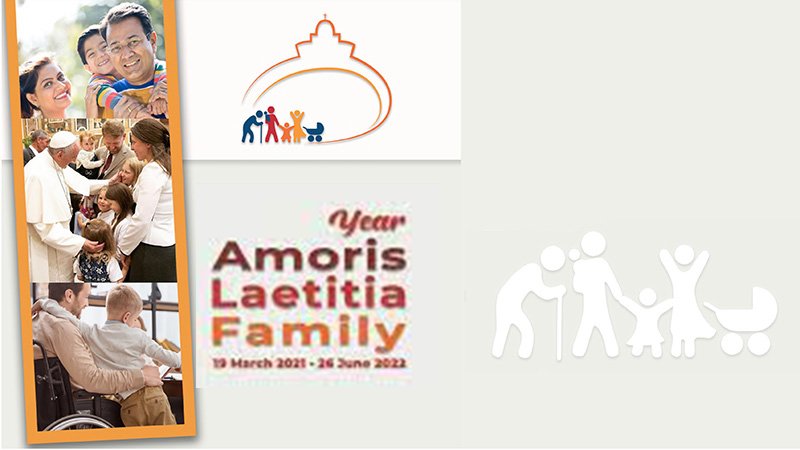
“Amoris Laetitia Family Year”

On March 19, 2016, the post-synodal Apostolic Exhortation «Amoris Laetitia» (The Joy of Love) on the family was signed. This document is a compendium of two synods on the family convened by Pope Francis in 2014, «The Family in the Context of Evangelization» and in 2015, «Vocation and Mission in the Family, in the Church and in the Contemporary World».

Amoris Laetitia marked the beginning of a path that prompted a new pastoral approach to the reality of the family.

Francis explains that the Exhortation «acquires a special meaning» for two reasons: «I understand it as a proposal for Christian families, which stimulates them to value the gifts of marriage and the family, and to sustain a strong love full of values such as generosity, commitment, fidelity and patience» and also «seeks to encourage everyone to be signs of mercy and closeness where family life is not perfectly realized or does not develop with peace and joy».

On the fifth anniversary of the Apostolic Exhortation, Pope Francis announced a year dedicated to families. This year was officially known as the «Amoris Laetitia Family Year» and invited Catholics to reflect on love in the family, enlightened by the Exhortation that captured the experience and challenges of today’s families and their vocation. This Amoris Laetitia Family Year began on March 19, 2021 and will conclude on June 26, 2022 with the 10th World Meeting of Families in Rome.

The Capuchin Tertiary Sister in communion with the Church

For the Capuchin Tertiary Sisters, it represented a pastoral challenge that led them to place themselves in the context of a mission exercised from the confinement, which made germinate in the bosom of the families other pandemics: intra-family abuse, abandonment, divorces, depression, loneliness, vices, senselessness and relativism…

From within the Amigonian Charism springs the concern to motivate the pastoral reflection of this Exhortation and to participate from the creativity of each work and community in the planning and living of this year. Pope Francis has dedicated the Family Year Amoris Laetitia to the Holy Family of Jesus, Mary and Joseph, patrons of the Congregation of the Capuchin Tertiary Sisters of the Holy Family and models close to our humanity, who in their availability to do the will of God, their obedience and listening continue illuminating and marking the way to build the domestic church.

St. Joseph, Custodian of the Year of the Family

To propose St. Joseph as the custodian of the Year of the Family is to affirm him as an example of paternal love and of the value and dignity of work. According to tradition, he worked as a humble carpenter in the town of Nazareth. Today, after three years marked by the pandemic (COVID 19), both paternal love and the dignity of work have become essential to the health and well-being of our families and communities. This paternal love given to Mary and Jesus gave them support and freedom; and today it teaches us to stop and let ourselves be accompanied by the spirituality of Nazareth, the spirituality of listening, dialogue and obedience.  

In the action of listening, it is necessary to be silent and empty ourselves of words. In the Holy Family of Nazareth this silence was available and generous, capable of making God’s dream come true: «You will be the mother of Emmanuel … be it done unto me» (cf. Lk 1:26-38). «He took Mary and the child and fled to Egypt … he set out while it was still dark» (Mt 2:13-14), thus bringing to life the words that Jesus would later say: «Blessed are those who hear the word of God and put it into practice» (Lk 11:27-28). It is in the bosom of the home that Jesus as a child learned that He was blessed and happy. It is in the family that we learn to listen in order to follow instructions and obey.

Proposal

It is necessary that the culmination of the Year of the Family becomes a new propositional stage, where we can continue writing the post Amoris Laetitia pages and that the emerging and hidden realities within the bosom of the family be accompanied and enlightened by this Post-Synodal Letter.

Let us practice the life of silence to listen to God, to listen to ourselves and to each other, because only in this way can what is creative, what is new, what God wants to awaken within the Church, within our domestic church, emerge.

To walk in synodality is the proposal that moves the heart of the Church today and it will be from the commitment of each member of the family that welcomes and lives its role, where it will be possible to listen, discern and build the necessary dialogue to rescue life and love in the family.

May Mary, Mother of the Church and Queen of families, intercede for us.

SR. MARIULIS GREHAN, TC

Categorías
Artículos

Approaching today’s youth and their choices

We want to begin this sharing, which more than an article is a reflection of our experiences, thanking the Capuchin Tertiary Sisters of the Holy Family for guiding and teaching us, but above all for giving us a voice in a world where silencing lives is easy.

We are Carolina and Santiago, two young Colombians, residents in the city of Medellin; we are 26 and 27 years old respectively and we want to tell you a little of our experience, with no other pretension than to bring you closer to the youth of today and our options. We have been involved in youth processes for more than ten years, starting in this beautiful story; thanks to the invitation of one of the sisters.

Belonging to a youth group, in particular to JUVAM (Amigonian Youth) was not seen for us as an option, considering that in our minds we had what the world offered us, empty experiences devoid of meaning and that filled us momentarily.

For many young people, going against the current could resemble a risk in terms of the social environment, being singled out, stigmatized and sometimes persecuted; approaching the message of Jesus at this time can be an act of rebellion, in a world where it is much easier to always put the cold and calculating mind in data, money and statistics, leaving the heart aside, without being empathetic with those who suffer, being indifferent; there Jesus invites us to move life.

In this way we began our JUVAM process, allowing us to be moved from within, learning to be docile to the project that Jesus showed us for our lives, awakening that sensitivity to the pain of our brothers, passionate about His message; there, each one and together gets as a team, we grew spiritually and approached what would be the mission entrusted by God, to be wife and husband, the best «team», with God at the center.

Nowadays, to talk about a project, for many young people can be overwhelming, tedious and old-fashioned, it is thought that one must plan on the way or simply go through each challenge that arises, but undoubtedly, through our youth process, from our Diocese in Caldas, Antioquia, we can say that there are young people who are passionate about life, sensitive to their brothers, critical of what happens in their environment, active in the areas and spaces where decisions are made that impact them.

In the youth, we find diversity, there are nature lovers, crazy about reading and other forms of art and expression, with whom we can have an excellent conversation; able to make their way and find in all these details and life options.

Approaching young people would not be possible if we see them through the stigma; we must see them in their integrity and what they represent for the world, a vital force capable of mobilizing and giving meaning to their projects. In this sense, Jesus is the example to follow, capable of clinging to and loving to the extreme the project that the Father designed for His earthly life.

We cannot end this article without inviting you to let yourself be moved by God’s strength, which invites us to take risks, to be courageous in moments where adversity can darken our path, but always with the faith and hope that, guided by the Spirit and motivated by the message of a young Jesus, we will find the best option.

Peace and Goodness!

With affection,

CAROLINA & SANTIAGO