

Categorías
Artículos

Clare’s light beaconed inside and out!

«How powerful was the illumination of this light and how strong the brightness of this source of light. Truly this light was kept hidden in the cloistered life; and outside them shone with gleaming rays; Clare in fact lay hidden, but her life was revealed to all. Clare was silent, but her fame was shouted out» (FF, 3284).

As St. Clare of Assisi’s (1194-1253) feast day approaches on August 11, I’ve been reflecting on the relevance of her spirituality in this present time.

Clare of Assisi is one of the great women of the Christian and Franciscan tradition. Within the context of the medieval world of the 13th century, Clare lived and struggled with many of the issues that are present in our day. In the life, spirituality and work of Clare of Assisi we can still find an answer to many questions and challenges in today’s world.

In our day of so much fear, uncertainty, violence, sickness and death caused by the pandemic, selfish distinctions and hostility between rich and poor, political conflicts, war, and environmental crisis – Clare has much to teach us about living together on our planet earth as sisters and brothers, all children of the one God. As the first Franciscan woman, she led the way in giving us a shining example of the feminine response to the challenge of Gospel values. Placing all her unique gifts at the service of others, she modeled a stance of complementary – leadershipWhile St. Francis moved the world with his extroverted charismatic leadership, St. Clare quietly built “stronger structures” behind the walls of the cloister.

“On Palm Sunday, 1212, Clare took a bold step on her spiritual journey. She renounced her privileged position in the nobility and received the garb of the followers of Francis. Eventually, she made her home at San Damiano in a small church repaired by Francis, just below the city of Assisi. Under God’s guidance, Clare created a new path for women, embracing poverty, humility, and charity as companions on their journey”.

Clare’s life of absolute poverty cuts through all the lures of our consumerist culture. She knew the One in Whom she believed and that One was all-sufficient for her. “Clare’s sole desire was to ground herself as a branch to the Divine vine; to be the Mirror of Eternity in the way she lived her life with her sisters and in the depths of her prayer and contemplation of the Crucified Christ and the Risen Lord. In this way, she allowed herself to be transformed into the image — the mirror — of the Godhead Itself”.

She is also teaching us how it is to build a true community based on the obedience of love.  Her example of servant-leadership was remarkably evident. In the Testament she wrote, the grace of sisterhood is being highlighted.  She said: “careful attention must be given to the establishing of relationships, it is precisely because she envisioned a cloistered life that the dynamic of human relationships is of such importance.  We create relationships by doing things together.   Our relationships with other sisters must be one of support”.  For Clare the “sister in office” (she did not use Abbess) must be a good listener, seeing in each person the one whom Jesus has looked at and called.  She desired that her sisters will be nurtured, spiritually, emotionally and physically. For it is in the nature of motherhood to give life. 

 “The mirror image was a favourite image in Clare’s writings.  The mirror is a vision and a symbol.  She was talking about the depths of reality in Christ reflected in the human person.  In her letter to Agnes she advised her to look into that mirror meaning Christ and behold therein the poverty, humility and, centrally, the sacrificial love of our Lord.  This mirror is not only there to reflect  the redeeming love of our Lord; but for her in the community there is no place for class distinctions or any other form of discrimination: everybody was accepted who felt called to her way of life.  For according to her, acceptance of others is the first poverty. She admonished her sisters to show the love they bear for each other by their deeds so that the sisters are able to love God and each other with greater intensity”.

Today, we face such terrible consequences because of our lack of reverence for creation. The environmental crisis results from a lack of appreciation for the good things that our God has given us for our benefit. The very existence of the life of our planet needs new vision. We, human beings so often fail to realize our interconnectedness with our mother earth.  We lose sight of our great responsibility to care for our common home.  Clare saw the reflection of a loving Creator of all these created wonders. In the words of Clare herself: “Always and in all things God must be praised.” 

Clare was a woman of prayer, strength and courage, of wisdom and insight.  She is teaching us the primacy of God and the great importance of prayer. Her light beacons to the outside because her inner life was deeply anchored in God, her loving Father.  As St. John Paul II said: “Her whole was a Eucharist because from her cloister she raised up a continual “thanksgiving” to God…”

Clare’s passionate spirituality continues to inspire us today: “We become what we love, and who we love shapes what we become”.

 “Look into that mirror daily… and ever study your face therein”.  (Clare, 4th Letter to Blessed Agnes of Prague, 1245)

Clare had a deep gratitude for the abundant kindness of God, she considered herself privileged to have been called to such a life.  Profound gratitude that made her exclaim as her last words, “ Blessed be You, O God, for having created me. ”Francis himself called her ‘Cristiana’, the Christian woman. She is indeed true to her baptismal name.  Clare –  which means light, clear and Illustrious light-.  A true Christian who gave a strong witness to the Light of Christ even from her cloister. Her shining light emanating from Christ Himself beacons and continues to shed rays of peace and hope to all corners of the world.

 SR. Mapin M. Pineda, Tc


Categorías
Artículos

Inés Arango: to surrender one’s life for the gospel

When we talk about Sr. Inés Arango, we spontaneously talk also about Bishop Alejandro Labaka and that is because their lives have been united forever in our memory and in our hearts, since they gave up their life  for the love of their brothers, on July 21st, 1987.

Otherwise, Inés, had been unnoticed in the simple daily tasks, like anyone of us, her sisters, in the Aguarico mission or in any other of the 34 countries in which we live. Anyhow, in the people hearts had remained , the mark and testimony of her life as a woman of faith, joyful, committed to Jesus Christ in her community and for the most in need people, courageous and determined to live coherently with what she was believing… and something more.

One day someone asked me which is the best thing we can be said about Inés? I answered, without hesitation, that she gave up her life. The surrender of one’s life is not a matter of a specific moment, but it is true that sometimes it happens as it occurred to Inés… “the critical moment of giving up the life”. Giving up life is rather a «long moment«, a long way lasting the whole existence, until the moment when it is given up completely and without reservation.

Therefore, when we approach Inés’ life, it is good to think about her “root”, support, source, nourishing, and relief … all that stands «behind» her person and fashions it.

Inés was born in «the city of eternal spring», in Medellín (Colombia), in the year 1937. She had the great luck of being born into a believing and deeply religious family. From her parents and siblings, she learned by osmosis, the values of believing, praying, serving the neighbor …They were freely living their faith in the everyday life and in the simplest things and she made her own this same attitude throughout her whole life. From them she inherited also vitality, energy, genius and a sense of the unusual, aspects allowing her to face with a great freedom, the difficult moments of her existence.

Among mischiefs and adolescent rebellions, Ines was growing in faith. We know that, first of all, the seed of faith must be sown and then it will germinate and bear fruit … may be an abundant fruit. Because of that, it is important that the Word be announced to us… through the word and the testimony of life… and also listening without silencing our concerns, desires, and yearnings. Some of that happened in Inés’ life.

Let us approach her life to verify what was resounding in her «inside» and was the engine of her existence, the deepest reason moving her to live a total dedication and to act risky and that was sustaining her whole life. The missionary concern experienced in her family, in the parish, in the school … was an abundant seed in the person of Inés, a seed sown in a fertile and good soil. And, actually Inés, from her very early age, did not silence her concerns. She always warmed up her desire and knew how to nourish it amid difficulties and sufferings.

And also the Capuchin Tertiary Sisters left their mark on Inés; in her daily experience with the group of girls in the boarding school in Yarumal, she noticed how they were living the Franciscan and in addition Capuchin style of life, enriched with the «charisma», and  «special touch l” received from their founder, Luis Amigó. This «special touch» was nothing else than an unconditional dedication to the least ones, to those to whom no one goes …living in the simplicity and joy of fraternal charity … nourished by the Word of God and the Eucharist… unconditional committed, out of love for Jesus Christ incarnate and made one of us, born of Mary, out of love for Jesus Christ the Good Shepherd seeking those who are lost, out of love for Jesus Christ who gave his life for us, dying on the cross and rising again and all that, according to the style of the Holy Family, living in fraternity, available and dedicated. The Capuchin Tertiary Sisters, who came from Spain to Colombia to be missionaries … We know that Inés was repeating that many times! And being already a Capuchin Tertiary Sister she was reclaiming the missionary commitment among us, sisters of her Congregation.

We can imagine Inés in this environment. Undoubtedly, in her dreaming heart, there were decisive moments of missionary seeding. Inés’s dreams will turn, little by little, into wishes and, at the end, her wishes into reality.

Let us go back to the life of Inés to see how she was daily listening to the deep music filling her with an evangelizing vigor and was able to discover what was before her, how she was discovering that life is meaningful only if it is offered and, furthermore, holding the Gospel in her hand and at the whisper of our Charism.

The Capuchin Tertiary Sisters, according to the expressed wish of our Founder, received this task: «to be the trainees of the Good Shepherd, looking for the lost sheep». In today’s language, it means to live in favor of the “least ones”, of the disinherited of the earth and that is a call to be a courageous woman ready to give up her life if necessary.

Inés faithfully lived so. She learned to receive as a GIFT this charismatic experience which marked her forever and also as a TASK and a duty that no one could accomplish on her place. Inés was a very receptive and determined woman, dreaming and critical, happy and cheerful. The «music» that Inés was listening in her inmost as well as all that was happening to her brothers, the Huaorani, were tending her heart, more and more, towards the “last ones”.

On these days of the month of July, being fulfilled on the 21st, the 34th anniversary of her life given up together with the Capuchin Bishop Alejandro Labaka, we are invited to participate in the events that the Vicariate of Aguarico organizes every year in memory of Alejandro and Inés and especially in the 15th Walk, that this year will be virtual and physical. We can follow it through the website: www.alejandroeines.org.

Let us celebrate also the commitment of our sister Inés reading again her biography “Clay and vessel in the wounded jungle” available in the congregational website in PDF format. Let us spread her story among young people and let us see in her a fulfilled experience of our missionary dedication to the most disadvantaged people. Let us also put her as our intercessor and let us pray for her beatification.

May Inés and Alejandro, disciples and missionaries dedicated to the heart of the Ecuadorian jungle, be for us a breath of fresh air, a whisper of the Gospel, a fraternal rumor, an evangelizing fire …

Hna. Isabel Valdizán Valledor, Tc

Categorías
Artículos

“I have seen how cruelly my people are being treated… I have heard their cry”

Thanks to my Congregation of Capuchin Tertiary Sisters, and especially to Sr. Ana Tulia López, Superior General and her Council, to Sr. Yolanda de María Arriaga, Provincial Superior and her Council of my Province “Our Lady of Guadalupe ”and to the Latin American Conference of Religious (CLAR), who provided me with a scholarship, it has been possible that, five months ago, I could begin a path of knowledge, accompaniment and painful discovery of a reality of death and resurrection, that our Church is living at present. Despite the COVID-19 pandemic, our group has been the first international and multicultural group, most of its members Spanish speaking people that, at the Pontifical Gregorian University, could complete the Diploma in Minors safeguarding, attending classes physically, during the months from February to June 2021.

It is not easy to acknowledge one of the wounds that the Church must take care of, beginning a path of conversion and reparation before the situations of abuse. It is illogical to pretend to make God speaking since forgiveness, as a characteristic of a compassionate God or that divine justice act on the sinful deeds of humanity. These ones are responses, often erroneous, given without knowing how to care for victims of sexual abuse or, in other words, without engaging themselves in the restorative healing task and assuming the humiliation, preferring to choose a defensive attitude for the good name or status of the Church.

It is the necessary to make visible the victims remained unattended and that is why it is requested their intervention and to accompany them through an empathic treatment that will cure them humanely and emotionally. Those who have courageously assumed their responsibility had to learn how to cope with the case processes and have offered the means of due treatment and compensation to the affected persons.

It is an obligation of the Church to care for the victims through the recognition, closeness and a good fraternal treatment approaching them like the God of Israel who listens to the cry of his people (Ex 3,7), creating spaces for dialogue and encounter, bending over to know their suffering and pain, attending to the needs of the brothers affected by the events and offering them the opportunity to express their feelings, emotions and unshared silences. That is the occasion to re-establish the faithful that are part of a community, giving them the possibility to be solidary through the reception that offers the strength to recover. This is a path of prevention and safeguarding in an ecclesial communion, creating support networks to work as a team with institutions, professionals and people with whom, in this course, we have woven fraternal ties and created a support network, because we have acknowledged that we also are vulnerable and we need to be supported and accompanied. This will be the task to carry on through the different commissions formed in the dioceses, parishes, religious congregations, CLAR and various International Conferences of Religious working for the prevention culture.

The healing process involves to accompany the victims without haste and without looking for immediate results. Rather, it consists in caring with a heart of mercy, walking alongside with those who carry difficult situations, taking each one his own responsibility towards their reality; it consists in listening to the cry, bending over and looking at them like God looks at his people, listening, approaching, overcoming prejudices, risking, being creative in inventing gestures of tenderness so that a gradual and patient process may take place and it may involve healthy symmetrical relationships and also inclusive understanding to welcome even the aggressors. In the community or the Church, must be offered a space for attention, openness and welcoming attentive listening; all that should be provided in an atmosphere of freedom and respect for each situation, always gazing like God, compassionate and moved by the caused wound, opening new possibilities to comprehend the experienced situation and to start a healing path, beginning with the “verbal testimony” presented as part of a salvation history, perceiving God of life’s acting and keeping in our memory that God’ s action, revealed in the pain of the past is transcended and gives meaning to the present.

The Church in her evangelizing task, walks alongside as a mother with its children and offers itself as an intermediary: it reveals the salvation through the events of a personal story manifesting love in the midst of suffering and offering a path of life and hope. I echo the words of Sister Nathalie Becquart, whom, in February 2021, Pope Francis appointed as one of the two Undersecretaries of the Synod of Bishops; affirming that “All of us, as baptized, are called to fight against clericalism which has been identified as the root of any abuse that is always the consequence of an abuse of power”, she remarked that it is necessary to promote discernment and to seek co-responsibility and subsidiarity, since a new style of governance, in the Church and that is the path of synodality involving the active participation of all the members in the shared mission, seeking consensus together since a free leadership, allowing the community to participate in the decision-making avoiding being the protagonists or a selfish narcissism, overcoming great institutional temptations of concealment, impunity, silence and deception … building again he coherent articulation (leaving dualism) mercy-justice, synodality-collegiality, vulnerability-precariousness.

The culture of prevention begins in the ecclesial life, in all its structures, dimensions and representativeness of all the members of the people of God; the Church mission, especially with regard with the most vulnerable («minors»), is to announce the Good News to all creation through an oblative service without domination.

At the end of this time of grace we return to our communities, parishes, dioceses with the hope of serving and helping the most vulnerable who demand love, sowing a culture of good treatment.

Hna. Priscila Brenes Granados, Tc


https://www.dropbox.com/s/ckmetktzoy9xib5/video%20FINAL%20Diploma%20CCP%202021.mp4?dl=0


Categorías
Artículos

Education in times of pandemic

It is known by all that COVID19 has permeated all the spheres of the human life. This pandemic surprised us when we were absorbed in what we were calling «normality» and asleep in our comforts and personal anxieties. We never imagined that something so miniscule would have the power to take away thousands of human lives around the world and in a record time. Neither social status, nor fame, nor money have been useful as “saving-life” pass. This reality made us to see that we are not as powerful as we believe and, as Pope Francis affirms, “our vulnerability was exposed”.

This pandemic has also unmasked the gaps existing in many areas of society and the educational field has not been an exception. The educational systems of the world have been confronted and challenged to change their dynamics and some of them did so with a higher speed and effectiveness than others. The great powers countries of the world, thanks to the virtual and digital media, managed to give continuity to the educational processes in a short time but unfortunately, for the so-called third world countries, the reality has been very different: in addition to the lack of connectivity in various territories, they could not rely on  electronic equipment and devices and so be able to access virtual classes and, as an important fact in this historical moment, a large number of the teaching population that we could classify as “digital illiterate”, has also slowed down the processes.

Since all this reality, great questions arise to challenge the education agents: What to teach? Why to teach? How to evaluate? What to do in a virtual classroom or how to design a didactic guide to keep alive interest and motivation about learning? These are only some of the many questions that the reality of COVID-19 involves in the education sector. And it is not so simple to think about education in times of pandemic.

In the first months, when we were confined, education experts spoke out and said that the school could not be the same once it would be possible to go back to the physical presence in classroom in the dynamic we now know as “alternation”. And it is so; many will surely have achieved this urgent and necessary innovation, but many others will continue to be submerged in the lags of a traditional education that does not permeate the students’ lives, nor does it enable them to become transforming agents of society.

Consequently, the roles and the scenario of the educational process have changed. The exigency is not only for the teachers about the use of technological media or in the urgent need to achieve a true curricular transformation committed to improve the educational quality. Parents and caregivers have also been forced to learn again and to place themselves in the perspective of teaching and, in most of the cases, they were not trained or accustomed to do it, because they do not have the tools or the basic educational level to accompany the academic process of their children. That has generated stress, fatigue and even school dropout within the houses, especially in the most vulnerable population.

We always say that responsibility for the educational process is a commitment concerning both educational institutions and families but, in theory, until before the pandemic, only the first instance really assumed this commitment. We must acknowledge that the task of “reinventing ourselves” has been assigned to both students, parents and educators.

It is common to hear a phrase that, at a given time, was valid: «we were not prepared»; now it is time to leave behind this justification and to arm ourselves with passion, dynamism and creativity to face the historical moment urging us. This challenge entails to recognize the structural problem of education, the evident disparity in educational and technological opportunities as a reality that cannot be ignored, but we should not rule out the possibility of developing a humanizing process within the educational institutions and whose priority is to train resilient students, capable of getting out of themselves, understanding life since an altruistic sense and aware of the need to work for an integral ecology. The 21st century education has to be an education encouraging rather than teaching how to think and to live together.


Initiatives like the Global Educational Pact, promoted by Pope Francis, aim exactly to open doors so that, education and real processes of social transformation can take place. Now it is the moment: let’s not lose the opportunity to re-signify the educational environment starting with small actions.

The pandemic has put us in front of this great challenge and according to our being and doing as Capuchin Tertiaries we own all the tools that we need to give a coherent response based on the Gospel and the tenacity of our Charism.

Hna. Yury Tatiana Amaya Mendoza, Tc

Categorías
Artículos

Let us love him, let us really love him

With these words, that actually are an invitation, the protagonist of this article, our sr. Rita White Arango, concludes the video we present, (it has been prepared by sr. Iria Natalia Ágreda Abreu in collaboration with other sisters), in which we have collected some “brushstrokes” of the life of sr. Rita who, at present the oldest sister of our Congregation, who, on June 27th, will be 109 years old.

Our written words are poor compared with the testimonies of the sisters who liked to share something about what sr. Rita has been for them and for the Congregation; so, grateful to the Lord for Rita’s long life, we’ll let the images and voices resonate and enter into our hearts.

Rita White Arango, that when she joined the religious life received the name of Hna. Pilar de Jesús de Manizales, is one of the fruits of the love of Mr. Enrique White and Mrs. Elisa Arango, that, by the Lord’s grace, on June 27th 1912, in Manizales (Caldas – Colombia), brought to the world this great woman. She was baptized on July 3rd of the same year. Rita’s parents gave her a good human and Christian formation and her education was fundamentally forged by reading and understanding texts that gave her an admirable intellectual baggage, at that time.

In 1932, Rita applied to join our Congregation of Capuchin Tertiary Sisters of the Holy Family and on July 2nd she began her postulancy in Yarumal (Antioquia) and on March 29th 1933, in the same house, she continued her formation in the novitiate. He made his First Profession on March 25th 1934, on the feast day we celebrate the mystery of the Annunciation and the beautiful act of God’s love that liked to take a body and become part of the humanity. Rita, has always been able to configure herself to her Lord throughout her whole life spent in love and dedication for the others. On January 22nd, 1939, she made her Perpetual Profession in Yarumal, offering all herself to the Lord for the service of his Kingdom of love, within our religious Family …

Sr. Rita spent most of her life as an educator, always striving to show to the children and young people, the face of Jesus the Master who accompanies and teaches God’s love to the others… She was a well-loved woman leaving in her students a deep trace of love for the Eucharist, the Virgin Mary, the Word of God as well as many values through which she was wonderfully forming her students in the academic, scientific and spiritual dimension, preparing them to serve the society and the Church in different ways.

In Rita’s personal life, the prayer, the accompaniment of good spiritual directors, the tenacity in whatever she intended to be and to do … helped her to be fervent, honest, patient, generous, constant, with sense of responsibility, prudent, available, cheerful and organized; she was adorned with a formidable memory that she has kept until not long time ago. Rita has been and is a woman of faith and dialogue; she was passionate about reading and she read with predilection the dwellings of Santa Teresa and was able to supernaturalize what is ordinary with religious mastery.

Since 1934 to 1967, our sister served in different communities in Colombia and in 1967, she went to Venezuela, at that time Province «Saint Francis», and she stayed there until 1991 when she went back again to Colombia, to her Province » Saint Joseph».

Rita held various services of responsibility in some institutions, such as director of different colleges, treasurer and administrator. She was also superior in various communities and novice mistress and she was always striving to give glory to God through all her being and doing.

Even when her responsibilities were consisting only in being the door keeper or in other offices in the library and today, as an aged sister member of the community “Our Lady of Montiel”, belonging to the Province “Our Lady of Divine Providence”, Sr. Rita has always been happy and smiling, revealing the living God whom she loves so much …

We like to end this article going back to its beginning, praying to the Lord to teach us to love Him, to truly love Him, as our sister invited us. That is what she tried to do throughout her long existence.

Happy birthday, Sr. Rita!

Categorías
Artículos

A man committed to accompany and to train lay people: Luis Amigó and Ferrer

As human beings we discover that we cannot walk alone and we need the others to grow humanly and spiritually. Because of that, as Pope Francis reminds us, we need to scrutinize the paths of accompaniment and formation, promoting processes leading to encourage growth in the Christian life (cf. EG 169).

The task of accompaniment and formation of lay people, may lead us to the temptation to look at the panorama with uncertainty and hopelessness but, Luis Amigó’s experience in this mission fills us with confidence, hope, and enthusiasm.

But, how did Luis Amigó carry out this mission? Let’s discover his pursuits, successes and limitations in this task, but, above all, his enthusiasm, perseverance and trust in God and inlay people that are responsible for their own process and committed to share the richness of Jesus Christ in their lives.

The human and spiritual vision of Father Luis takes its origin in a concept centered on the dignity of a person able to allow himself to be transformed and to transform the Church and the world he inhabits. We cannot forget that Luis Amigó, during his youth, was formed in some movements integrated into the secular Catholic spirituality and committed himself in a religious and social promotion of people, namely, the School of Christ and the Congregation of San Felipe Neri; that strongly affected his apostolate of accompaniment and formation of the laity, which generates a personal and social transformation. He so  refers it in his writings: the Third Order is a Lord’s deed innovating the Church and completely transforming the society (cf. OCLA 1016-1017).

On the other hand, «man is created at image and likeness of God» (Gn 1,27) and so he owns the dignity of being son of God (cf. OCLA 1323); because of that, it is always necessary to work for the integral formation of the person. His formative accompaniment to lay people, more than a scientific, psychological or educational theory consists in a lifestyle expressed in a particular way of being, staying and evangelizing, striving to incarnate in his person and to instill in the life of the Christian, their baptismal obligation. For this reason, Father Luis frequently insisted on the wealth, nobility and dignity honoring and distinguishing us the Christians, who have been made children of God and heirs of his glory (cf. OCLA 1329).

The apostolate with the lay people was always present in the life of Fr. Luis, when he was still a simple Capuchin as well as when he was a bishop; he was well rooted in everyday life and was allowing himself to be enlightened by the human pedagogy that Jesus uses with his disciples: respect for the dignity of the person, listening to reality, use of a known, familiar and contextualized language, reading and interpretation of the Scriptures, closeness and affection for people.

Since his youth, he assumed accompaniment as something constantly present in his multiple formative activities, mainly in the congregations of the Venerable Third Order, the Daughters of Mary and the Luises (cf. OCLA 50). His concern for the formation of the young people of both associations was oriented towards the Christian life (cf. OCLA 2170) through an accompaniment that emerges as an imperative in the process of personal growth of the members of the groups and a human and spiritual wisdom integrated in the reality of his time, employed in daily life and proved by a true and convincing witness of Christian life.

The culminating moment of this apostolic service, occurred at the beginning of his priestly ministry, when he was appointed as Commissar of the Venerable Third Order, on October 20th, 1881 and entrusted with all the necessary faculties… (cf. OCLA 60-62). The footnote n. 39 referred to of OCLA 61, collects the opinion of Fr. Melchor de Benisa OFMCap regarding Father Luis’ apostolate in this area: “He had a great skill and a clinical eye in recognizing people who wished to enter the order and he was recommending to them no to make policy but, rather, to be extremely seraphic, as they were the right arm of the parish priest…”. He was interested about the formation of the Third Order members because he wanted to lead them to God, since his life witness and that is what his brothers acknowledged when they declared: “They were respecting him as a holy man and following his instructions with diligence and joy».

Father Luis promoted a formation that would affect the spiritual fervor of the members of those groups of the Third Order that «were rapidly spreading during the first years of the restoration and, in the year 1893 reached an amount of 17,864 Tertiaries, dependent on the Capuchin province of Toledo of which the Servant of God was one of the provincial Councilor » (cf. OCLA footnote n. 40).

Luis Amigó worked tirelessly in the progress and propagation of the Third Order, which was attended by a huge crowd of faithful; the organization of the groups strongly contributing to their growth, in such a way that, they became a considerable number of brothers and sisters… and that brought to mind the need to go on founding new congregations (cf. OCLA 61). He was also encouraging the members of the Third Order to participate in congresses as training opportunities as well as in other celebrations (cf. OCLA 2449).

During his episcopal ministry he wrote letters, circulars and apostolic exhortations requesting his priests, among others, to accompany and to form the Christian life of the lay people, with apostolic zeal and a tireless evangelical activity (cf. OCLA 1137). All that expresses his concern for the formation in the spiritual life and his commitment with great zeal and interest for the salvation of souls and to make known and loved by all Jesus Christ (cf. OCLA 1142-1143) as well as the tireless work and the restoration of the society turned away from Jesus Christ. In order to reach this aim, he was asking lay people of both sexes to work hard since, usually, persons pay more attention to them, that to the priests (cf. OCLA 1147), he was considering himself a collaborator of Jesus the Good Shepherd to attract the “lost sheep” into the fold, leading them to the field of the Church where they can be satisfied with the Jesus Christ’s doctrine (cf. OCLA 1136). He was as well caring about the formation of Christian families as a support and sustainer of society, fixing their eyes on the model of the Family of Nazareth (cf. OCLA 1102-1103) and paying attention to the reality interpreting it in the light of the faith and discerning his decisions about economic, social, moral and spiritual difficulties that society was experiencing (cf. OCLA 297 and 1054). He promoted also the advancement of science, whose source and origin is God, as a means of progress for peoples (cf. OCLA 936), the building of the peace and justice emanating from God’s mercy (cf. OCLA 656-657) and the construction of a more humane society where the graces and favors received from God should be used for the benefit of others, considered neighbor and brother (cf. OCLA 1051). These and many other concerns, made Luis Amigó a man committed to accompany and train well immersed in the Christian, social, political, economic reality and in the transformation of the society founded on charity and on Jesus Christ’s doctrine.

In addition to all that, we could say that Luis Amigó was a man able to glimpse the important role of the laity in the Church and in the society and to appreciate the need of walking together in synodality in order to build the God’s Kingdom and that is what the Church remembers us at the present time.  In his writings he reflects this idea saying that” lay people are obliged to work, each one in his own sphere of activity, in spreading the faith and making Jesus Christ and his holy doctrine, known to men” (cf. OCLA 1147); through these words, he put into evidence the great importance of the secular apostolate We know that, his relationship with them was favored by a join active and responsible participation in events, celebrations and organized activities, both in the spiritual and civil fields.

Today we, the Capuchin Tertiary Sisters, feel urged to share with the lay people the gift of our Charism (cf. Const. 63), a gift of the Spirit for the whole Church and for the extension of the Kingdom, to promote since the novelty of the Holy Spirit and of Father Luis a formative accompaniment as a processual and integral dynamic, using the pedagogy of Christ the Good Shepherd, an feature speaking us of the profound experience of Jesus caring for each one of his sheep, to seek paths that open us to a new mentality, to walk alongside the lay people and to promote different ways of being and staying moved to compassion by mercy, no-appropriation and inclusion.

Sr. MARÍA ANABELLE CÉSPEDES MORALES, TC

Categorías
Artículos

«Help yourself and heaven will help you»: A self-sustainable formation

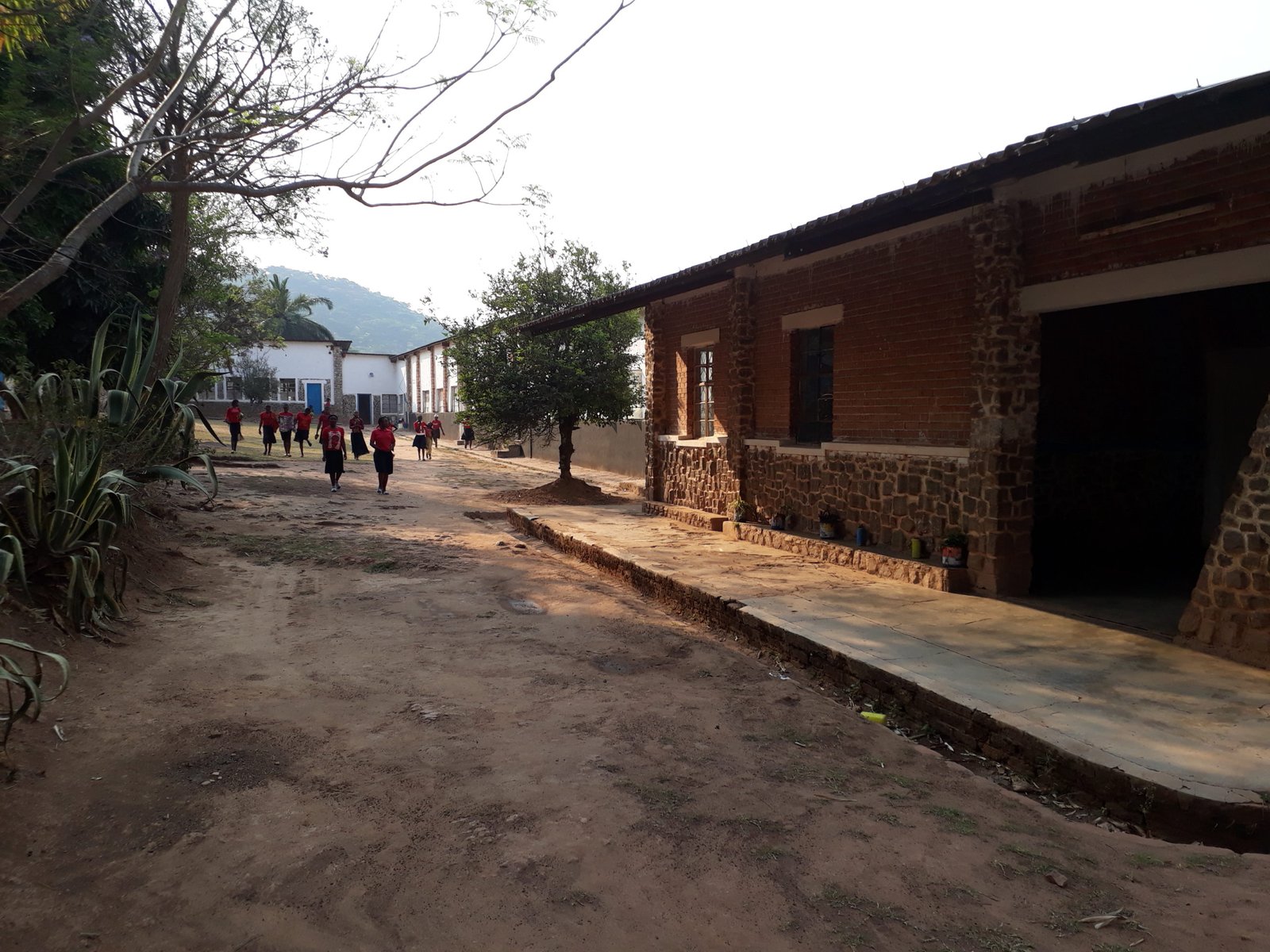
Since the beginning of our congregational presence in the Democratic Republic of Congo, in 1971, and specifically in the Mission of Kansenia, one of the priority was the creation of a “foyer” (school-home).  The name of this «foyer», unchanged in the time, is “Kinzala”, which can be translated as “a home that never dries up”.

Accepting the invitation of our Founder, Father Luis Amigó, to be always open to the signs of the times in order to respond to the real needs of the people we want to serve, the sisters who started our mission in Africa, having discovered the precarious situation of the young women training,  they launched the foyer project, still existing after 50 years.

The Kinzala foyer aims to an integral promotion of the women, offering to the young women a platform where they themselves are the main agent of their formation, through an active participation in the organized activities and deploying their gifts in a society, as persons  created in the image of God and having the right to receive an appropriate education.

In life, all that is important has a high price. Education is one of the important dimensions of each person and the education received by a young women in Kinzala foyer requires a responsible work at all levels, since it does not provides only content, but consists in a training for life.

Many of the young women accessing to the Foyer come from villages quite far from the Mission and do not have sufficient resources to pay the expenses of the boarding school. That is why, “yesterday and today”, the foyer struggles to be self-sustainable, creating self-training and learning strategies, which, at the same time, are a financial support putting into practice the comprehensive education we talked about before.

As Fr. Juan Antonio Vives, TC emphasizes in his book «A man who trusted in God» when he speaks about  the Amigonian method in educating people according to  Jesus style, the young person «is certainly the main agent of his education. Many educational actions fail when the student is not given the time to value and long for them. Even the best measure may become pernicious and paternalistic, if the student is not in the position to receive it. In education, it is not enough that the educator want to do what is good: it is necessary that the boy or girl like and accept that same thing as good. Luis Amigó gives a great value to the ​​moments of reflection on the student part. He knows that only he who becomes aware of his situation, is able to make a free decision to change ”.

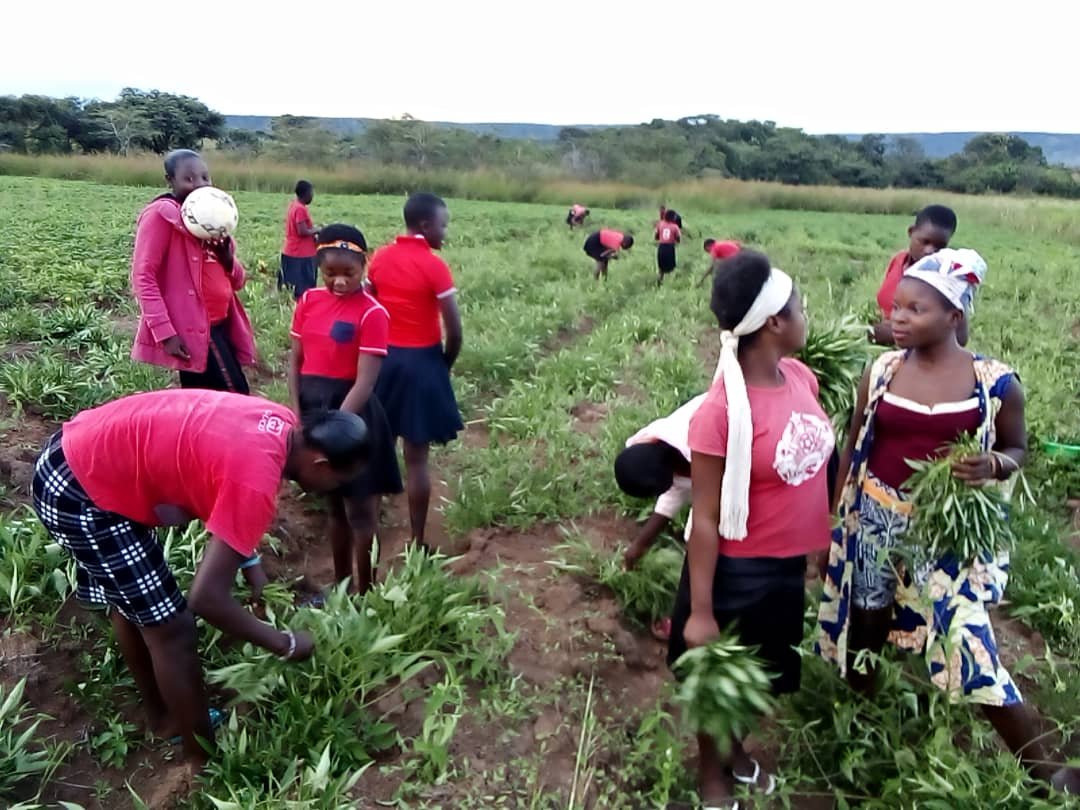
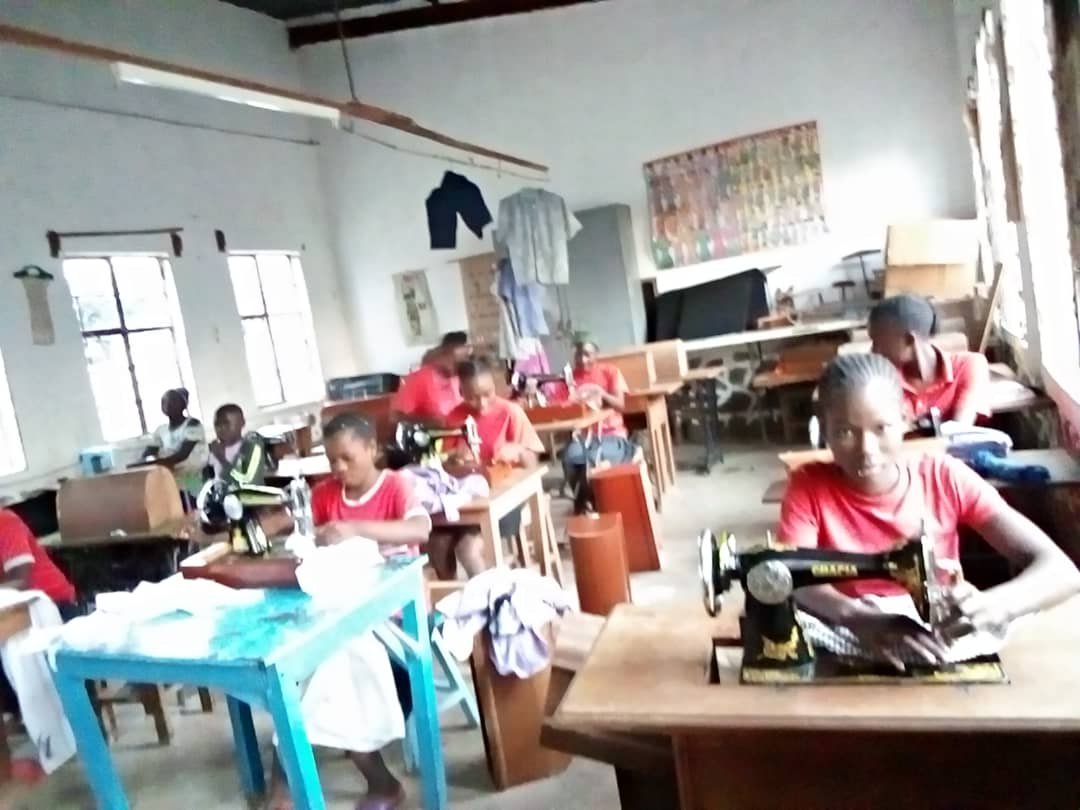
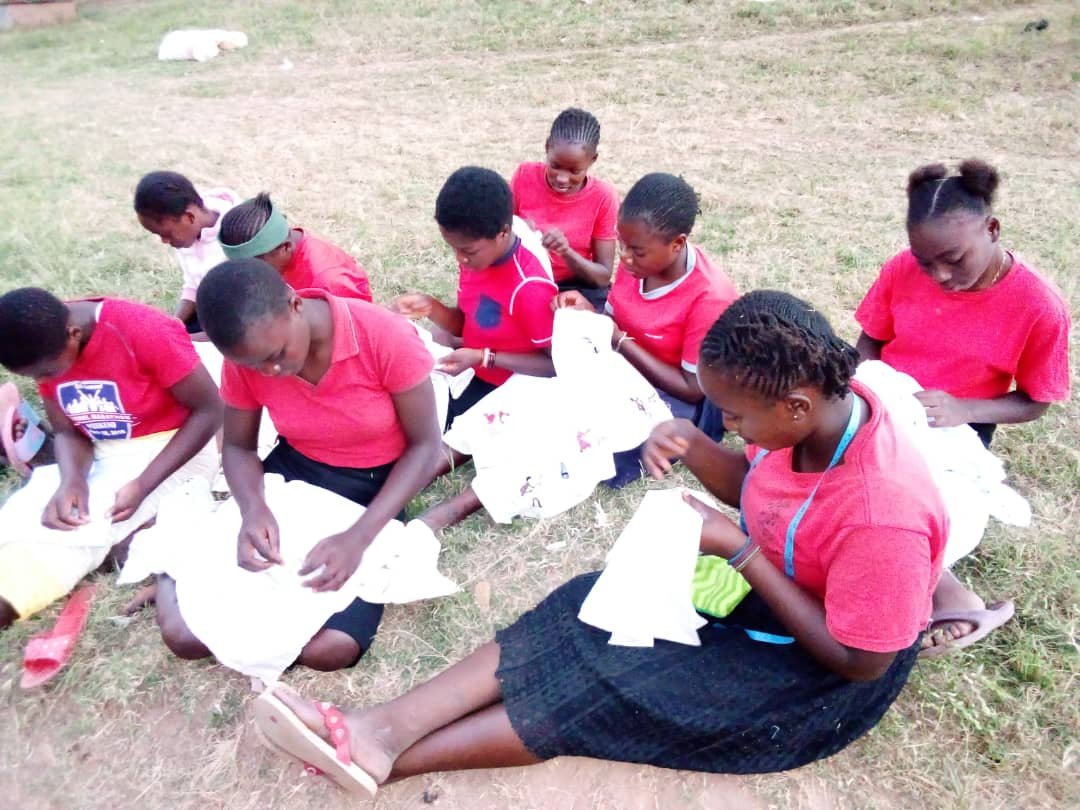
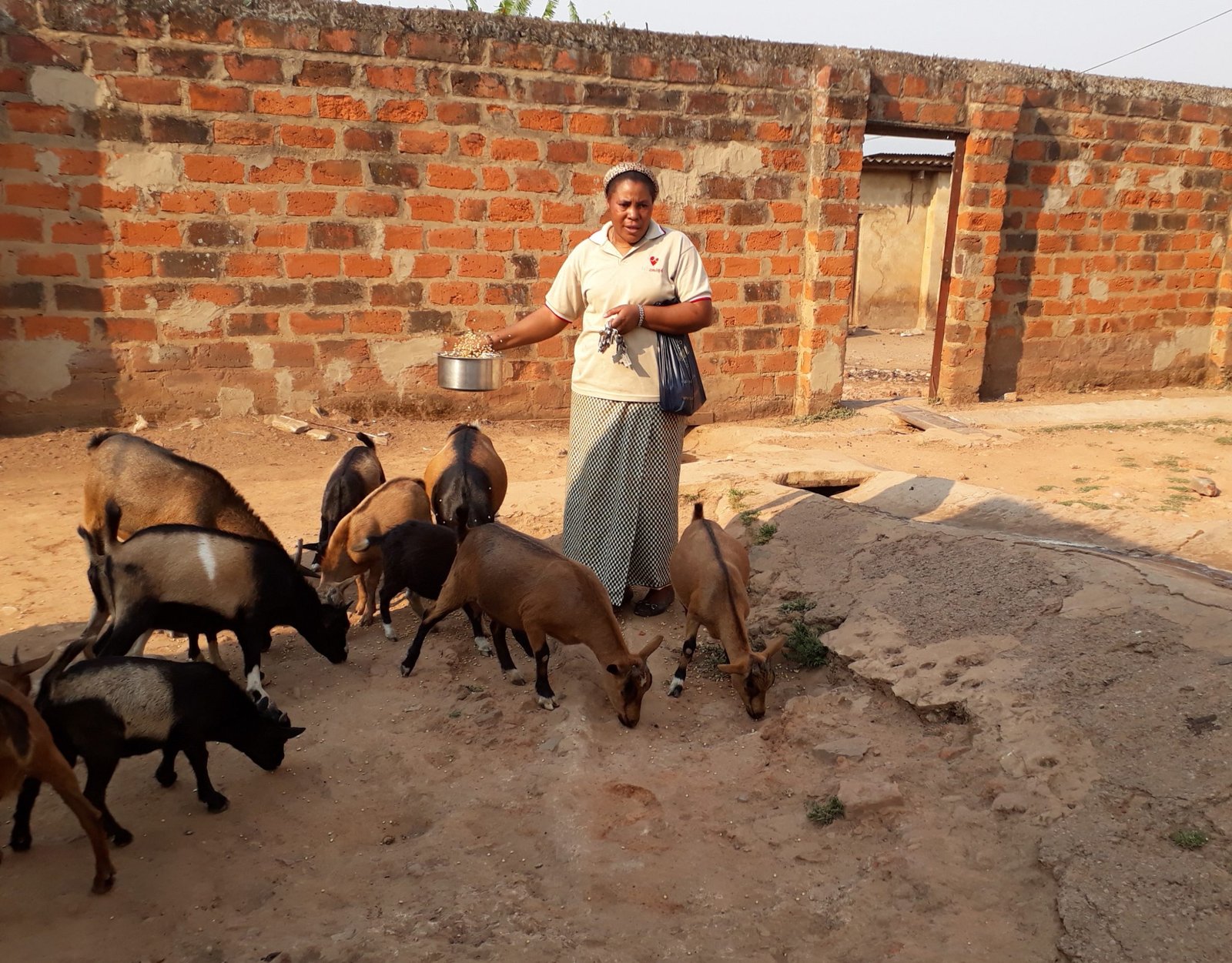
In the Kinzala foyer we have encourages the young woman to be the main agent of their training and, in addition to the literacy or basic general culture courses and secondary school studies, we initiate some of the young women in practical domestic economy. There are spaces to learn sewing and embroider and in a good extension of land belonging to the Foyer they cultivate (corn, beans, peanuts …) and raise animals (pigs, goats, chickens …), for their daily consumption  as well as means of financing support of the same  Foyer.

  • Literacy teaching and general culture. Although it is preferable that young women have finished primary school, we sometimes welcome some who are not able neither to read nor to write, since in many villages there are no schools. For those girls that become aware of the need to train themselves and show their will to learn, we provide an education appropriate for their reality and possibilities.
  • Agricultural work: Most of the girls cannot afford the boarding and school expenses in goods. For this reason, they cultivate the fields to cover their basic necessities; among others they cultivate corn, beans, peanuts and various kinds of vegetables that contribute to their daily diet.
  • Raising animals. The young women take turns in feeding the pigs, goats, chickens … and cleaning the rooms. The animals are consumed for food in the Foyer, but they are also a source of income because with the money they get from their sale they pay other common expenses, carry out different activities organized in support to the young girls’ own training and buy sewing materials. Everyone does it with enthusiasm and joy.
  • Sewing and embroidery workshops. Once they arrive to the Foyer, the young women that have not completed primary school are provided literacy and general culture courses, as we mentioned before, and also practical training; they learn to sew and embroider and that offers them the possibility to start a little trade that later will serve them in their origin places. The tablecloths, dresses, bags and whatever they produce, are for sale and what they get is an income for the Foyer and it contributes to buy new cloth and materials.

During all the years of its existence, a quite high number of young women have passed through the Kinzala foyer and they have learned from the life and for the life. The lack of financial resources has never restrained the desire to train themselves in order to help the others. These women have been responsible leaders in their villages and society; they have formed stable families and have shared with other women what they had learned with the sweat of their brow and through the work of their hands …That is for them a lived experience of self-sustainability that continues to help them to raise their families, putting into practice the popular adage: «Help yourself and the heaven will help you.»

Education is a right but, at the same time, it is a privilege to experiment that we ourselves are tracing our own learning path, valuing the training price. The person who strives to make his training possible is an entrepreneur and is able to adapt to the reality of society, always looking for alternatives allowing him to get out of many situations in which he feels abandoned to his destiny. To achieve that, in the Kinzala Foyer, awareness is a vital tool that helps the young woman to become aware of her reality and to involve herself participating fully in all the proposed activities.

We thank God who accompanies his sons and daughters at all times. All is grace!

VIRGINIE KAZADI TSHILANDA, TC

Categorías
Artículos

Beyond popular religiosity: Mary, queen of Poland

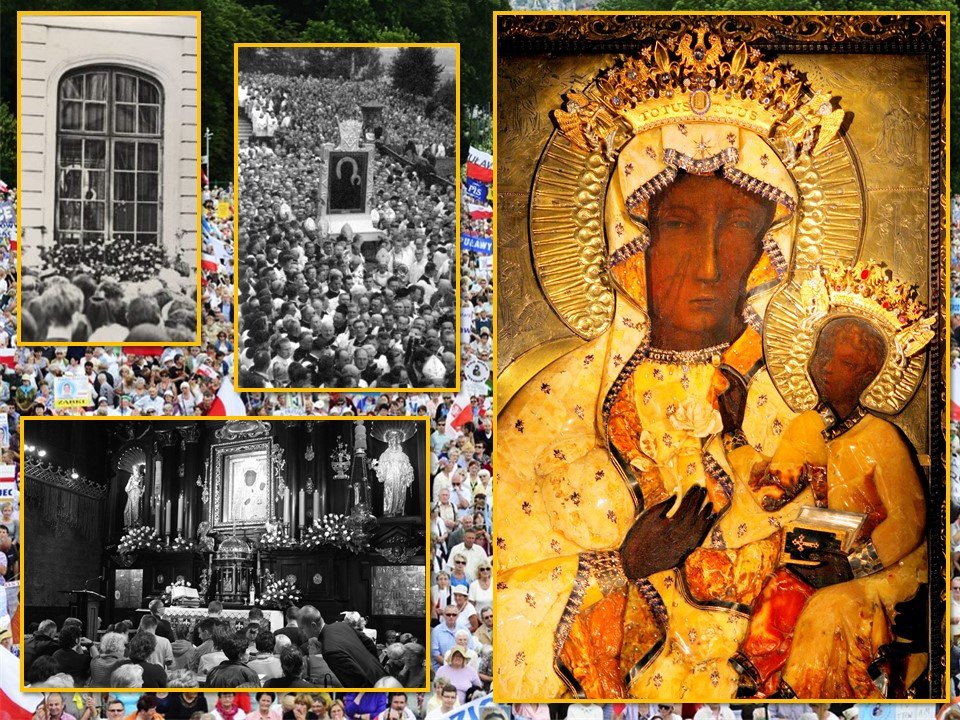
When I reflect about my experience of God, my first memories are the traditional Sunday Eucharist with my parents and brothers. Once the Mass was over, my father led us by the hand in front of the image of the Mother of God (in Poland we call Mary  so, rather than «the Virgin»), the Black Madonna, Mother of God of Częstochowa, Queen of Poland, with her serious face and two wounds on her cheek. I remember that, as a child, I did not know why we were kneeling before this somber and majestic image, but it seems that this was not bothering Maria: she does always know why she looks at us pointing to her Son. I am Sr. Alicja Grzywocz, Tertiary Capuchin, Polish, and I have the pleasure to share with you some “brush strokes” about Mary’s experience as Queen of Poland.

Even though from Rome to Gniezno – the first Poland capital – there are a little more than 1500 km, the Christian faith took almost a thousand years to reach these Slavic lands. Our prince Mieszko I was baptized in the year 966 and the first church he ordered to build was dedicated to the Assumption of the Virgin Mary. To this day, the Gniezno Cathedral – that below its walls hides the ruins of that first church – is called «mother of the churches of Poland». A very fruitful mother from whom her children have inherited a very special veneration for the Mother of God.

The first hymn of our country was a prayer sung to the Virgin Mary. With her and with the name of Mary on their lips, the Polish army began its battles that – among other reasons, due to its geographical location in the center of Europe – have been very numerous  throughout our history. It was in the XVII century –  lso in the context of a war – that the King of Poland crowned the Mother of God, naming her Queen of Poland. The curious thing is that almost 50 years before, the Virgin herself requested to be called so. The story tells that an Italian Jesuit praying in Naples, saw Mary dressed as a Queen and holding the Child Jesus in her arms. The Jesuit wanted to hail the Virgin with a title with which she had not yet been venerated by anyone. Our Lady took the initiative and told him: “Why don’t you call me Queen of Poland? I love this kingdom and I am going to do great things for it, because a peculiar love for me burns within its children». The Jesuits – after carefully examining this apparition and having received from the Church the confirmation of its authenticity – informed our king, who liked to welcome the before mentioned Jesuit, that walked to Poland, the Kingdom of the Virgin Mary. At the top of the tower of the Church of the Assumption, in the main square of Krakow (at that time, the capital of Poland), it was placed a crown as a sign of acceptance of this request of the Virgin.

The most desired moment of the coronation did not occur until after the invasion of Poland by Sweden and Russia (known as the «Swedish flood»). A key moment in this war was the miraculous defense of the Jasna Góra (Clear Mountain) monastery in Częstochowa, where the icon of the Black Madonna was worshiped. The chronicles tell that a very limited group of soldiers, after having spent the night in prayer before the icon of the Mother of God, defended Jasna Góra because She was fighting with them against a much stronger army. Other cities, after hearing the news, went back to the battle with a renewed spirit, well knowing that the Virgin was on their side. The victory in Jasna Góra and finally in the whole Poland, inspired King John Casimir to crown the Virgin as Queen of Poland and to pronounce her vows on behalf of his entire kingdom. The celebration took place in Lviv (now belonging to Ukraine, but then to Poland) in the year 1656.

This one was not the only time that Mary has been crowned Queen of Poland: this fact has been repeated more than 50 times, renewing, in different historical moments, the commitment that that entails. A few years after Poland had regained independence (1918) and once ended the II World War II, two very significant jubilees took place: in the year 1956 the 300th anniversary of the vows of John Casimir and of the coronation of the Virgin as Queen of Poland and, in the year 1966, the 1000 years of the baptism of Poland. Cardinal Stefan Wyszynski (a close friend of John Paul II and whose beatification will be next June) proclaimed novenas in preparation for these jubilees. In 1956 the whole nation renewed its vows before the image of the Mother of God of Czestochowa and began the preparation for the Millennium Jubilee of Baptism: one of the realized initiatives was the pilgrimage of a copy of the image of the Black Madonna of Czestochowa through the parishes of Poland.

I have heard many people speaking about that pilgrimage and although I did not live it because of my age, I can perceive the importance of this event in Poland. The context was very unfavorable since the communist government was striving to make all the possible to stifle the faith in Poland. During 9 years they observed the pilgrimage of the icon of the Virgin that every 24 hours changed parish. People were decorating their houses and streets to welcome the Black Madonna, the crowd was praying day and night before the image … The communists saw that all their efforts to weaken the faith were in vain, since the pilgrimage of the Mother of God of Częstochowa was awaking a very special strength in everyone. Finally, they decided to arrest the Virgin … In the 1966, a few days before the celebration of the millennium of the baptism of Poland, under the pretext of controlling the vehicle where the icon was transported, they seized it and took the image to the Warsaw Cathedral, preventing its passage through the parishes that were still waiting to receive their Queen.  After the jubilee they put the image at the window of the sacristy, secured with bars, and forbade to continue the pilgrimage; although that, people tried again to continue the pilgrimage but, once again, the communists took the image and brought it to Częstochowa, where it remained during 8 years strongly protected behind bars and under military surveillance.

Surprisingly, during these 8 years the pilgrimage took an even greater strength: what was carried from one parish to another was … an empty frame. People continued to decorate the houses and streets of their villages, the churches were full of people and everyone was praying before the empty frame of the image of their “imprisoned” and safeguarded Queen. The message is very clear: faith makes us free and there is no way to imprison it; the Polish people gathered before the empty frame of the icon of the Black Madonna, pointed out whom they wanted to serve and to whom their heart was belonging.

The Czestochowa monastery is still one of the most important places in Poland. Every year something like 250,000 people leave their towns and cities and walk to the Black Madonna. The oldest pilgrimage will soon turn 400 years of tradition. For some of them, it is more than 600 km on foot. For those who live «on the way» to Czestochowa it is a pilgrimage of hospitality: during the months of July and August they keep the doors of their houses open to host free pilgrims who come to present their intentions and to ask the blessing of the Queen and others, in front of their houses, set tables with water, sweets, bread … to comfort the pilgrims.

Why is it so popular the Virgin of Częstochowa and not any other else image among many other miraculous representations of Mary that are in Poland? Perhaps, the people so many times wounded by wars and other evils, see in the sad face and scared face of the Black Madonna, a Queen able to of understand and share their suffering … Perhaps, looking at this icon, they remember the victorious battle despite the magnitude of the enemy and regain hope in their daily fights Or perhaps, the Mother of God holding the Child Jesus in her arms, inspires them a most simple and trusting prayer: “Madonna, Black Madonna, how it is good to be your son; let me, Black Madonna, hide in your arms ”, as one of the songs says.

Every day at 9:00 p.m. before the icon of the Queen of Poland in Częstochowa, but also in thousands of families who spiritually join with Jasna Góra from their homes, people pray «Apel Jasnogórski» – «Appeal of the Clear Mountain ”. It is a prayer to present to the Queen what they have lived during the day and to beg her blessing upon the night and the following day; it usually ends with a sung prayer: «Mary, Queen of Poland, I am with you, I remember, I watch over». The last time in which I was able to experience that in Czestochowa, after a walk of 100 km from my birth parish to Jasna Góra I understood that, may be, more than saying we: «I am with you, I remember, I watch over», as polish people, it is our Queen who tells us that. Her presence in Poland is “breathed” at every step and at no time She has forgotten this people that she herself chose to be her Queen and, like every Mother, day and night, she keeps watch and cares for her sons and daughters.

Wherever you are, sooner or later, you will surely come across the image of the Black Madonna, Queen of Poland, since her people have always carried her with them… Pray to her also like us: “Madonna, Black Madonna, how good it is to be your son Let me, Black Madonna, hide myself in your arms”. And I hope you hear in your heart her response: «I am with you, I remember, I watch over….»

ALICJA GRZYWOCZ, TC

Categorías
Artículos

In the family … Joyful in the Lord

Two months have already passed since the beginning of the “Amoris laetitia family” Year, an initiative accepted with enthusiasm everywhere in the world and we like to turn our gaze to our family life experiences. We discover that we have lived very happy moments allowing us to enjoy the work, the rest and the meetings … we have learned also to be cheerful in the midst of difficulties. One to the other, we pass that joy and our open heart as source of happiness because “there is more joy in giving than in receiving” (cf. Acts 20,35). That is exactly what the Year of the Family intends: to help us to grow in the joy of loving and to be missionaries of joy; that at the end of this Year dedicated to the family, may we be grown in the joy that is fruit of the true love.

We also recognize that, in some moments, sadness has invaded us and we have transmitted in the environment our negativism and lack of integrity and we have almost caused family breakups. “Conflict cannot be ignored or concealed. It has to be faced. But if we remain trapped in conflict, we lose our perspective, our horizons shrink and reality itself begins to fall apart” (cf. EG 226).

Let us today enter barefoot into our reality, because it is sacred land (cf. Ex 3,5), always keeping our gaze fixed on God who is joyful. This joyful God dwells in us.

God makes happy our hearts: «You have given to my heart more joy than when they abound with wheat and new wine» (cf. Ps 4,7). Joy is born in the heart of God; He is neither sad nor melancholic and therefore, those who love God experience his same feelings and rejoice with Him , “But joy for all who take refuge in you, endless songs of gladness! You shelter them, they rejoice in you, those who love your name” (cf. Ps. 5,11).

God rejoices in his creation and God’s creation reflects the joy of its Creator: “Desert pastures blossom, and mountains celebrate” (cf. Ps. 65,12). The Word of God invites us to join and rejoice with it and to sing joyfully, raising our voices and clapping: «Sing joyfully to the Lord, all the earth» (cf. Ps 95,1).

As a part of that creation, we also rejoice: “With all my heart, I will praise the Lord; let all those who are helpless, listen and be glad.” (cf. Ps 34,2), “Praise the mighty rock where we are safe” (Ps 95,1). With Jesus, joy is always born and reborn in us and we are set free from sin, sorrow, inner emptiness and loneliness (cf. EG 1). Saint Paul VI told us: “No one is excluded from the joy brought by the Lord” (cf. Exhort. Apost. Gaudete in Domino 22).

The great danger in today’s world, pervaded as it is by consumerism, is the desolation and anguish born of a complacent yet covetous heart, […] where there is no longer room for others […]  God’s voice is no longer heard, the quiet joy of his love is no longer felt”(cf. EG 2).

“Shout praises to the Lord, everyone on this earth” (Ps. 100,1). That is a personal and family matter.

In our common home the wounded and abused nature, lives the human family, the family of humanity, a family of a broader level that also within itself, receives wounds that tear and disjoin it. That is why “The urgent challenge to protect our common home includes a concern to bring the whole human family together to seek a sustainable and integral development” (cf. LS 13).

The best ecological practices require the cooperation of all and of each member of the family. The excessive consumerism affecting us today is an important cause of the high environmental pollution we all are complaining of, without thinking that each one of us contaminates individually himself and does not take into consideration the family, group and social consequences of our personal and common choices.

Every year, the UN invites us, on the International Family Day, May 15th, to deepen one of the sustainable development goals. This year 2021 the theme is goal no. 13: “Take urgent action to combat climate change, focusing on families and family policies to adopt urgent measures to combat climate change and its effects”.

The UN invites us to pay attention, among others, to the following goals:

  • To improve education, awareness and human and institutional capacity, in order to mitigate the effects of this climate change.
  • To strengthen resilience and adaptive capacity to risks related to climate and natural disasters, in the different countries.

Our assignments could be: To consume only what is necessary, to enjoy the outdoors, free spaces and ornamental plants, to keep clean and welcoming the spaces of our house since we deserve clean places where we like to stay, to use what is necessary because, maybe, we have things that someone else needs.

In short, let’s keep what we have in such a way that it may be useful and delighting to us; at the same time, let us make the others feeling well. Do you like to be up for it?  I am up for it and I invite you to do the same.

What is left to us, is to carry out actions in order to face this challenge as a family, dragging our neighbors to do the same; through that, we’ll build families happy in their daily love and enjoying the space where we live. Neighbors too will feel well; Pope Francis invites us to be good neighbors “[…] the sense of neighborhood [where] each person quite spontaneously perceives a duty to accompany and help his or her neighbor […] where these community values are maintained, people experience a closeness marked by gratitude, solidarity and reciprocity. The neighborhood gives them a sense of shared identity” (cf. FT 152).

This same month of May we celebrate Pentecost. We need the Holy Spirit’s warmth and fire for the transformation of families. He works in us and helps us to carry out our tasks and this is the experience of many praying people in whom a different life pulsates and whose gaze sees beyond; that could be granted to us too.

The first task of Christians is precisely to keep alive the flame that Jesus brought to the earth (cf. Lk 12:49); and what is this flame? It is love. Without the fire of the Spirit, sorrow supplants joy, routine substitutes love, service turns into slavery. The Holy Spirit makes us to experience the moving joy of being loved by God (Pope Francis Catechesis, March 17, 2021). And whoever feels loved, loves and loves with joy.

HNA. BERTA MARÍA PORRAS FALLAS, TC

Categorías
Artículos

Biodiversity

Origin of the concept of «Biodiversity» and its commemoration on May 22nd

“The care of creation is not only due to practical reasons such as a responsibility towards the future generations;  its deepest reasons are theological. The creation is a  work of the Holy Spirit and cannot be destroyed without offending its Author” (P. Raniero Cantalamessa OFMCap)

The topic that concerns us today is «Biodiversity«, an expression originated in a scientific environment, but that quickly awakens interest in philosophical, social, political, economic and religious fields and in people interested in the conservation of biological diversity because they fear the irreversible harm of natural environments, endangering the basis of the human existence.

The UN seeks solutions and in the United Nations Scientific Conference in New York (1949); it  deals with the theme «Conservation and use of resources» but its interest is focused on the adaptation of natural resources to the requirements of the economic and social development, without taking care of its conservation.

The first summit about the earth takes place at the «Stockholm Conference on the human environment» (1972). It sets out the need to preserve the land, flora, fauna, and natural ecosystems, avoiding their depletion and taking into account the benefit of present and future generations. In its statement, it exposes the principles for the conservation of the human surroundings, makes recommendations for international environmental action, and warns governments that they must take the necessary actions to control activities that may cause an atmospheric damage and their consequences on the climate. To fulfill its declaration, it creates the United Nations Environment Program UNEP, the largest environmental authority in the world.

The concept of biodiversity is the result of several studies carried out by Thomas Lovejoy (1980) President of the Biodiversity Centro of Amazonia, university professor and principal member of the UN Foundation and Norse and McManus (1996); in their studies they use the expression “biological diversity” referring to the variety of species, including genetic and ecosystem diversity. In the National Forum on Biological Diversity, held in Washington, Walter G. Rosen (1985), is the person who, for the first time, when he is talking about the variety of life on earth, at all levels, from genetics to different biomes, he uses the expression “biodiversity”. So, this expression becomes popular in the report of the event, published by Edward O. Wilson, professor at Harvard University.

The Convention on Biological Diversity held in Rio (1992) is based on these studies and deepens in the problems related with the production of toxic and polluting materials as well as of clean energy and of the drinking water. He synthesizes the concept of «Biological Diversity» as the variability of living organisms from any source, including terrestrial and marine ecosystems, other aquatic ecosystems and the ecological complexes they are part of. One of its greatest achievements is the Convention on biological diversity, which makes the issue of biodiversity becoming part of the political agendas of the signatory countries and not only concerning development but also in the environmental care, considering that the biodiversity future depends on both biological and sociocultural processes. This Convention is an international and juridical binding treaty, whose text is approved on May the 22nd 1992.

On the other hand, the Millennium Summit, gathers in September 2000, at the UN headquarters in New York, to approve the Millennium Declaration and eight objectives to work out until the year 2015 as UN values: peace, security, and disarmament; eradication of poverty; protection of the common environment; human rights; democracy and good government; protection of vulnerable people; attention to the needs of Africa and UN strengthening.

At this summit, to commemorate the day when the Convention on Biological Diversity was approved, the United Nations, on December 20th 2000, declares May 22, the World Biodiversity Day; its purpose is to propagate the meaning and value of biological diversity (species and ecosystems) in human life. This date is designated as an opportunity to sensitize governments, media and people in general, about problems of common interest that are still unresolved and to require the implementation of concrete political actions.

Many are the achievements of the Convention on Biological Diversity, in the different summits: in Nagoya (2015), the Strategic Plan for the Decade 2011-2020, in Cancun (2016) the United Nations Environment Program, in Kunmimg (2021) the Summit of climate adaptation and its efforts to end COVID 19.

There are still outstanding debts with the planet; since if the ecosystem is damaged, it cannot offer the expected well-being and zoonotic epidemics related to some ecosystem diseases, appear. Biodiversity is in danger and it is everyone’s obligation to protect it, making an aware use of its resources and generating protection measures well knowing that, every day, we received from it innumerable and often unperceived benefits. Among them we mention the following ones.

Bees and hummingbirds pollinate the planet: plant plants that produce flowers for their food. Forests regulate temperature and plants generate oxygen: plant trees that will generate oxygen and your environment will be cooler. Reefs are home to a quarter of the marine species and protect the coasts from waves, storms and tsunamis; take care of the coasts and beaches, avoid disposable products of polystyrene or plastic. Mangroves capture carbon dioxide: protect them if you have the privilege of living near them.

Thank you.

LIGIA INÉS PÉREZ ARANGO, TC