Categorías
Últimas Noticias

Closing of the month of ongoing formation

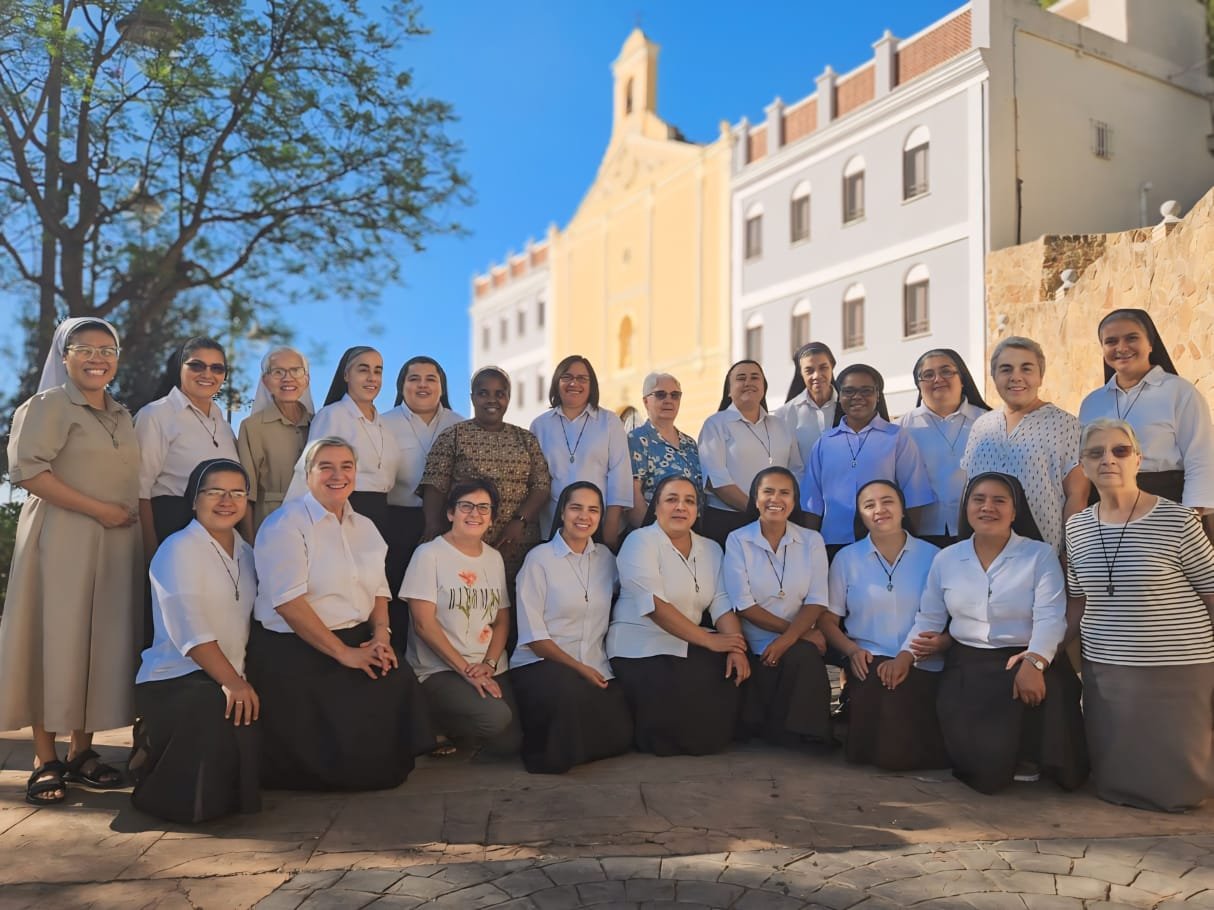
After visiting, from our General Curia in Rome, the Franciscan and ecclesial places, twenty-three sisters of twelve nationalities participated in the month of congregational spirituality from June 1 to 30, in the Sanctuary House of Our Lady of Montiel, accompanied by Sr. Isabel Valdizán and Fanny Londoño, delegates of the General Government and members of the General Formation Team. This space has allowed them to deepen in the Final Document of the XXIII General Chapter «Together we go forward, we generate and care for life» in its various nuclei, all of which refer to care.

During this month, our Sisters coming from different countries and provinces received formation and accompaniment from our Sisters: Estela Aldave, Medrano, Inmaculada Sancho Fabra, Amparo Alejos Morán, Bozena Orlowska, Isabel Valdizan Valledor and Fanny Londoño Sosa, Capuchin Tertiaries.

In addition to the participation of Professor Alfonso López Fando, Father Jaime Rey Escapa, Ofm. Antonia López Arroyo, Religious Adorer.

In the last week of the Exercises and with the same «thread» of CARE, Margarita Saldaña Mostajo, Consecrated Laywoman of the Family of Charles de Foucauld, accompanied the group.

We thank the Lord and the Congregation for this time of grace and we hope to return to each Demarcation to our Sisters as witnesses and heralds of so much good received, in turn we thank the efforts of the General Government and our Sisters Isabel and Fanny in the mission entrusted.

Categorías
Últimas Noticias

Lights of Love and Compassion: Celebrating 75 Years of service and religious surrender in Argentina

What are we celebrating ?

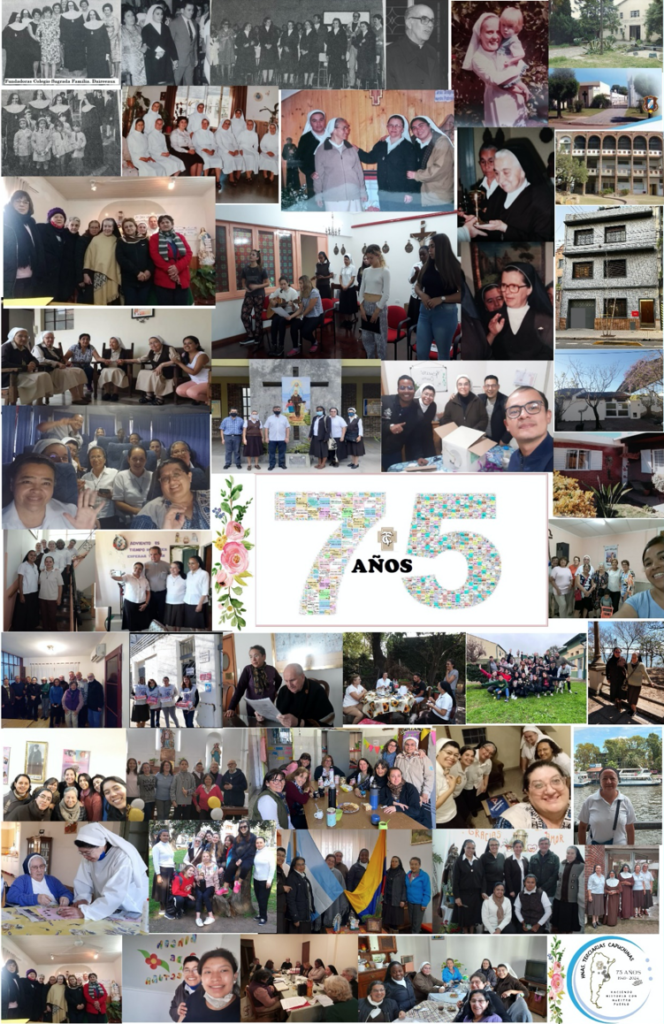
«Here we are Lord… bringing to your presence 75 years of life, history and mission of the Congregation of the Capuchin Tertiary Sisters of the Holy Family, in our land Argentina.

It was in June 1949 when Sisters Concepción de Linares, María Jesús de Elzaburu, Juliana Azcárate, Catalina Lizoain, Julia Fernández and María Luisa Antón… flooded the landscape of Santa María de los Buenos Aires with Amigonian light and assumed the first mission in our country.  So much courage, so much bravery, so much ardor could only come from the strength of your Spirit, from the maternal impulse of the Mother, Our Lady of Luján and from the missionary dynamism that they had imbibed from Father Luis Amigó» (Br. Dora Arboleda TC).


As we commemorate 75 years of religious presence in Argentina, we celebrate the legacy of the first sisters who impregnated every corner of this land with their Franciscan Amigonian charism. Throughout these seven and a half decades, the apostolic works carried out have been truly historic, marking the lives of countless people and leaving an indelible mark on society.

Every page of this history has been written with the unwavering love of those sisters who have given their lives in service to the proclamation of God’s love. Every work, every gesture of kindness, every word of comfort has been like ink imprinted in the hearts of those who have been touched by their tireless work and unwavering devotion.

The places that have been blessed with the presence of different Sisters and those that continue today are full of living testimonies, people whose lives have been transformed by the love and dedication of those who have been instruments of divine grace. Every smile, every hug, every act of compassion has been a seed of hope sown in fertile ground, bearing fruits of love and solidarity.

On this anniversary, we raise our voices in gratitude for the sacrifice and dedication of each sister who has been light in the midst of darkness, hope in the midst of despair and love in the midst of pain. May their legacy live on for generations to come, inspiring others to follow their example of selfless service and unconditional love.

May the flame of faith and charity lit by our Congregation continue to burn brightly, illuminating the path of those who seek comfort, hope and redemption. May the history of these 75 years of religious presence in Argentina be an eternal reminder of the transforming power of God’s love manifested through his son Jesus.

May the legacy of the Capuchin Tertiary Sisters of the Holy Family, whose love and dedication have deeply marked the history and soul of this country, live forever! May their example guide and inspire us to continue building a better world, full of compassion and fraternal love!

S. Cristher Arianny Mosquera M.

Categorías
Artículos

«Sowing Seeds of Change: Boy Scouts as Guardians of the Environment.»

Three loud whistles and to the cheerful cry of “Manada, manada”! And to the response of «Scouts be prepared!» the boys who make up the group of swains get ready to begin the afternoon program.

The Scout movement by nature emphasizes the values of our spirituality «Franciscan – Amigonian» since the patron of the movement is «Francis of Assisi» and a very important emblem for the «Pack» of Cub Scouts, is the metaphor that arises from the little flower of St. Francis and the wolf. While I was in Chiquimula I had the opportunity to activate the Scout Group #62 «Father Luis Amigó»; the movement provides the opportunity to give the formation of “Zagales” and Scout skills, making this a very meaningful experience for children and young people who participated in it.

A particularity of the movement is that it is a space where technologies are not used and where you can connect with nature and with you brothers and sisters , through games, challenges and adventure; a principle of the movement is that as a  leader of the movement you have to get involved in everything the children do, not as an onlooker or someone «who commands» but following the example of Jesus, someone who serves and gets involved, an aspect that is quite significant for the children; it is evident that it is a valuable experience for them in expressions such as: This is the best thing that has happened to my life! The sisters go first so I am encouraged to continue follow them! The children understand and internalize that the leader is the one who serves, the one who goes first and the one who makes an impact by giving  example.

The members of the scout movement, as well as those who are not part of it, receive touches of the movement’s philosophy, since the fact of activating a group like this impacts the entire educational community, making the students in general be fascinated by their natural environment, «fall in love with it», this through participation in the scouting activities. This is achieved through participation in camps, reforestation days, days of contemplation of nature in rural environments, and convivial gatherings where enjoyment and joy are undeniable, sowing in them the awareness that in nature the different dimensions of God are revealed to us.

To the children of the movement as to the young people of the school, we sow the seed and the conscience of the «change of chip» not doing activities for the sake of doing them but starting from the small, making them aware that all, scouts and non-scouts «We are called to leave the world better than how we found it» and convincing them from concrete and small actions as for example «I am the change I put down the garbage in its place» and when achieving this small but important action to continue with more complex actions as separating the types of waste.By organizing the students by grades to help the maintenance staff to check how the waste is separated and finding out how unpleasant it can be when it is not properly separated, they generate the awareness that every small or large action has a positive or negative impact on the common house.

With the significant learning that comes from the Scout philosophy combined with the Amigonian pedagogy, «ecological conversion» is progressively achieved and young people and children are able to export this knowledge at home and replicate the change.

I am currently in Totonicapán and i am making my way to reactivate the movement. I am in charge of JUVAM and while it is true that I encourage this spirit of encounter with nature and to raise awareness of the values of “Laudato Si”, little by little the ground is being prepared so that young people and children, together with teachers and the community of sisters, can go down the path of the process of «ecological conversion» and the progressive experience of an «Integral Ecology».

It is worth mentioning that both, the Colegio Sagrada Familia of Chiquimula City (where I had the opportunity to develop this experience) and the Colegio Pedro de Bethancourt in Totonicapán City ,have been recognized with the “Bandera Verde Ecológica” award granted by the Municipality of Guatemala City and the Chamber of Commerce of Guatemala, Both institutions are also working together with the Human Rights Office of the Archdiocese of Guatemala to deepen the «Laudato Si» and provide experiences that support and motivate this mission of «Sowing seeds of change in children and young people who become environment  keepers».

S. Sheny María Fajardo Méndez


Categorías
Artículos

“In Search of a Home: Challenges and Opportunities for Migrant Minorities”.

With a hopeful outlook, we contemplate the hopes and struggles of migrants who, since ancient times, throughout the length and breadth of planet Earth, have moved in search of new ways to live with dignity, overcoming scarcity and the social or political pressure they have had to face, achieving the meeting of peoples where new civilizations have arisen.

A very general overview of the statistics on migration in the world should serve to raise personal and social awareness of this phenomenon, which is not new but which is now becoming a social problem, and governments are debating whether to implement laws or close borders. There are more than 281 million migrants, including children, adolescents, women and men. Of these, 169 million are workers, according to statistics. In addition, 206 thousand people are trafficked, 43 million are refugees seeking asylum, 60 thousand are resettled refugees, 61 million are displaced by disasters, 71 million are displaced by conflict and violence, and 64 thousand have disappeared in their search for a home.

“Have mercy, God”, and the most admirable thing is that, despite their struggles and efforts, the remittances they send to their countries of origin, expanding the profits of national banks, are the largest in recent times: 860 billion dollars last year. This last figure demonstrates the courage, sacrifice and resilience of these people, who assume the consequences for love of life and home (Luis Donaldo González Pacheco, Mexico).

The search for safety and a better life drives every person to move. However, migrants face significant challenges, such as differences in land, language, idiosyncrasies and laws. Despite these difficulties, they find opportunities for work, food, shelter and, most importantly, security for themselves and their families. This reality affects all of humanity and should not lead to labor exploitation, slavery or the violation of their rights. Instead, it is essential to recognize and value the contributions that migrants make to the nations that welcome them, regardless of their origin.

González expands, in the context of salvation history, by reminding us of the displacements of God’s chosen people. Abraham and Jacob left their lands and died far from them, following what God had asked of them, and thus forged a history in motion as part of the divine project. In the New Testament, Jesus and his parents also had to migrate to Egypt to protect their lives, facing circumstances similar to those of many people migrating today.

No human being moves for no reason; behind every person there is a story that begins the moment he or she decides to seek a better life. This is the principle that drives every man or woman to leave their homeland. The challenges mentioned above become obstacles, but the love of life gives them the power to face them. These challenges form their heart in humility, fortitude and perseverance, reminding us that only those who love are capable of enduring rejection, mistreatment, insults and abandonment in order to reach their goal.

Numerous experiences are shared in social networks and magazines that are dedicated to not forgetting the stories of empowerment that many migrants around the world have achieved. Their socio-cultural contributions to host communities include increasing food diversity, creating new music and sporting achievements. A Honduran migrant opened a restaurant, bringing the cuisine of his home country to the Mexican culinary scene. A Venezuelan migrant created an orchestra in the Dominican Republic to share his music with the youth of his community. In 2019, Emmanuel Iwe, an 18-year-old Nigerian soccer player, signed a contract with Deportivo Saprissa, a Costa Rican soccer club. These are just a few of the many stories that represent the diverse contributions of migrants (IOM, regional office for migrants).

Every search implies leaving, leaving, moving forward, taking on and facing the new that adventure brings. As the biblical text says: “He who seeks, finds”. But to get there, it is necessary to face and overcome challenges, with the hope and illusion of settling down and starting a new life. Migrants express their desire to return to their land of origin, facing new challenges with the security of a job, a house and daily bread, and always with an eye on those who stayed behind.

S. Edelma Toruño Reyes


Categorías
Artículos

Connected and Committed: «Youth Communication through Social Networks»

In the bustling environment of a high school classroom, I often observe a phenomenon as subtle as it is revealing: young people, each seemingly immersed in the screen of their mobile phone. While checking their latest notifications, commenting on a new post, or quickly responding to a message, they await my first instruction of the class, «put away your devices.» And in that unsettling dynamic, a spontaneous conversation arises with a young person who manages to shift my preconceived ideas before they can settle into my repertoire of recurrent complaints. “Sister, there is something in the consecrated life that attracts me: it’s seeing them live fully!” Her words allowed me to discern two certainties that become a prelude to this article: on the one hand, young people see beyond the apparent, and on the other, they are in search of depth, not superficiality as we often believe. Each class makes me think that, in the face of youth communication through social networks, there are barriers we need to overcome together with them:

Moving from «surfing» interactivity to the depth of words: Social networks are a wide-open window to the most populated continent in the world, where responses are instant, attractive, anonymous, interactive, and addictive, catering to all our appetites, even the darkest and most harmful ones. Faced with this reality, today’s youth question with greater awareness that commitment cannot arise from content that disappears with a scroll, but rather from the beauty of building their inner world, inspired by the Spirit, which moves the heart, guides to full truth, and when known, makes one wiser, firmer, and more human. But, as the saints teach us, an inner life is not understood if it does not lead to commitment: «not in saying many prayers, but in much loving» (St. Teresa). Therefore, it is necessary to create a culture of digital silence as an attractive path to reach others, through the depth of words and not through superficial interactivity.

Moving from the «myopia» of pragmatism to the insight of utopia: From a pragmatic perspective, what is tangible and immediate is more «pleasing.» «What works,» what produces practical and concrete results, and from this point of view, young people traversing the digital continent might disappoint us. Hence, it is worth finely highlighting the beauty of the utopian, of not getting trapped in the here and now to the point of losing sight of what we could be. Therefore, we need to learn to dream with young people, just as Christ did, launching into utopian visions of life. The insight of utopia is not about living in naiveties but about that capacity to dream, create, and aspire to much for ourselves and others as a first step that allows for a committed life that can restore to the Gospel that provocative force often lost in daily living. A utopia that moves us from the immediate, the useful, and tangible to evangelical ideals pointing toward a more humane future, and from there, the words of writer Eduardo Galeano make sense: “Utopia is on the horizon. I walk two steps, it moves two steps away and the horizon shifts ten steps further. So, what is the purpose of utopia? That’s it, it serves to walk.”

Moving from cyber hedonism to the proposal of asceticism: Young people daily receive a very deceptive “good news”: You can have it all, you can live it all, you can try it all, and there is always a way back! The happiness they receive is very much associated with success and pleasure (as a hedonistic imperative), and even the contemporary image of beauty is tremendously reduced to the physical, it is somehow the tyranny of Instagram. Therefore, it is worth announcing the Good News that does not stop putting the cross at the center of its proposal; in evangelical happiness, suffering and the capacity to renounce are included not as a limit but as a liberating force. It is not about saying that life is only suffering, but that in life there is suffering, and people who suffer are also happy, and there will be moments where delaying satisfaction will be healthy even for the soul, because we cannot abandon the idea that anything we want to last and take root will involve effort and sacrifice, and that is not bad, it is human. Therefore, we need to recover the value of asceticism as a way to order everything that disorders the good, beautiful, and true in us. This must be a valid proposal for the youth of our time because, unlike the world’s attractive «good news,» you can’t have it all! And whoever wants to sell us another idea will make us very unhappy because real life demands doses of sacrifice, renunciation, and only when we understand this dynamic will we live less frustrated, less incomplete, and certainly much more committed to ourselves and others. In the words of José María Rodríguez Olaizola (2014), we would say: The Gospel must be understood from its polarities. If you stick to one part, you mutilate it. An evangelical polarity is «death and resurrection»; the Gospel is not a mere cross. But, at the same time, the triumphalist discourse of resurrection without going through the concrete passion and the cross is a bucolic evasion. It’s both things. Let us not stop believing that young people are capable of overcoming these barriers and moving from the media attraction of social networks to a more connected and committed life.

Sr. Beatriz Iliana Quintero Pérez

Categorías
Artículos

“Ukraine. The scars of war and the road to recovery ”

When I was asked to write this article and share my experience about the war in Ukraine, my heart shrank and many memories flooded into my mind. To tell the truth, until a few years ago, I didn’t even know where Ukraine was on the European map. Today, this country is familiar to me, because of the many people I met during the moving experience I had in Poland, welcoming refugee families into our community; it is dear to me because I came to know it through its stories, which revealed to me a multiethnic people, having and cultivating linguistic and religious differences, united, however, by a single dream of independence; and, finally, I feel it close because of its faithful quest to achieve its own identity, as did so many other countries, including my own.

The cry of the Ukrainian people is a cry to be heard, understood and welcomed. It is the voice of a country, seeking to raise its eyes, to look beyond to find confidence in change and to discover a horizon of freedom. Through the stories of so many people, I learned that Ukraine is a beautiful, rich land, with sumptuous baroque, Byzantine cathedrals and medieval castles, as well as having avant-garde architecture and being the homeland of renowned personalities such as the famous engineer Igor Sikorskji, the brilliant computer scientist Max Levchin and many others such as the extraordinary pianist Vladimir Horowitz, Taras Shevchenco, Ukrainian hero and poet, etc.

Ukraine, as its own name defines it (U-craina), a borderland, between two worlds, an intermediate land, a country between the West and the East. In its name is written its history, its present and its future, which struggles to take shape, due to this senseless and intolerable war. A people that seeks to realize the desire to differentiate itself from its roots that have become chains and to realize the dream of fully living its national and identity feeling.

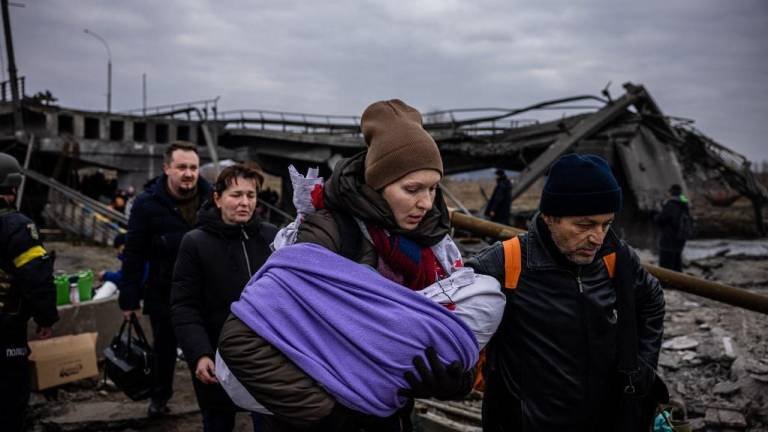
Today, after all this time, after the beginning of the war, which has not yet ended, we cannot speak of scars, but of wounds that continue to bleed with long-term negative effects on all aspects of life, health, environment, economy, work and development of the country. But there are invisible wounds, such as the traumas caused by the conflict, by living in the darkness of a shelter, the precariousness due to lack of food, water, heating, the fear of the sound of a siren or the wake left by a passing plane.

Waves of fear and terror that pierce the soul like daggers and seriously compromise the psycho-physical health, especially of children, the most vulnerable, leading them to withdraw into themselves and into social isolation, to have nightmares and panic attacks, to live in fear of losing their parents, friends and perhaps their future, as well as to grow up with the feeling of how fragile they may be.

The war has robbed them not only of their childhood, but also of the magic of dreaming and believing in dreams; it has opened chasms in their school careers, weakening their prospects for a bright future.

The conflict has also had a strong impact on the elderly, increasing the phenomenon of poverty and social isolation. A state of vulnerability further aggravated by the effect of immigration and the recruitment of young people. The war has been extremely violent for Ukraine, disrupting the labor market and causing a massive exodus, forcing more than a third of the population to move, taking refuge either within the country itself (about 7 million) or, as women and children, (about 8 million) abroad. The negative impact of the conflict has affected the financial situation of each and every family left without a livelihood.

In addition, the war has left deep wounds on the country’s natural landscape, with farmland particularly affected, contaminated and littered with mines, as well as burned forests and destroyed national parks. Important installations and industries were bombed, causing heavy air, water and soil pollution and exposing the inhabitants to toxic chemicals. Not to mention the electricity restrictions that have hampered the provision and delivery of health services, leading to an increase in pneumonia and respiratory diseases, also due to the country’s harsh winters.

But Ukraine is not just a wounded country, but a people that is finding the strength to heal even from something as ugly as war, because it carries in its heart the desire for freedom and the conviction that it can contribute to restoring a dignified life for all its inhabitants and dreams of a country in which no one’s dignity is discriminated against and trampled upon and in full respect for human rights and democracy, always and only the common good is sought, which guarantees security and the necessary conditions for dialogue and peaceful coexistence. It has many reasons to seek a solid and lasting renewal because it thirsts for fraternity and peace.

But with war we are all defeated, even those who do not participate in it. And a path of recovery is born from the depths of each person, who desires a peaceful coexistence and is committed to build it from the «battles» of every day. In fact, as Msgr. Vincenzo Paglia says in his book «Sperare dentro un mondo a pezzi» (Hope in a broken world), that to get out of the «broken world» it is necessary to know how to dialogue with everyone, to start from the last ones, to favor the encounter between different peoples to build a peaceful coexistence, opposing the tensions that lead to conflict. He writes that we must live by building fraternity, which is perhaps the word that best honors the art of gratuitousness and freedom; it can truly help us to be convinced that our responsibility to be builders of peace lies within ourselves. It speaks of peace, of war, of the last, of the elderly and immigrants, but above all, it makes us reflect on a new humanism that concerns globalized man.

For this reason, we are all involved in this path of recovery, from the leaders of nations, to the baker and the children, all involved in a path of mutual trust: trust between individuals, peoples and nations, to overcome conflicts and divisions. As Pope Francis exhorts, «let us hasten along paths of peace and fraternity.

Let us rejoice in the concrete signs of hope that come to us from so many countries, beginning with those who offer assistance and welcome to those fleeing war and poverty». In fact, we have all been protagonists of small or large gestures of solidarity towards the Ukrainian people, experiencing how the only antidote to war and despair is to unite people around good deeds and works towards those in need, above all, towards the most vulnerable, since this is precisely the criterion for the development of a society. Even if at this moment there seems to be no glimmer of hope for possible negotiations, we must never lose hope and we must keep alive the ideal of peace and trust in God. Courage!


Sr. Milena Prete, TC

Categorías
Últimas Noticias

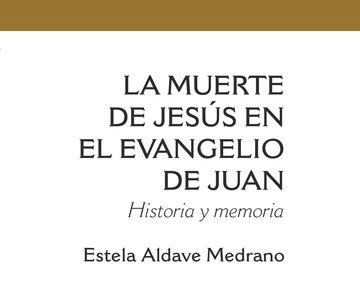
«The Death of Jesus in the Gospel of John». Sister Estela Aldave presents her new book.

«A few days ago, PPC Editorial published the latest book by Sister Estela Aldave tc, entitled «The Death of Jesus in the Gospel of John». This work offers a historical and theological perspective on the passion and death of Jesus, as presented in the Gospel of John. It highlights the originality of the Gospel in interpreting these events as an act of divine glorification and exaltation.

We, the Tertiary Capuchin Sisters of the Holy Family, express our heartfelt thanks to our Sister Estela Aldave for sharing her work on the passion and death of Jesus from the perspective of the Gospel of John. Her exegetical approach and her ability to interweave history with theology have provided an invaluable source of knowledge and reflection. The depth of his analysis and the clarity with which he presents the hermeneutics of the early Christian community will continue to enrich our understanding of these momentous events. This book not only forms, but also inspires, allowing us to contemplate the death of Jesus from the Joanic perspective.

In the April issue of Vida Nueva magazine, columnist Jaime Vázquez Allegue, has presented his literary and theological work as the recommended book of the month.

PRESENTATION OF THE BOOK.

According to Sister Estela Aldave, the Gospel of John does not seek to narrate the life of Jesus chronologically, but focuses on the memory and interpretations of the early Christian community. Despite this, historical elements can be identified in the narrative, such as the concern of the Jerusalem priestly aristocracy for the popularity of Jesus and his potential conflict with Roman power.

The book analyzes key moments such as the meeting of the Sanhedrin, the prayer in Gethsemane, and the trial and crucifixion of Jesus, highlighting Jesus’ peaceful and authoritative stance in the face of the violence of the authorities. Death on the cross, far from being a defeat, is presented as the hour of glory of the Son of God, a concept that is reinforced by the Resurrection.

The work concludes with a reflection on the relationship between the death of Jesus and the central message of the Gospel: the revelation of divine love and the promise of salvation. This analysis offers a new understanding of Jesus’ passion and death, inviting readers to see these events not as a tragic ending, but as the fulfillment of his redemptive mission.

The work is now on sale and can be purchased online or in bookstores in Spain.


Biography Sr. Estela Aldave Medrano

She was born in Logroño in 1974.

She holds a doctorate in Biblical Theology from the University of Deusto (2017). She took several courses in Jerusalem during the time of her degree in Biblical Theology, which she completed in 2008. His doctoral thesis was entitled «Death, Mourning and New Life in the Fourth Gospel. An exegetical study of Jn 11:1-12:11 in the light of ritual». She also holds a diploma in Social Work from the University of the Basque Country (1996).

She is currently a professor of different biblical subjects at the Regional Center of Theological Studies of Aragon (CRETA), in Zaragoza, and at the Faculty of Theology of Northern Spain, Vitoria-Gasteiz. She has been a member of the Board of Directors of the Association of Spanish Theologians (2013-2016). She is also a member of the Editorial Board of Reseña Bíblica and the Revista Aragonesa de Teología.

Categorías
Artículos

Capuchin Tertiary Sisters and lay people, walking together caring for and cultivating life.

To reread is to look at a document again, it is to return to its origin entering to the root of its intuitions, to listen and to see with depth its scope and utopias, it is to inhabit its content appropriating it, respecting the essential, to establish a dialogue between yesterday’s experience and today’s experience.

To turn our gaze to the Congregational Life Project «to care for and cultivate life» implies allowing ourselves to be led by the Spirit, to travel in his company along the itinerary marked by his Word and welcomed by the Capuchin Tertiary Sisters of the Holy Family, In the XXIII General Chapter of the year 2022, which gave rise to the final Document, «Together we go forward, we generate and care for life» and enter barefoot into the eight calls of God, with courage and commitment, to break into the novelty of the new stage of consolidation Time of «caring for and cultivating life». 

The Congregational Life Project embraces in itself a charismatic experience lived by «Francis of Assisi, the mystic and pilgrim who lived with simplicity in a wonderful harmony with God, with others, with nature and with himself (cf. Pope Francis, Laudato si no 10,»); the witnessing life of the poverello invites us to create home communities where everyone, sisters, Lay Amigonians and those who share the mission, have a place and the ability to care for and cultivate life in all its dimensions, it is there, in the unfathomable depths of fraternity where the various gestures that enrich human and fraternal relationships sprout, where one learns to stir the earth so that the germ that opens to existence, has deep roots and grows with the endearing strength to generate life, a life ready to guard, safeguard and protect the universe and in it all beings called to protect.

Throughout history, the Holy Spirit has invited the Church to be a tireless seeker of new paths and to live God’s Project in the mission entrusted to her, the proclamation of the Kingdom; Many men and women, consecrated and lay, aware of their responsibility and belonging to the «flock of God» (I Peter 5, 2), have joined this inspiration to be immediate collaborators in the processes of evangelization of peoples, the Amigonian Laity and those who share the mission with the Capuchin Tertiary Sisters, They have committed themselves to live the Christian life based on the charism bequeathed by Father Luis Amigó y Ferrer and today, they are called to join the Congregational Life Project «to care for and cultivate life» by sharing their own richness, which will later become a transforming force.

Caring for and nurturing life requires unified, coherent and mature people, unafraid of adversity and their vulnerability, resilient men and women with the inner disposition to adapt without complaint to the challenges of the journey, sisters and lay people who care for their own lives and those of others with the tenderness and compassion of the Good Samaritan, determined to enter barefoot into the depths of their being to encounter their own truth, to give thanks for the gifts received and to question those gestures that do not allow them to draw from the broken vessel the most genuine that the Father has placed in the heart of the human being.

The Congregational Project, «to care for and cultivate life», is not only a right of the Capuchin Tertiary Sisters of the Holy Family, but a duty, whose main objective is to involve the Lay Amigonians and those who share the mission in the construction of the common home, in whose interior the beauty of the beings that God has created and human life beats with its joys and hopes, its searches, fragilities and failures, cultural and economic inequalities, wisdom, charismatic and formative aspirations? All this is a revelation of the Spirit and a gift for those who, feeling in their being its creative power, follow in the footsteps of Luis Amigó and Ferrer and in synodality, walking together, make of their daily life a permanent care and cultivation of human existence, both at the personal and community level, as well as at the social level.

This is a permanent task, a praiseworthy mission, which can only be achieved when, in the quiet silence of daily life, one enters the sacred sanctuary of one’s interiority and encounters the surprising presence of the living God who reveals himself and speaks to the heart.

He who takes care of his interiority, connects with his roots and is capable of dialoguing the most intimate secrets with the One who has made of him a unique and singular creation, placed in the heart of the common home to safeguard human life, is clothed with love, to welcome with an equal, kind, affectionate treatment and a compassionate-merciful attitude typical of Francis of Assisi and Luis Amigó, women and men immersed in the immense universe, talented, innovative, ignorant and foolish people; old people and children forgotten and discarded to ensure their own interests; sick, poor, marginalized and excluded, little visible to the eyes of the world; young people tired and without sense of life. The Sisters, the Lay Amigonians and those who share the mission, are the ones summoned to surround with the tender embrace of love that brings closer, breaks the cold schemes and widens the bonds of fraternity.

All this supposes the ecological conversion that implies the loving awareness of not being disconnected from other creatures, of forming with the other beings of the universe a precious universal communion. For the believer, the world is not contemplated from the outside but from within, recognizing the bonds with which the Father has united us to all beings (Pope Francis, Laudato si no. 220).

The Capuchin Tertiary Sisters, seekers on the way, the Lay Amigonians and those who share the mission, committed to the Church and the Congregation, are the first invited to let themselves be infected and affected by this congregational commitment, being witnesses of the authentic and coherent living of the calls that God makes to walk together, to advance, to generate, to care for and to cultivate life.

Sr. Ana Tulia López Bedoya, tc

Province of Our Lady of Divine Providence

Categorías
Artículos

A transcendental proposal based on the family project from the perspective of the Capuchin Tertiary Sisters.

In the heart of contemporary society, where family dynamics evolve and transform, working with families emerges as an imperative need. From promoting emotional well-being to building inclusive communities, working with families is becoming increasingly relevant in the modern world. This article briefly outlines a proposal for accompanying today’s family from our spirituality, highlighting key principles and practices that can strengthen and nurture families on their spiritual journey.

The family, as a community of love and life, reflects God’s communion and loving relationship with humanity. From its origins, humanity was created with the capacity and responsibility to love and live in communion. The love lived within the Holy Family is so vital that St. John Paul II described it as an «efficacious sign of God’s love,» making it a sanctuary where life and love are intertwined. It is in the family that the first experience of love and relationship is forged, a fundamental learning place where meaningful relationships are developed and the ability to make free and wise choices is cultivated. It has therefore been given the title of «first school of humanity», essential for the development of society.

Here are some aspects where the proposal of accompaniment to families could be centered.

  1. Strengthening the relationship with God: Family accompaniment from the Franciscan Amigonian spirituality begins with the strengthening of the relationship with God in the bosom of the home. Like the Holy Family, families today can cultivate a life of prayer, worship and obedience to God’s will, establish times of family prayer, participate together in the sacramental life of the Church and seek to discern God’s will in family decisions.
  2. Healthy Family Relationships: The Holy Family teaches us the importance of fostering healthy family relationships based on love, respect and communion. Family accompaniment focuses on helping family members cultivate unity and mutual support, as well as addressing conflicts and challenges constructively, facilitating open and honest communication, promoting forgiveness and reconciliation, providing tools to resolve conflicts peacefully, fostering empathy, and promoting open and respectful dialogue between parents, children and other family members. As Pope Francis would say, «It is in the united family that children reach the maturity of their existence, living the meaningful and effective experience of gratuitous love, tenderness, reciprocal respect, mutual understanding, forgiveness and joy.»
  3. Supporting the stages of family life: Family accompaniment from the spirituality of the Holy Family recognizes that families go through various stages and transitions throughout life. This may include forming new families, raising children, caring for the elderly, and adapting to changes in family structure. Provide support and guidance at each of these stages, helping families discern how to live their faith authentically and meaningfully amidst the challenges and joys of family life.
  4. Promoting Solidarity and Service: The Holy Family challenges us to live Christian values through service and solidarity with others. Family accompaniment includes opportunities for families to engage together in works of charity and service to those in need, both within the community and beyond. This not only strengthens the social and community fabric, but also enriches the spiritual life of the family by putting into practice the commandment to love one’s neighbor.

In conclusion, family accompaniment from the spirituality of the Holy Family offers an integral and enriching approach to strengthen and nurture families in faith and in daily life, following the example of Venerable Luis Amigo from closeness, minority and simplicity.

Sr. Rosa Alix Fajardo Gómez, tc

Mother of the Good Shepherd Province

Categorías
Artículos

LECTIO DIVINA SECOND SUNDAY OF EASTER

MERCY SUNDAY

First Reading

A Reading from the Acts of the Apostles 4:32-35

The group of believers were of one heart and one soul.

Psalm

Ps. 117:2-4,16ab-18,22-24 R: Give thanks to the Lord, for he is good, for his mercy endures forever.

Second Reading

A reading from the first letter of the Apostle John 5:1-6

Who is he who overcomes the world but he who believes that Jesus is the Son of God?

A reading from the Holy Gospel according to John 20:19-31

Blessed are those who believe without seeing!

First Reading – Acts of the Apostles 4:32-35: In the reading from the Acts of the Apostles, we will hear that the early Christian communities were characterized by a spirit of communion and the practice of helping one another. The believers shared what they had, attended to the needs of the most vulnerable and lived in fraternal union, thus reflecting the values of the Kingdom of God proclaimed by Jesus, highlighting the importance of this community life as a testimony of the love of Christ in the midst of a society marked by inequality and injustice, we must take advantage of these strong gestures by which, more than by words, an authentic Christian is recognized.

The life of the first Christian communities was centered on the person of Jesus, on his message of love, mercy and the hope of his return. These fundamental aspects gave cohesion and meaning to community life, strengthening the faith and commitment of the first Christians.

Psalm – Psalm 117:2-4,16ab-18,22-24: In today’s Psalm, we are invited to give thanks to the Lord for his goodness and everlasting mercy. Let us remember that the Lord is good and his love endures forever. May this Psalm motivate us to praise the Lord with gratitude and joy in our hearts.

Second Reading – First Letter of John 5:1-6: In this passage, the Apostle John speaks to us about the importance of faith and love in the life of the believer. He begins by affirming that he who believes that Jesus is the Christ is the son of God. This belief in Jesus Christ as the Messiah is fundamental to Christian identity and to the relationship with God as Father.

John goes on to explain that loving God implies keeping his commandments, and that these commandments are not a heavy burden, but are the way to live in communion with God and with one’s brothers and sisters. Love for God is manifested in obedience to his commandments and in love for one’s neighbor, thus reflecting the relationship of sonship with God.

Gospel – John 20:19-31: In today’s Gospel, Jesus tells us: «Blessed are those who believe without having seen.»

In the Gospel of this Second Sunday of Easter, Mercy Sunday, the appearance of the risen Jesus to his disciples is recounted. This passage shows us different aspects of the experience of faith of the disciples after the resurrection of Jesus. But even more we will highlight the experience of Thomas in the encounter with Jesus who in the face of his uncertainties and distrust will respond with a merciful look that allows him to verify for himself the resurrection, Jesus, not without confronting his unbelief allows Thomas to touch, feel, see and feel to make the experience he needed in the encounter with Him, to purify his experience of faith.

LISTEN

In the first part of the passage, we see the disciples gathered in a place with the doors closed for fear of the Jews. Jesus appears in their midst and shows them his hands and his side, displaying the wounds of the crucifixion as signs of identification. This experience fills them with joy and infuses them with the Holy Spirit, sending them on a mission to forgive sins.

Thomas, one of the disciples, was not present at Jesus’ first appearance and expresses skepticism about the resurrection. Jesus appears again and invites him to touch his wounds, which leads Thomas to a profound confession of faith: «My Lord and my God!».

CONTEMPLATES

The name «Thomas» is a shortened form of the Aramaic name «Ta’oma,» meaning «twin.» In the Gospel of John, Thomas is also known as «Didymus», which is the Greek form of «twin».

From a biblical point of view the fact that Thomas is called «Didymus» or «twin» may have a symbolic or representative meaning in the context of the Gospel narrative. Some scholars suggest that this nickname may reflect the duality of Thomas’ faith: on the one hand, his unbelief and skepticism in the face of Jesus’ resurrection, as shown in John 20:24-25; and on the other hand, his profound confession of faith when he finally acknowledges Jesus as his Lord and his God, as recorded in John 20:28.

In any case, the designation «Didymus» or «twin» could also allude to the dual or ambivalent nature of Thomas’ personality, which oscillates between doubt and faith, between unbelief and confession of faith. This duality in the figure of Thomas can serve as a reminder for us believers to feel in some way identified with him in terms of our experience of faith that is sometimes so changeable and in need of certainties, but above all always understood by Jesus and lends itself to a personal experience of encounter with Him that transforms our gaze and allows us to confess Him as the Lord of our life. 

ASK YOURSELF

  • How do I identify with Thomas and how does his experience of encountering the Risen Jesus help me?
  • Does the resurrection have the transforming power it had in the lives of the disciples in my own life?

INVITATION

Let us allow ourselves to be invited by Pope Francis to concretize our believing experience like Thomas: «In the saving contact with the wounds of the Risen One, Thomas manifests his own wounds, his own wounds, his own lacerations, his own humiliation; in the mark of the nails he finds the decisive proof that he was loved, awaited, understood. He finds himself before a Messiah full of gentleness, mercy and tenderness. That was the Lord he was looking for, he, in the secret depths of his own being, because he had always known that he was like that. How many of us seek in the depths of our hearts to find Jesus, just as he is: sweet, merciful, tender! Because we know, deep down, that He is like that. Having rediscovered personal contact with the kindness and merciful patience of Christ, Thomas understands the profound meaning of his Resurrection and, intimately transformed, declares his full and total faith in him, exclaiming: «My Lord and my God» (v. 28). Beautiful, beautiful expression, this of Thomas! (Regina Coeli, April 12, 2015).

Sr. Sandra M. Velásquez Bedoya, tc