Categorías
Últimas Noticias

Diploma in minors protection

On January the 19th, almost at midnight, our sister Priscila Brenes Granados, arrived at Fiumicino airport in Rome. She will enrich the community of the General curia with her presence for several months.

Sr. Priscila is from Costa Rica and she belongs to “Our Lady of Guadalupe” Province but, during the last five years she has been carrying out her mission in Mexico, concretely in the community of Tabasco, working as a director in the “Oasis de Paz” Family Home where our Community receives, accompanies and trains unprotected girls whose rights have been violated.

The Province “Our Lady of Guadalupe”, through the CLAR (Latin American Conference of Religious), has been offered a scholarship for one Sister to get the “Diploma in Minors’ Protection”, granted by the “Center for Child Protection” in the Pontifical Gregorian University, in Rome. The course, is organized this time in Spanish, it will begin on February the 8th 2021 and will end about June the 15th 2021.

The objective of the Diploma is to promote the protection of minors at an academic and professional level, through a training program whose principles are, first the victims, from a Christian vision of the human being in his own culture and a multidisciplinary perspective, fed and inspired in the Christian spirituality and the Gospel.

Among the competencies and skills to be acquired there are the following:

  • To recognize the signs of abuse in the victims and of risk in the abusers.
  • To help and support the victims of abuse and the secondary victims.
  • To reflect about the spiritual and theological implications of abuse.
  • To include spirituality in the objectives and measures of protection.
  • To create protection networks in their countries, local churches, religious communities and other circles.
  • To help the Church leaders to appropriately handle complaints.
  • To identify the instruments for an adequate intervention.
  • To adapt the specific guidelines implementation for the protection of minors in each context.
  • To provide training courses about the protection of minors and the prevention in schools, parishes, formation houses, etc.

We wish to Sr. Priscila that this experience may be fruitful and helpful for her to grow humanly and spiritually and to bring her valid elements that will illuminate and stimulate the apostolic work she carries out, together with her community in favor of the most vulnerable minors whom they serve and accompany.

Welcome Sr. Priscila!

Categorías
Últimas Noticias

Celebration of the world day for consecrated life in the General curia

On February the 2nd, Feast of the Presentation of Jesus in the Temple, we celebrate the World Day for Consecrated Life that Pope John Paul II established 25 years ago. This celebration invites to present to the Lord the dedication and service of many consecrated men and women, a living presence of Christ in the midst of our world and, at the same time, prompts us to continue carrying out the mission we have received and sharing each day with our brothers and sisters the light of the Risen Lord that illuminates all darkness.

The motto of the XXV Day of Consecrated Life of this year 2021 has been: «Consecrated life, a parable of fraternity in a wounded world». In the message that, on this occasion, the Congregation for the Institutes of Consecrated Life and Societies of Apostolic Life sent to all consecrated people, we find a constant reference to the Encyclical “Fratelli Tutti” written by Pope Francis and inspired in Saint Francis of Assisi; through it, the Pope invites us to operate together to rekindle in all «an universal aspiration to fraternity» and “to dream together” (n. 8) so that “in the face of present-day attempts to eliminate or ignore others, we may be able to respond with a new vision of fraternity and social friendship (n. 6). This Encyclical is a precious gift for every form of consecrated life that, without hiding the many wounds that affect fraternity, may find in it the roots of its prophecy.

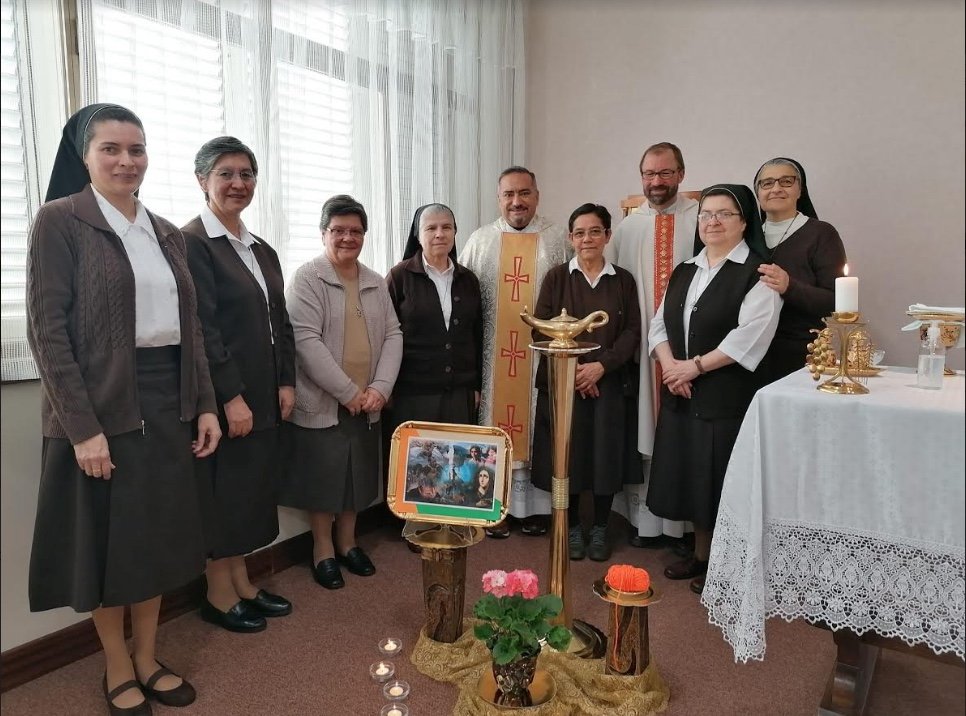
In our community in Rome, we celebrated the Consecrated Life Day´s Eucharist  together with our Capuchin Tertiary Brothers of the General Curia renewing our consecration to the Lord, in the Church and within our charismatic family at the service of our discarded, most vulnerable, injured and abandoned brothers, at the edge of the existence path.

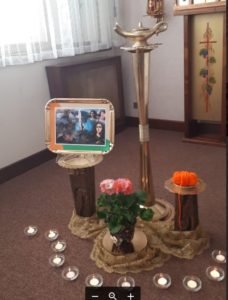
We tried to express the very motto of this day through the following signs:

  • A lighted lamp: through it we manifested that we are urged to be the light received from the Lord, a “light to enlighten the nations”, in the very realities we live;
  • A skein of wool that, once woven, creates a network, intertwining the fraternity: through it we asked Mary, an expert weaver, to accompany us in our follow-up and dedication as consecrated persons and we gave thanks for the gift of the brothers;
  • A poster presenting some of our world wounds: through it we expressed that, together with Mary, the offering Virgin, our Mother of Sorrows whose soul was pierced by a sword, we feel called to be a balsam and a compassionate and merciful presence for our brothers and sisters whom we accompany and serve.

At the end of the liturgy of the Word, holding in our hands our lit lamps, we renewed our commitment to live in obedience, poverty and chastity and we prayed to the Lord that He may be the “All” of our lives and to give credibility to our missionary announcement, as men and women of solidarity, communion and love for the others.

After the Eucharist, we shared the meal in an atmosphere of authentic joy and brotherhood. With the words of our Founding Father, Luis Amigó: Let us give thanks to God for all!

Categorías
Últimas Noticias

A different option of service to others

Probably the name of Yamile Cabrera Cuevas is not so familiar to most of the sisters of the Congregation, but some of them have shared their life with this woman that, during 30 years,  has been a member of our Religious Family. She was born in Chile and received her formation in Colombia where she lived for many years; she also worked for a time in Africa, concretely in Benin.

Yamile, at the end of a long discernment, carried out through different stages, has finally decided to leave the Congregation. It is not usual to inform publically that a sister took this kind of decision, but the interviews she gave in Chile about her situation have been published in the press and in the social networks, so we also, through our webpage, like to say some words about that.

Since the year 2010, being still a member of the Congregation and having been granted the canonical permissions, Yamile began to work in the Mayor’s Office of Quilicura (Chile), a marginalized area of ​​Santiago, she committed to the responsibilities related to her service. One of her most important tasks in the institution was the constitution of the Office of Migrants and Refugees. After seven years dedicated to work with the migrants, she began to lead the Human Rights Department and, later, the Women’s Department (See: Meganoticias.cl).

However, after all this engagement in the social service in the Mayor’s Office, Yamile decides to take a new step, presenting herself as an independent candidate to lead it. In fact, on January 8, 2021, she and her team, having already gathered the requested signatures, presented herself at the offices of the Electoral Service (Servel) in order to register her candidacy.

Some sisters and lay people knowing Yamile and aware that a religious must not assume public offices which entail a participation in the exercise of civil power (CIC 285), they were quite surprised by the news about that and, without knowing her real situation within the Congregation, approached to the General superior asking her for clarifications that would help them to understand what was happening. Because of that, and since, as we have already mentioned, the networks continue publishing news about this issue, we from the General Curie, consider important and necessary to publically  inform about this matter.

In 2017, Yamile applied the required authorization to begin a probation period in a Secular Institute and was granted it for three years but a few months ago she applied for the definitive exemption of her Vows in the Church and the indult of definitive departure from the Congregation of Capuchin Tertiary Sisters of the Holy Family, in order to commit herself to the political activity and so she made a different option of service to others. We wish her all the best for this new experience.

Categorías
Artículos

Whatsapp What will change about its new privacy terms

Changes in Whatsapp this is what really happens with your data.  What will change about its new privacy terms and whom will affect?

 Actually, everything is quite simple, but the interest to attract your attention may cause, in certain web sites, some exaggerations and a little bit of confusion.

And because of that, I will try to explain you everything, including the WhatsApp changing aspects, what that means for its users, and why, if you live in Europe, you don’t have to worry about it. So, if that concerns you or you have any questions about this matter, your mind will keep quite.

Which are the changes in the new privacy policies

In 2014, Facebook bought WhatsApp for $ 16 billion. During the acquisition process, when it received the permits from the European Commission, Facebook ensured that it did not have a reliable and automatic way to link the WhatsApp and Facebook accounts of their users. However, once the operation was completed, they announced that they would begin to combine these data and because of that, the European Union accused them of providing misleading information.


Temporary WhatsApp messages: what they are, their limits and how to use them

The new privacy policy is a new step in this direction: the data of WhatsApp users will be shared with the other Facebook or Instagram services. This is a mandatory change and it means that its users must accept this condition if they want to continue using WhatsApp. If they don’t accept, they won’t be able to use the app.

But there is an important matter: this change does not apply to users belonging to the European Union. That is due to the European data protection regulation, (EU-GDPR) that forbids Facebook to share the WhatsApp data with other companies, to its own profit.

Therefore, if you live in Spain, France, Italy or any other country, member of the European Union, these changes will not affect you; even if you accept them, Facebook will not share your data with the rest of the applications of its company.

Sharing this data, Facebook aims to have more complete profiles of all its users, by unifying the information they provided (and also the information they not provide but it somehow collects) through all the applications belonging to a single profile. That will help WhatsApp to better target its advertising campaigns, to the personal likings of its users and so to earn more money through a more effective advertising.

Why that does not affect European countries?

As I have told you, in 2016 Facebook began to combine some data of its WhatsApp users, specifically their telephone numbers, with the rest of the companies. That prompted the authorities to initiate an investigation, and Facebook temporarily cancelled such a policy that, however, is still effective today.

In fact, WhatsApp has a kind of sub-company created only for European users, so that, here, users don’t have to share contents. The app used worldwide belongs to the company WhatsApp LLC, while in Europe it belongs to the company WhatsApp Ireland Limited. Since the companies are distinct, the conditions and agreements offered to European users are approved by the European Commission and are different from those offered in the rest of the world.

But what happens in America and other continents?

It is necessary to understand that data privacy is an issue that Europe has been working on during several years; sometimes we do not give the true importance to our data on internet and that cause a certain misunderstandings about the application.

First of all, the arrogance with our personal data and its daring in the way of using them (the company itself or its partners), is a legacy of Facebook’s habit. So it is not surprising that people put up that Facebook changed WhatsApp policies in a fraudulent way.

Second, people have understood that privacy policies are confused and they don’t really have the “power” to do something, obliging companies to collect less data.

Chats are still safe for everyone

One thing that should be clear for you is that Facebook cannot read what you write in your chats, so that, in no case and in no place, the conversations content will be sent to them. And it is so because WhatsApp uses what is known as end-to-end encryption.

Facebook cannot see the content of messages or phone calls because WhatsApp communications are encrypted. Facebook also says that it does not keep logs about people you contact through WhatsApp, and that WhatsApp contacts are not shared through Facebook.

WhatsApp has many positive aspects. It is easy to use and the communication is secure but it is true that WhatsApp is Facebook and we should remember that many people do not trust in Facebook.

There are alternatives apps, such as Telegram and Signal that recently have received a large number of new users.

It seems that the understanding of what happens with our digital data, require an advanced training in computer science and a law degree. And Facebook, a company owning a lot of money and a stock value of more than $ 700 billion, did not or could not explain what was happening in such a manner that people could understand it.

If you do not have a Facebook or Instagram account, your WhatsApp will continue working the same; perhaps in the future they will add some advertising on their platform, but if you live outside Europe, the new privacy policy will surely merge your data with the two applications Facebook and Instagram.

 A personal and ethical debate

If you refuse to accept these policies, your account will surely be disabled. There are other alternative applications such as Telegram or Signal, performing the same function, something like Coca-Cola and Pepsi. If you consider that your data are not so important and you have no accounts on social networks like Facebook or Instagram, you may leave your account as it is and continue with the service.

At the end, that is a personal decision. If you ask me for a suggestion, I would tell you to install Telegram and to learn a little about its use, so that you will not depend only on a single operator. Remember that, on internet, nothing is free and we pay for these applications through our data; these companies know what we like and what we don’t, in order to focus on advertising and they sell these data to big multinationals that, later, will send us their advertising as it is already happening  with TV or radio. What a dilemma!

By: Webmaster

Categorías
Últimas Noticias

Virtual meetings of the General Government and the demarcations

During the months of November and December 2020, the General Government has held several online meetings, with the common purpose of accompanying the sisters of the Congregation, strengthening our fraternal bonds in this special time that we all live, transmit hope and share life with the different groups and communities called together. We note some of these encounters:

  • The meeting of the General Government with the Demarcation Government Teams took place from 16 to 18 November, with the participation of 35 sisters. In addition to the above, it was a privileged moment to present concerns and initiatives that emerged during the year 2020, glimpsing together concrete actions for the future. The nuclei emphasized especially revolved around the pandemic, the formation, the accompaniment of communities and sisters, the economy, the reality of the apostolic works, the celebration of the chapters and renewal of the relevant services, the socio-political situation in the countries and its repercussions, also pointing out, among all, some clues that lead us to continue looking for and making way, for which no one has elaborated recipes. We must stay awake, reading the concrete signs that are appearing, trying to give new, risky answers of shared solidarity, not from the usual schemes, but from a new way of understanding life, to which the pandemic continues to push us.

The evaluation of the meeting by the sisters was very positive, although with the feeling that many things had remained «in the inkwell», because time is always short.

  • On November 19 and 20, the General Government met with the Formators of the postulancy, novitiate and juniorate stages of the Congregation, with the participation of 17 Masters from four continents. The reunion of some of the formators who already knew each other and the knowledge of others who have subsequently assumed this mission or who did not know each other, already justified this fraternal space, but also, according to the proposed objective, shared concerns and experiences lived by each in the different stages, around the accompaniment of the processes of young women, the discernment and the application of the contents and evaluation guidelines «ad experimentum» that we are managing in the Congregation until the celebration of the next General Chapter.

The meeting was of great wealth and mutual support, detecting many common realities, despite the different cultures and specific situations of each country or continent. Some points to be taken into account by the formators themselves and also the communities were clarified.

The evaluation of the formation sisters was highly positive and we hope to be able to repeat this type of encounter.

  • The General Government also organized a meeting with the novices of the single Spanish-speaking Novitiate in Guatemala (6 November) and the formation team of the same (24 November). Changing stages, 3 meetings were held with the juniors of the Congregation: in Spanish and English (25 November at different times ) and in French (29 November). On November 21, the meeting took place with the 12 communities of Asia, of the Viceprovince General «Santa Clara». And up to and including December 17, there have been meetings with various communities from all continents, having prioritized the homes of elderly and sick sisters, as well as the small fraternities, located in more distant places, which are multiplied in some countries, sometimes with only one or two presences. It has been a great joy for the General Team to be able to enter these warm, open corners of our houses, to share with simplicity the life of the sisters, their fears and joys, the reality that they are assuming on a personal level and of the apostolic and pastoral presences, accompanying people, serving the poor, children, listening to those who suffer…

A beautiful opportunity also, to congratulate each other with some Christmas of this year 2020, so different from other occasions and at the same time so faithful to reality, around the Family of Nazareth, our patroness, contemplating Jesus in the center, together with Mary and Joseph.

Categorías
Últimas Noticias

Launch of our new website

We are pleased to announce the launch of our new website www.terciariascapuchinas.org.

Its design is updated and renewed and you will find it more attractive and with an image much more visual and functional. Our purpose, through it, is to allow people who already know us, to know more about us and to help other people to know our life and mission in the world; we’ll also report some news about the Congregation and events in which we participate.

We have updated our website adapting it to the latest technology, choosing a simple and practical design for an easy navigation, in such a way that access to the content of the website be fast and intuitive. Among the innovations of the web page, you will note a simple menu that allows you to access to all the sections and content that may interest you the most. Furthermore, its responsive design facilitates a faster and more agile navigation, conveniently allowing us to appear on both computers and mobile devices.

All the information about the Congregation is up-to-date, in order to avoid the issue of different versions of the same topic; it can be easily downloaded, printed and / or shared through email or social networks.

The new website has been designed using a clean aesthetic, big images and combined ocher and brown colors, which are the franciscan and capuchin colors and all that provides luminosity and identity; we have cared the typography and the distribution of contents, aiming to build a webpage, modern and up to date.

As a further innovation, we have integrated new sections and a map showing our presences in the world and the Contact button. We have introduced a completely renewed form through whom it is possible to contact us and to make any other questions; that allows to the user to communicate with all the communities of each Demarcation, using the organizational emails, recently implemented.

Thanks for your visit!!!

Categorías
Últimas Noticias

General data protection regulation (EU-GDPR)

Since May the 25th 2018, came into effect the new European General Data Protection Regulation (EU-GDPR), related to the protection of physical persons, with regard to the personal data processing and their free circulation. The GDPR must be obligatory applied since this date and that imposes numerous duties to the organizations that are obliged to safeguard the privacy.

As a religious Congregation registered within an European state, we are obliged to fulfill some requirements that we have been implementing since the year 2018.

It is important to establish a “roadmap” in order to satisfy the new Regulation, because there are several important legal decisions that we must take into account and we’ll expose ourselves to pecuniary sanctions if we do not implement this Regulation.

The first step we have taken is the execution, identification, and analysis of the areas of risk and to document the personal data processing that we are developing, through an inventory of all the processing activities carried out by the Congregation. For this purpose, we rely on the advice of Atico34, a company of lawyers whose headquarters is in Madrid that is guiding us in the implementation of this Regulation.

One of the requirements of the GDPR for our Congregation is the express consent.

The GDPR establishes that all organizations are obliged to obtain an express, unequivocal and verifiable consent, not tacit, to manage the information they obtain from their members.

All the sisters must give our consent so that the Congregation may keep our personal data; this is something that already happens in practice, but the Regulation requires that each member of the Congregation issue and personally sign a document. In this format the scope and characteristics of this requirement that is divided into: Consent, Protection of Personal Data, Confidentiality Commitment and Authorization to use the sister’s photograph.

We are implementing the GDPR in our Congregation, setting in various aspects of the Regulation like the organizational emails and our websites. The fulfillment of this Regulation allows us, among other aspects, to guarantee transparency, to safeguard the personal information and to protect the sisters’ personal data. I would like to emphasize that this Regulation is a challenge and invites us to understand better and to get familiar in the use of data according to the international regulations and laws that we are incorporating into our structures. Obviously the matter is very broad and we are accompanying each Demarcation in the implementation of this Regulation, punctually informing and explaining them all the relevant aspects and requirements that we will develop.

The Congregation and the Demarcations handle in their respective Secretaries, the data, signatures and personal images of all the sisters that must be protected from possible manipulations.

We’ll continue in the implementation phases of this Regulation and to report about new features.

May the Lord carry on this work that the Congregation started and may He find in each sister the necessary availability and responsibility to welcome and put into practice these civil dispositions that, nevertheless, reflect the attention and care of God for each person in his uniqueness.

Categorías
Artículos

The Family: Transverse axle of our apostolic mission

“…The Christian proclamation on the family is good news indeed”(cf. AL 1)

The celebration of the Holy Family feast day is, for the Capuchin Tertiary Sisters, an opportunity to rejoice, reflect and engage themselves.  Family of Nazareth is the best school of humanity to whom the Church always refers us.

In his last encyclical “Fratelli tutti”, Pope Francis, referring to the edification of a great family, he speaks of love saying: “love shatters the chains that keep us isolated and separate; in their place, it builds bridges. Love enables us to create one great family, where all of us can feel at home… Love exudes compassion and dignity” (cf. FT 62).

We have acknowledged that family continues being the best environment to comprehend the meaning of life, to discover and to develop the personal and community gifts, to grow up in the values ​​that make better the human person, to be what we really are, to care the things we have been given while we are here on the earth and everything else that we can recognize.

If all that is so important and we discover and receive in it what is fundamental, it is vital, for the Capuchin Tertiary Sisters, to work with families, to be bridges and to be a light to help them to carry out the mission of sowing what makes possible the sprouting out of a more compassionate, kind, loving and tender humanity … the humanity we need nowadays.

Climate change, as Leonardo Boff says, is not a disease but a fever showing that, in the planet, something is wrong; as well, drug use, femicides, violence, drug trafficking and all the realities damaging life that injure us, are its consequences but their real cause is the violence dwelling in our heart, selfishness, indifference and individualism. The family is the only institution that can always generate a new culture and it is what we really needed to overcome the evil threating life and propitiate «the culture of encounter» of which speaks Pope Francis.

Our Father Founder, Luis Amigó, called us “of the Holy Family” because his desire was that we live as a family of sisters creating, in our daily life, relationships of mutual trust, security, friendship, unlimited concern for the others and our community be the environment where each one may overcome her fear and get all that, according to the psychologists, a person needs to feel well, to give the best of herself and to project herself to the mission in the best way.

«Nobody gives what he does not own.» Let’s continue engaging ourselves so that our communities be really spaces of life and each one may receive from me the best, the constructive and what God has done through me. And all that we’ll project to the families with whom we share our life and mission, telling them that it is possible to forgive, because I have been  forgiven and granted the  mercy of God and of my sisters and, at the same time, I am sorry for their little mistakes; that it is possible to serve because, in my community, we are one at the service of the other; that it is possible to sacrifice ourselves for the goodness of the other because “we take turns” in carrying each one the burdens of the other; that  it is possible to feel well in the family,  because people who sees us realize that in our community we care about the sisters most vulnerable, sick, sad, in mourning or in crisis, knowing that, sometime, we all go through these situations.

Furthermore people notes that we are growing up and how we protect each other! We are also growing in the belonging feeling proving that our roots are like those of the ceiba, a tree green even in times of drought, because it takes water from an inner source: it does not need to be watered since it  lives from inside. When our communities drink water from the true source that is God, they keep always alive and reflect the green of hope that only He can provide us.

The family life that our Father Luis glimpsed for the Capuchin Tertiary Sisters when he founded us, inspires us and leads us to work with families, as our Constitutions say in No. 61: “The example of the Family of Nazareth encourages us in our daily life and in our apostolic labor, urges us to create a family atmosphere and to pay special interest to the Christian promotion of families”.

One of the congregational dreams is that each local community live as a true family of sisters, accompanying the families and praying for them. We continue walking under the watchful eye and constant protection of Jesus, Mary and Joseph, in communion and solidarity with the families of the world.

Sr. Lilia Celina Barrera Ramirez TC

Categorías
Artículos

Weakness can transform into fortitude

Covid 19 pandemic that is troubling the world since almost one year, leads us to experiment the fragility of human nature, the limitations of the health care resources even in the most developed countries and the precariousness of our life. On the other hand, we are experiencing that it is transforming the world, not only with regard to cultural habits and our ways of meeting, but also in other dimensions of our life.

Coronavirus threatens our lives, puts in crisis our economy, reveals the bands of poverty that sometimes we cannot see and even less find out, brings us to live situations of vulnerability and leads us to think about the meaning of human life. In order to face these new and unpredictable situations we are striving to get new answers to our material and moral needs, inventing or discovering new forms of family and social subsistence and refining our sense of solidarity; furthermore, the experience of impotence frequently leads us to deepen into the spiritual and religious dimension of our life.

Through media and social networks, continuously circulates contradictory news about the virus and among them we mention the convenience or no convenience of measures imposed by governments to contain its spread, the possibility to get soon a vaccine that would contribute to contain the massive contagion and the alarming information about the number of infections and deaths. This avalanche of information creates tension, fear, doubts and also expectations of something that, from a scientific point of view, no one can guarantee. Loneliness, the loss of the own loved ones and the socio-economic consequences of the pandemic, envelop in pain and suffering an increasing number of the world’s population that, frequently, lose hope and trust in institutions and that contributes to destabilize the social and moral equilibrium of the citizens.

On the other hand, we are witnesses of many initiatives of solidarity promoted by organizations and people working hard to alleviate pain and loneliness and to care the most fragile population. The commitment of those that work in direct contact with the sick people, exposing themselves to the risk of contagion as well as the joint effort of researchers who seek out efficient therapies to save lives and vaccines that may prevent contagion, are lights that illuminate the shadow and death in which we live. And we know also that, beyond these concrete testimonies, many people are discovering or rediscovering the light of faith and the experience of their fragility leads many people to look for something that exists beyond what is visible and to renew their contact with God. The high number of people that during the “lockdown” participated in the Eucharist through the medias as well the millions of people who, through television and social networks, followed on March 27th 2020 the prayer promoted by Pope Francis to ask God for the end of the pandemic, are a clear proof of that.

When darkness envelops the earth, when man lives the dramatic experience of pain and annihilation, when he experiences his greatest fragility, God comes out to meet him and, with discretion, he manifests his glory. That is the great mystery of redemption achieved for us in the Word made man to be part of the human history.

At the moment of creation, God broke the darkness of the initial chaos by creating light (Gen 1,2-3), the mysterious presence of God in a pillar of fire, led the Jews out of the darkness of their slavery (Ex 13,21-22)  and the light of the Risen One forever enlightened humanity, awakening hope and faith in their hearts (Lc 24,13ff).

The experience of fragility that the world is undergoing is undoubtedly an experience of pain and death, but, as Paul says, in human weakness the strength of God is manifested (2Cor 12,9-10) and we really perceive that the Lord is discreetly present in our midst, through the goodness sprouting out during  pandemic.

Franciscan and Amigonian charismatic sources relate several facts proving that weakness is a fertile ground for newness and life. Francis of Assisi, before taking a significant route change in his life, experienced a profound human failure when he suffered a military defeat and felt sick and Father Luis Amigó grew humanly and spiritually through the hard experiences of his parents’ death being he still very young, the social violence caused by the political situation and the epidemics.

The Word of God and history, teacher of life, tell us that is we assume our fragility and weakness with faith and trust in the Lord, they may open for us the way to a new creation; pain and death destroy but the heart of man, always thirsty for life, looks for what can regenerate it and faith, putting us in relationship with God and inserting us into his new and eternal life, is a light and a source of hope illuminating the darkness that surrounds us and sets in motion charity, that always renews goodness and life.

The same pandemic is transforming our lifestyles; it is breaking cultural patterns and habits that, perhaps, are not bad in themselves, but, perhaps, need to be reoriented and, at the same time, it leads us to rediscover the taste of simple things, the value and the importance of relationships and family life, the beauty of the encounter that at present we cannot have, the usefulness of the means of communication that enable us to continue working as well as many other things. All that could be the beginning of a new more human, relational and ecological life, and all that is very positive.

For the believer also, the pandemic is an experience of fear, disorientation, pain, death, fatigue, restless search out of what may help us to overcome this moment and sometimes he also fells in the indiscipline and refuses to apply the sanitary measures proposed and imposed by civil governments but, at the same time, the epidemic is an invitation to take the lamp of his faith in his hands, to keep it on pouring in it the oil of prayer that puts him in communion with God and intercedes for the world, to firmly hope that the Lord can do everything, to commit himself to others through acts of charity and to be obedient and collaborative with the civil and ecclesial authorities (Rm 13,1; Tit 3,1), following their directives and motivating others to do it. That is what Father Luis Amigó did, in similar circumstances (cf. CW 2192).

Fortitude springing from weakness and light breaking the darkness: when these two apparently opposing realities interweave, life is regenerated and the experience of the pandemic, even in the midst of the pain that continue affecting us, will transform into a profound renewal of personal and social life. Let man disregard not this opportunity and let him entrust to his Creator the re-creation that humanity needs nowadays.

Sr. Cecilia Pasquini TC

Categorías
Artículos

Religious life and Social Networks

Humanity is living a crucial moment due to the pandemic and to the “infodemic” (saturation of information dispersed and broadcasted at every moment) however, possibly,  in later years we will be certain of the question above described and we will know whether consecrated life is not depleted by technology and social network.

At present, it is evident that, due to technology, religiosity forms have completely changed. Writers, who do not ignore the autonomization of religious practice, nor the changes of life and contemporary religious imaginary in the world, affirm that the same religious ideology is modified by the social networks, and the new interactions through the digital world. However, the question could be: “Will social networks and internet be the best resource to grow spiritually? Is it necessary to be present in these new scenarios?

Talking about social networks, we realize that a radical change has taken place in the life of many people as well as in their way of acting and thinking. It is enough to look around us to notice that, in very few decades, society has changed so rapidly that we have been not able to realize it. Today it is normal that, as in all our houses, parishes and religious communities, there is a connected to the internet computer that allows us to send and receive information by e-mail or to maintain contacts through Facebook or Twitter; all these instruments have strongly modified our daily life and relationships and not only the social ones, but also the dialogue about and among religious beliefs circulating through Internet. I

t is exactly the appearance of the web that led the Church to rethink about the mission entrusted to her by Christ: to announce the Gospel up to the ends of the world. Indeed, the Church and consecrated life propose the evangelical message increasing the use of the instruments that web provides like, for example, religious blogs, news portals, spaces for personal reflection or discussion about spiritual issues and the presence of religious men and women in social networks.

A study made in the year 2019 revealed that, among adult people, the four most used social networks are Facebook, Pinterest, WhatsApp and Twitter and, among the adolescents, TikTok and Instagram. The general tendency is that, as access doors to social networks, people are using mobile devices and it is significant that, in fact, the two most used worldwide social networks work like applications only for mobile devices: WhatsApp that has more than 1.9 billion users (data referred to the second half of 2018), Instagram 800 million users (data referred to January 2018) and TikTok with more than 700 million users.

All these data provides coordinates to outline an adequate apostolic action: they facilitate a healthy realism, allow reconsidering more or less general needs according to the trends and offering an opportunity to examine ourselves taking into consideration these data.

Because of that, social networks offer an opportunity to serve the culture of love and, within such a great banality, they offer an oasis of faith and spirituality. The web may provide many experiences but it I necessary to identify them well because, quite often, they may be empty.

That is why it is convenient to consider the following recommendations:

  • To use internet as an information tool
  • To pay attention to the digital mediation in the relationship.
  • To establish criteria about the need and the use of the network.
  • To take into account that, in order to balance all the aspects, “the less is better”.
  • To be authentic.
  • To create off-line spaces (disconnection).
  • To keep the control.
  • To plan.
  • To apply the congregational Protocol for the use of social networks.

By mandate of Jesus Christ, we should evangelize through internet, because it belongs to  the missionary nature of the Church, the world expects that from us (without knowing it) and internet, being an inhabited place and an atrium of the Gentiles is always an opportunity. We have been created and we are on the web to be light.

But it is not enough to “stroll” the digital streets, simply being connected: it is necessary that the connection favor a true encounter. (Pope Francis, Message 50 Day of social communications).

Our presence in the networks should be an output to the peripheries. We should be witnesses, create communities and be daughters of the Church and women of prayer.

Some keys to think about the Internet with the Church: We have to ask ourselves:

  • Do I use the web as a medium and as a place inhabited by human hearts?
  • Do I promote a culture of meeting with others or do I take refuge in closed sectors?
  • Do I accept my responsibility by showing myself as a Christian online?
  • Is internet part of my life of faith (prayer, sacraments, spiritual life …)?

Consecrated life should contribute to network with a witness of

  • Fraternity.
  • Life according the Gospel.
  • Mercy and personal encounter.
  • Hope for our society.

The network gives us the possibility of a «free» and effective apostolate, it can help us to live the Charisma, it empowers our creativity, it inserts us into a new culture where we can instill the Gospel, it fosters us in personal encounters with users of any conditions and allows us to give more visibility to the Congregation.

The great challenge is to be significant and not only to be in the network; we should penetrate into consciences, promote a true encounter and update ourselves personally and as a community; that has to be a planned exercise having a clear objective and we have to know how to communicate every day in an attractive way and always showing ourselves explicitly or implicitly. It is worth to be present in the networks and so be witnesses of mercy, hospitality and constant evangelization, since the personal identity of a consecrated woman is related not only with herself but with God. «So that they may see your good works» (Mt 5,16).

Some advice and tools to be more productive on social networks:

  1. To schedule
  2. To plan our time into tasks.
  3. To set a limit to the time.
  4. To use a calendar.
  5. To create templates for content.
  6. To manage the information.
  7. “To take the pulse” of the audience.
  8. To work as a team.
  9. To measure, increase and improve.
  10. The blockage belongs only to our imagination.