

Categorías
Artículos

Commitment to creation: A proposal for self-sustainability

«The vitality of the Earth and the future of the human species will only be guaranteed if we manage to endow them with sustainability. Otherwise, the future may be very dark» (Boff, L. (2013). Sustainability. What it is and what it is not).

«We are not God. The earth precedes us and has been given to us», affirms Pope Francis in his ecological magna carta, Laudato Si, to respond to the accusation that in our Judeo-Christian tradition, the Genesis account that invites us to «dominate» the earth (cf. Gen 1:28), favors the savage exploitation of nature, and presents an image of the dominant and destructive human being. The Pope makes it clear that this is not a correct interpretation of the Bible. Today we must read the biblical texts in their context, with an adequate hermeneutic, and remember that they invite us to «till and tend» the garden of the world (cf. Gen 2:15).

Bearing in mind that «to till» means to cultivate, to plow or to work, and «to care for» means to protect, guard, preserve, guard, watch over, this implies a relationship of responsible reciprocity between human beings and nature, in the context of the intimate relationship between the poor and the fragility of the planet, as the Pope concludes in the same Encyclical. This generates conditions for self-sustainability or, in a more far-reaching term, sustainability, defined in 1987 by the United Nations as «meeting the needs of the present without compromising the ability of future generations to meet their own needs». Thus, an ecological discourse goes hand in hand with a social discourse and we cannot think of sustainability without considering the poorest, who are the ones who suffer most from the consequences of environmental mismanagement.

This is our commitment to creation: to inhabit it as an Oikos, called «Common Home» by the Pope, and to enter into otherness with it, in the sense that being «other», we establish relationships of care and reciprocity. She nourishes and sustains us and, in turn, we care for her and allow her to be reestablished, in such a way as to guarantee her stability. Likewise, as a work of creation, humanity must be looked upon for its dignity and the common good, in pursuit of sustainable development.

In the so-called Agenda 2030, the United Nations, in 2015, established 17 goals to achieve sustainable development (SDGs) on the planet, covering three fundamental dimensions, social, economic and environmental. The goals prioritize the fight against poverty and hunger, the defense of human rights, inclusive and equitable education, gender equality and women’s empowerment, the shift towards responsible consumption patterns and planet-friendly economic growth. They were proposed with a holistic and systemic vision, since everything in the world is connected, to be applied in local, regional, national and global scenarios, including the commitment of governments, the private sector and civil society, in each particular context.

As a Congregation that is committed to dignifying human life in an environment that must be cared for, we have been an expression of some of the SDGs and today, in a special way, we have the challenge of assuming them with greater evangelical and missionary commitment. Our effort has been concretized in six (6) of the 17 SDGs:

Objective 1: To put an end to poverty in all its forms throughout the world. The preferential option for the poor, which is expressed through the presence of our Congregation among the excluded and most vulnerable people in society.

Goal 2: End hunger. We have contributed to achieve food security and improve nutrition in vulnerable populations, such as minors, adolescent girls, students and the elderly.

Objective 3: Guarantee a healthy life and promote well-being for all at all ages. The promotion of health, disease prevention and care for wellness and health, have been one of the pillars in the evangelizing mission.

Goal 4: Ensure inclusive, equitable and quality education and promote lifelong learning opportunities for all. Education for life, the key to escape poverty, has been at the heart of our evangelical proposal.

Goal 5: Achieve gender equality and empower all women and girls. In order to reduce discrimination and violence against women, we work in the areas of Protection, Health, Education and Social Promotion.

Objective 12: Ensure sustainable consumption and production patterns. Our approach is to permanently educate on responsible consumption and lifestyles that do not conflict with environmental care and that also optimize the use of resources.

The other objectives summon us as part of creation, for sustainability in all its dimensions, counting on the solidarity of the world. Let us do our part with the awareness of a common origin, of a mutual belonging and of a future shared by all, as the Pope reiterates in Laudato si (202), being daughters of Francis of Assisi, patron of ecology and of Luis Amigó, the man of integral ecology for his harmonized and integral life, to strive in actions that give self-sustainability to nature and to human life.

Sr. Sor Alicia Vásquez, Tc and Gabby Vásquez

Categorías
Últimas Noticias

Pope Francis gives us a text dedicated to the liturgy

On June 29, the Apostolic Letter of Pope Francis «Desiderio desideravi» on the liturgical formation of the People of God was published. In Vatican News, we share the reflection made by Juan Manuel Sierra López, Professor of Liturgy at the Ecclesiastical University of San Dámaso in Madrid, Spain.

The communication of the Dicastery for Divine Worship, in announcing this new document, presents it as a reflection (meditation) on the beauty of the liturgical celebration. Although the Dicastery warns, previously, that following the Motu proprio «Traditionis custodes», intends to increase the ecclesial communion according to the liturgical books of the liturgical reform of the Second Vatican Council   

Structure of Desiderio desideravi (Dd)

 The theme that appears in the heading is: «the liturgical formation of the People of God». The text of Dd begins with a brief introduction (n. 1) where the Pope explains that after Traditionis custodes he wants to reflect on the liturgy.

More clearly he expresses his intention in number 16, dealing with the theological meaning of the liturgy, when he writes: «With this letter […] I would simply like to invite the whole Church to rediscover, guard and live the truth and power of the Christian celebration».

Still, in number 61, by way of conclusion, he asks that the holy people of God be helped to drink from the main source of Christian spirituality, rediscovering the principles expressed in the Constitution «Sacrosanctum Concilium» of the Second Vatican Council on the sacred liturgy.

And as a final touch, in the last paragraph of the Letter, the Pope asks to abandon polemics in order to listen to what the Spirit is saying to the Church, maintaining communion, admiration for the beauty of the liturgy, under the gaze of Mary.

Source: Vatican News

Categorías
Últimas Noticias

The vatican on the revoke of abortion in the U.S.: «It is a powerful invitation to reflect together»

The 50 U.S. jurisdictions may or may not restrict abortion. The U.S. Supreme Court, the highest court in the land, decided to overturn the constitutional right to abortion, leaving it up to the states to decide whether or not to terminate pregnancies. The vote took place on Friday, June 24. The decision was settled with a majority of 6 to 3.

The Vatican, through the Pontifical Academy for Life, indicated that this decision will make it possible to ensure adequate sex education and guarantee health care accessible to all, whose President, Archbishop Vicenzo Paglia, also assured that the Court’s decision will serve as a reflection for many nations.

«In the face of a Western society that is losing its passion for life, this act is a powerful invitation to reflect together on the serious and urgent problem of human generativity and the conditions that make it possible; in choosing life, our responsibility for the future of humanity is at stake,» the Archbishop declared.

Following his remarks, Archbishop Vincenzo urged the reopening of a non-ideological debate on the place of the protection of life in a civil society and called on nations to provide solid assistance to mothers, couples and unborn children.

«The fact that a great country with a long democratic tradition has changed its position on this issue also challenges the whole world. It is not right that the problem should be left aside without adequate global consideration. The protection and defense of human life is not an issue that can be confined to the exercise of individual rights, but is a matter of broad social significance,» he emphasized.

In addition to the Vatican, the U.S. pro-life campaign also spoke out and declared the Supreme Court ruling «a momentous day for human rights.»

Several U.S. jurisdictions have already announced that they will ban abortion in their territory, including Alabama, Arkansas, Ohio, Ohio, Oklahoma, Texas, Wisconsin, North Dakota, South Dakota, Idaho, Kentucky, Louisiana, Michigan, Mississippi, Missouri, Tennessee, Utah and Wyoming.

Source: Weekly Magazine


Categorías
Últimas Noticias

Thousands of migrants die in search of the «American dream»

The Darien Gap and the border with the United States are the deadliest points. Millions of cross-border migrants in the Americas yearn for better socioeconomic conditions. In 2021 alone, more than five million migrants were registered in the continent, according to data from the UN Refugee Agency (UNHCR).

The unfortunate thing is that, because of their desperation, thousands of them die of suffocation, drowning and massacres, especially in the Darien Gap, located between Colombia and Panama, and on the border with the United States.

More than 6.000 migrants have been reported missing or dead in the Americas from 2014 to today, according to the International Organization for Migration (IOM). Sixty percent of the deaths took place on the U.S. – Mexico border. While some 1.750 people died by drowning, in the Rio Bravo, the natural border between Mexico and the United States; the lack of water, food and a place to stay, cost the lives of 861 people. Other migrants were victims of violence, accidents or died because they were traveling in subhuman conditions.

Another problem people face is that, crossing the continent with their belongings and families in tow, they become victims of criminal groups. It has been proven that many of them suffer extortion, sexual violence and robbery.

Changes in Migration Dynamics

According to Maureen Meyer, an official of the Washington Office on Latin America (WOLA), migration dynamics have changed due to the strong economic impact caused by the pandemic. This has resulted in migration not only of Central Americans and Mexicans, but also of South Americans and Haitians.

Other variations observed is that migrants are not only considering the United States as an option to fulfill their «American dream». Other destinations such as Mexico, Colombia, Ecuador, Peru, Costa Rica, Chile, Canada and Brazil, have become important migratory destinations, so explained William Spindler, UNHCR spokesperson for Latin America to DW.

Source: DW

Categorías
Artículos

Accompanying in the nightfall of existence «My experience of accompanying my elderly and sick sisters»

Before sharing my experience in relation to this topic, I want to take in some elements that will help contextualize my words: I come from a country where a small portion of our beloved Congregation is present, the works are of missionary character and work in parish ministry, communities with few sisters, therefore, one of the reasons to come to Colombia for formation or for other reasons is to know communities with enough sisters and houses with older sisters, so that planning a trip to Medellin always includes the visit and sharing with our elderly and sick sisters.

Our Constitutions say: «They have spent their energies in the service of the Congregation and now they encourage us with their experience and witness of fidelity to the Lord» (Const. 34). And so it is, the sisters who come to this community live a concrete stage of their life with its own characteristics: reduction of the rhythm of life, having more time for things, especially prayer which, together with pain, is the daily offering to God and a way of continuing the mission in the world. They also feel helplessness, fear, pain, need for listening, companionship and help from others, they begin to depend. Although we know that it is a normal stage of life, we are not always ready to go through it, it takes us by surprise and it is a process to adapt to the changes.

I have been accompanying the community «Nuestra Señora de Montiel» in Medellín for 5 months now, where I share life with our elderly and sick sisters together with a group of sisters who form the «support team» of the community. We are immediate in charge of looking after their wellbeing.

If I am asked what does this mission mean to me? I say that, like any mission, it implies a service that I welcome with faith and good disposition; an opportunity to love, serve and grow. Although I had no work experience in this area, I have two clarities that help me, «the mission is with my sisters» and «we walk together»; these are the keys to assume with love the day to day, which is always full of novelties and feel that we are all on the way at different paces, but together as we are asked by the synodality. 

Some lessons for life:


  1. To live the welcome and respect

In a world where the elderly are excluded, to SEE the sisters as elders; to recognize that they came first to the Congregation, that they have traveled a path of following and service that we continue, helps me to value and respect each one in her own reality. 

  1. To express gratitude feel 

The sisters who are in the community have spent their lives and energies living their vocation and carrying out a mission, no matter if in relevant positions or humble services, they all carry the high bar «HERE IS A FOLLOWER OF JESUS, BUILDER OF THE CONGREGATION», it is a merit that no one can stop; therefore, in their presence only gratitude, much gratitude to honor their legacy.

  1. To contemplate the work of God, to welcome a blessing

Each sister is an eloquent SIGN of what God is capable of doing in each human being when she takes it on her own; sometimes, in the midst of their limitations, it is not very easy to discover «the work that God has done in them». However, their lives reflect God’s faithfulness and mercy and His saving action.

  1. To appreciate the essential 

In adulthood many physical or mental faculties are lost and it is surprising to find the essence of each sister. What she has cultivated during her life is what remains.  So you can enjoy the joyfulness, prayer, availability, strength, and active service among the many gifts that God placed in their hearts.

It is beautiful to contemplate some details of the present of the sisters that simply fills the heart with tenderness and admiration: the sense of God and their relationship with Him, no longer with numerous words or great speeches; they just know how to be, they are like little candles at the foot of the tabernacle. A great testimony is that even in their pain they look for the community and ask, «Where are they all? Bring me to them”.  Despite the fact that they no longer go out from the house, they still have a sense of helping others, especially the poor. They care for others and for those who care for them. They create bonds and share their wisdom in words of encouragement and messages that help them grow. Their sense of belonging to the Congregation is also noticeable. They ask for the sisters, they ask for their names to be repeated over and over again, they ask to be told who to pray for and, if the young women in formation come to such spaces they like to tell them their stories over and over again, offering them prayer and giving them advice; they are for them like a grandmother with her grandchildren. 

Finally, for those who read this story, the invitation is to value the elderly around you.  They have a lot to give, so let us not miss the opportunity to give them proximity, gentleness, company and help.

Sr. Bilma Freire Chamorro,  Tc

Categorías
Artículos

Embracing personal reality, the reality of the brothers and sisters and of creation, is the starting point of our synodal path

With the convocation to the XXIII General Chapter, the theme around which the congregational-capitular experience revolves in its various phases began to resonate in prayer and in the spirit: “Strengthened in the Spirit, we embrace our reality and suffering humanity, advancing with hope on a synodal path”.

This theme initially locates us in what is weak in our personal reality, proposing the intuition of allowing ourselves to be strengthened by the Spirit, who calls us to re-captivate ourselves, «to recover the great desires, the marks of the wounds of our passion for Jesus and the Kingdom” (cf. José Mª. Arnaiz, SM, “From disenchantment to enchantment, passing through re-enchantment”), to return to the source that seduced us, to return to the roots that perhaps we have not cared for and watered carefully, but who are on the best ground, that of fundamental belonging: Jesus and His Kingdom.

The being and doing in the future of our congregational family is already giving us a glimpse of well-defined spaces and missions to which we are being re-sent: «To embrace our personal and community reality, and that of each Demarcation. To embrace the reality of the environment in which the suffering of our brothers and sisters and of creation is stirring».  Once these realities are recognized, we should humbly opt to take up the path together, to begin to re-create possibilities of reparation, of closeness, of mutual support, and above all of security and hope, with the conviction that in this new sending we are not alone and that we can awaken a new Pentecost: as an experience of re-enchantment, of re-birth in life for the following of Jesus in witnessing joy as disciples, stimulated and accompanied by our founders, by their experiences of conversion and commitment to the Gospel.

Francis and Clare of Assisi, Father Luis Amigó and our sisters of the first hour once again appear at our side, almost taking us by the hand to lead us to the ruins, to our vulnerabilities, not only the external ones, but those that deep inside groan and cry out for compassion. The «leper» excluded from coexistence, from harmony, from fraternity, from activity, from joy and hope, whom perhaps we have taken hidden, and not listened to, ignored, thinking that «he can stay there» and that «he can hold on a little longer». 

This reality is touched today in the family-community, and is inviting us to embrace it, to work as sisters in the closeness that led to the recognition, the embrace and kiss that transformed the personal reality of the leper and of Brother Francis, leading him then to San Damiano, to the place of encounter with the broken, disfigured, dusty, forgotten, victimized Christ in the brother and sister with whom we live. It is a slow and difficult process of recognition and identification, but an excellent way towards the experience of the reparative dynamism of our being, able to face the internal and external causes of our insecurity and proud selfishness, welcoming the possibility of finding new realities, new searches in the paschal journey of the Congregation.

To place ourselves as consecrated women, as committed lay people, with the personal reality that accompanies us today, before the extreme love that led Jesus to the cross, is the opportunity to feel the projection of that love, in the gift of brothers and sisters, with whom it is possible to unite answers, qualities, attitudes, ideals, options, strengths and to begin again putting our grain of sand in the strengthening of life and vocation, of identity and mission as Capuchin Tertiary Sisters, before the humanity that also suffers new, deep and serious vulnerabilities: «… the scourge of misery, hunger, unemployment, diseases without access to health centers, lack of schooling, child and youth labor for the survival of the family, trafficking of women and children, organ trafficking, lack of housing, displacement, war, corrupt political and even ecclesiastical administrations, slavery and injustice of all kinds, the cry of the destruction of the common home and the «throwaway culture» that affects above all women, migrants and refugees, the elderly, native peoples and people of African descent»… It hurts «the impact and consequences of the pandemic that further increases social inequalities, even compromising the food security of a large part of our population. It hurts the clamor of those who suffer because of clericalism and authoritarianism in relationships, which leads to the exclusion of brothers, lay people, especially women in the instances of discernment and decision making on the mission of the Church… it worries the «lack of prophecy and effective solidarity with the poorest and most vulnerable…» (cf. Final Message of the Ecclesial Assembly of Latin America and the Caribbean).

These multiple situations against the Kingdom continues recognizing in consecrated life, in women, sisters and disciples who are bearers of hope, assisted by the Spirit of the Lord who makes all things new; and trusts and hopes that «we will return singing from the congregational Chapter experience», offering compassionate fruits of listening, discernment, forgiveness, and a more sensitive, decisive and risky missionary attitude to project, create and open new ways of announcing in order to walk together, making a new world possible, a creation revitalized by active, simple and lesser fraternity, driven by the Franciscan-Amigonian spirituality and determined to put in common not only vulnerabilities, but possibilities, intuitions, demands, vocation, options, even contradicting ourselves, contradicting customs, projects, securities, ways of living and thinking. 

Then we will begin to live the XXIII General Chapter, as one more step on the way of restructuring our lifestyle and mission, celebrating the wedding feast, in which, if the jars of wine have been emptied and we feel the threat of the end of the feast, we can also feel the woman who has been able to say a YES without limits even in the midst of chaos; she shows us the work that frees us from sadness, hopelessness, distrust, fear that often overwhelms us: «Do whatever He tells you…» and the capitular, personal, community banquet will make our hands, wills and freedom agile, to make the empty jars overflow and allow us to taste the new wine, the best and the capacity to take up again the motivation and initial option and source of our religious profession, of our commitment in front of life in abundance for all, in front of the lament multiplied by so many marginalized brothers and sisters, so many voices, so many realities that ask us: «Go and repair my house». 

Sr. Ana Mora, Tc

Categorías
Últimas Noticias

The pope stresses the value of the elderly in societies and communities: «In old age they will continue to bear fruit»

Photo source: Ecclesia

Pope Francis has chosen the theme «In old age they will continue to bear fruit» for the Second World Day of Grandparents and the Elderly, to be celebrated on July 24, with the intention of highlighting that «they constitute a value and a gift both for society and for ecclesial communities».

The Vatican said in a statement that Pope Francis has chosen this theme because «too often» the elderly «are kept on the margins of families and of civil and ecclesial communities».

«Their life and faith experiences can help build societies aware of their roots and capable of dreaming of a more supportive future,» but also their wisdom can be heard «in the context of the synodal journey that the Church has undertaken».

«The Dicastery for the Laity, Family and Life invites parishes, dioceses, associations and ecclesial communities around the world to find ways to celebrate the Day in their own pastoral context, and for this purpose will make available the appropriate pastoral instruments,» statement concludes.

THE WORLD DAY OF GRANDPARENTS AND THE ELDERLY

We recall that, Pope Francis announced the institution of this Day after the Angelus prayer on Sunday, January 31, 2021, establishing the celebration on the fourth Sunday of July, close to the liturgical memory of Saints Joachim and Anne, grandparents of Jesus.

«Link» between generations to transmit to young people the experience of life and faith, «grandparents are often forgotten – the Pope stressed on that occasion – and we forget this richness of guarding the roots and transmitting them». Hence, the Pontiff’s decision to institute this World Day.

Source: Diocesan Service of Communication – Diocese of Mondoñedo-Ferrol

Categorías
Últimas Noticias

In the school of synodality: various online courses begin in july

Fuente: Vatican News

Virtual meeting with Cardinal Grech (Archive photo) 

A series of conferences on the theology and practice of synodality has been launched to accompany the clergy and laity in the process of ecclesial renewal begun with the Synod 2021-2023. Proposed on the web in different languages, the meetings are held by speakers from around the world to offer an intercultural vision of the Church. Registration is open for the first course.

Tiziana Campisi – Vatican City

An intercontinental and intercultural project to accompany formation in theology and the practice of synodality: is the aim of the program of online courses for bishops, priests, men and women religious, lay men and women, conceived within the framework of the synodal journey that the Church is undertaking and which invites us to generate processes of conversion and reform. The courses are free of charge, offered in Spanish, English, Portuguese, French and Italian, and are given by speakers from all continents, who will offer a global and intercultural vision of the Church. In the context of the process of ecclesial renewal initiated with the Synod 2021-2023 «For a Synodal Church: communion, participation and mission» – which will culminate with the XVI Ordinary General Assembly of the Synod of Bishops in October 2023 – the initiative aims to support all the People of God called to this process of ecclesial renewal.

First meeting in July

The first course will be held in July, over three weeks, and will include lessons, conferences, reflections and the sharing of experiences on the processes of discernment and common decision-making in the Church. The Latin American Episcopal Council (CELAM), the Council of European Bishops’ Conferences (CCEE), the Federation of Asian Bishops’ Conferences (FABC), the International Union of Superiors General (UISG), the Union of Superiors General (USG), the Latin American Confederation of Religious (CLAR), the Union of European Conferences of Superiors and Major Superiors (UCESM) and the Conference of Jesuit Provincials of Latin America and the Caribbean (CPAL), are sponsoring the Massive Open Online Course (MOOC).

Registration can be done through this site: bit.ly/registersynod

Source: Vatican News

Categorías
Últimas Noticias

Clar’s message in the face of political instability of our countries

The General Assembly of CLAR, gathered in Rionegro – Antioquia (Colombia) from June 1 to 4, 2022, was an opportunity to scrutinize once again the signs of the times and in them, listen to the voice of the Spirit that never ceases to open our ears so that we listen as disciples (Is 50,4). 

As Religious Life on pilgrimage today in Latin America and the Caribbean, we see with deep concern the deterioration of democracy, the social fabric and the growing political instability in several of our sister countries where fundamental freedoms are being compromised. In the framework of the Summit of the Americas, meeting in Los Angeles, we make a vehement call to political, social and economic leaders to prioritize the response to the rifts that the Covid 19 pandemic has exposed in the health, educational and social systems. 

It is unacceptable that the threat to democracy, climate change and the lack of equitable access to economic, social and political opportunities continue to disproportionately and severely affect the lives of the most vulnerable and systematically excluded people in each of our countries. Today we raise our voice of solidarity, united with the poor and the earth, who cry out more forcefully than ever for life. We also express our closeness and affection in solidarity with our religious brothers and sisters, especially in Cuba, Haiti, Nicaragua and Venezuela in these moments of extreme difficulty and insecurity. The situation of their communities of faith and life, and especially that of the persons and communities they accompany, challenges us and invites us to care for one another with the certainty that we carry a treasure in earthen vessels and in a condition of fragility (2 Cor 4:7). 

Together with you, we ask for all Religious Life, and for those who join the movement of global solidarity with the marginalized of history and with the earth: courage, inner serenity and full trust in God’s action that permanently restores social and environmental justice. We call upon Religious Life to be vigilant, watchful and supportive in prayer, communication and political and social advocacy for the most vulnerable. 

Committed and persevering witness strengthens us, and this strength inspires us with solidarity and hope. Mary, the Woman of the Dawn, continues to accompany and guide the journey of our people as she did with the first Church when it was going through the night of persecution and intolerance. With her and with the women of the Dawn, we unite in this journey in favor of life. 

Participants XXI CLAR General Assembly

 Bogota, D.C., June 9, 2022 

Source : CLAR

Categorías
Artículos

Taking up the challenge to be silent in order to listen

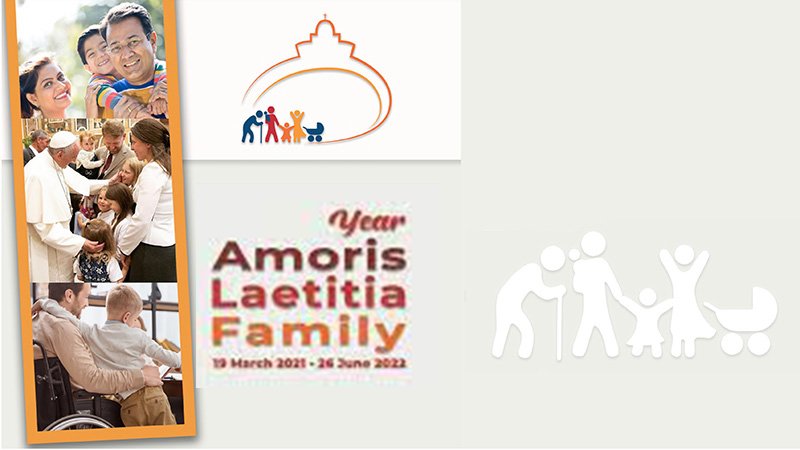
“Amoris Laetitia Family Year”

On March 19, 2016, the post-synodal Apostolic Exhortation «Amoris Laetitia» (The Joy of Love) on the family was signed. This document is a compendium of two synods on the family convened by Pope Francis in 2014, «The Family in the Context of Evangelization» and in 2015, «Vocation and Mission in the Family, in the Church and in the Contemporary World».

Amoris Laetitia marked the beginning of a path that prompted a new pastoral approach to the reality of the family.

Francis explains that the Exhortation «acquires a special meaning» for two reasons: «I understand it as a proposal for Christian families, which stimulates them to value the gifts of marriage and the family, and to sustain a strong love full of values such as generosity, commitment, fidelity and patience» and also «seeks to encourage everyone to be signs of mercy and closeness where family life is not perfectly realized or does not develop with peace and joy».

On the fifth anniversary of the Apostolic Exhortation, Pope Francis announced a year dedicated to families. This year was officially known as the «Amoris Laetitia Family Year» and invited Catholics to reflect on love in the family, enlightened by the Exhortation that captured the experience and challenges of today’s families and their vocation. This Amoris Laetitia Family Year began on March 19, 2021 and will conclude on June 26, 2022 with the 10th World Meeting of Families in Rome.

The Capuchin Tertiary Sister in communion with the Church

For the Capuchin Tertiary Sisters, it represented a pastoral challenge that led them to place themselves in the context of a mission exercised from the confinement, which made germinate in the bosom of the families other pandemics: intra-family abuse, abandonment, divorces, depression, loneliness, vices, senselessness and relativism…

From within the Amigonian Charism springs the concern to motivate the pastoral reflection of this Exhortation and to participate from the creativity of each work and community in the planning and living of this year. Pope Francis has dedicated the Family Year Amoris Laetitia to the Holy Family of Jesus, Mary and Joseph, patrons of the Congregation of the Capuchin Tertiary Sisters of the Holy Family and models close to our humanity, who in their availability to do the will of God, their obedience and listening continue illuminating and marking the way to build the domestic church.

St. Joseph, Custodian of the Year of the Family

To propose St. Joseph as the custodian of the Year of the Family is to affirm him as an example of paternal love and of the value and dignity of work. According to tradition, he worked as a humble carpenter in the town of Nazareth. Today, after three years marked by the pandemic (COVID 19), both paternal love and the dignity of work have become essential to the health and well-being of our families and communities. This paternal love given to Mary and Jesus gave them support and freedom; and today it teaches us to stop and let ourselves be accompanied by the spirituality of Nazareth, the spirituality of listening, dialogue and obedience.  

In the action of listening, it is necessary to be silent and empty ourselves of words. In the Holy Family of Nazareth this silence was available and generous, capable of making God’s dream come true: «You will be the mother of Emmanuel … be it done unto me» (cf. Lk 1:26-38). «He took Mary and the child and fled to Egypt … he set out while it was still dark» (Mt 2:13-14), thus bringing to life the words that Jesus would later say: «Blessed are those who hear the word of God and put it into practice» (Lk 11:27-28). It is in the bosom of the home that Jesus as a child learned that He was blessed and happy. It is in the family that we learn to listen in order to follow instructions and obey.

Proposal

It is necessary that the culmination of the Year of the Family becomes a new propositional stage, where we can continue writing the post Amoris Laetitia pages and that the emerging and hidden realities within the bosom of the family be accompanied and enlightened by this Post-Synodal Letter.

Let us practice the life of silence to listen to God, to listen to ourselves and to each other, because only in this way can what is creative, what is new, what God wants to awaken within the Church, within our domestic church, emerge.

To walk in synodality is the proposal that moves the heart of the Church today and it will be from the commitment of each member of the family that welcomes and lives its role, where it will be possible to listen, discern and build the necessary dialogue to rescue life and love in the family.

May Mary, Mother of the Church and Queen of families, intercede for us.

SR. MARIULIS GREHAN, TC