Categorías
Últimas Noticias

Spanish-speaking Congregational Novitiate:

On February 11, six young women entered the Novitiate in Guatemala, coming from different nations and demarcations. This formative stage will be accompanied by a formation team composed of Sisters Nancy Monterroso, Novice Mistress, Liliam Ramirez and Marta Ulinska. Let us keep a firm hope that the seeds continue to germinate, let us commit ourselves to effective support from prayer and communion of sisters that translates into gestures of closeness and renewed attitudes of life. For the formators and sisters in initial formation, these contributions are of great value. May the Lord who has initiated in our Sister Novices: Anna, Jholainys, Flory, Ana Christina, Susana, Lucia, bring it to a joyful completion.

Categorías
Últimas Noticias

Junicon 2023

On January 6 of this year, the period of preparation for Perpetual Profession began, a stage that will be guided by Sisters Fanny Londoño Sosa and Marigladys Sanchez Gonzalez and has the participation of eight junior sisters of different nationalities.

We rejoice with our Sisters:

Vannessa Vasco Monsalve, Colombia

María Veneranda González Palmar, Colombia

Karla Cristina Cano Cárdenas, Colombia

Gloria Enith Denis Saavedra, Panama

Beatriz Iliana Quintero Perez, Panama

Nguyen Thi Hong Nhung (Anna), Vietnam

Amélie Segbegnon HOUNDOGANDJI, Benin

Assriwa Assella Nicolette CATARIA, Benin

We accompany them with our prayers in this new and decisive stage of their lives.

Categorías
Últimas Noticias

Pope Francisco promulgates motu proprio on the financial control of institutions

Pope Francis promulgated an Apostolic Letter in the form of a «Motu Proprio» on the «juridical persons instrumental to the Roman Curia» in which he reaffirms the importance of the control and surveillance of financial transactions.

The Press Office of the Holy See released this new «Motu Proprio» signed by Pope Francis on December 6, together with the law «on juridical persons in the Vatican City State» which is scheduled to begin on December 8.

The new law is composed of 22 articles and is signed by the President of the Governorate of the Vatican City State, Cardinal Fernando Vergez Alzaga, and by the Secretary General of the same Dicastery, Sr. Raffaella Petrini.

“The person who is trustworthy in very small matters is also trustworthy in great ones.”

Pope Francis quotes Luke (16:10a) at the start of the Motu Proprio. The Motu Proprio consists of 8 articles. In the introduction, the Pope points out that after the promulgation of the apostolic constitution «Praedicate Evangelium» it is also «necessary to regulate the various funds, foundations and entities which, over the years, have arisen within the curial institutions and depend directly on them.»

For this reason, the Pope established that this «regulation applies to the instrumental juridical persons» that refer to the Holy See, registered in Article 1 of the Statute of the Council of the Economy and located in the Vatican City State, «to the exclusion of the Curial Institutions and the offices of the Roman Curia, of the Institutions connected to the Holy See and of the Governorate of the Vatican City State.»

Among the technical aspects addressed in the document, it highlights the importance of the supervision and «vigilance and control in economic-financial matters» carried out by the Secretariat for the Economy.

Source: Vatican news

Categorías
Últimas Noticias

International Migrants’ Day

In view of the increase in migratory flows in the world, in the year 2000 the UN general assembly proclaimed December 18 as International Migrants’ Day, with the aim of promoting the exchange of experiences and opportunities for collaboration among countries and regions in the face of the difficulties of international migration.

The purpose of this event is to highlight the challenges, difficulties and adversities faced by migrants around the world, as well as to call on the nations of the world to contribute to making migration a safe, regular and dignified process.

Origin of Migrants’ Day

One of the main antecedents in the creation of this event lies in the adoption of the International Convention on the Protection of the Rights of All Migrant Workers and Members of Their Families by the General Assembly of the United Nations in 1990.

Human migration refers to the processes of voluntary or forced migration of people from their country of origin or residence, on a permanent or temporary basis.

Paradoxically, the restrictive migration policies imposed by countries, together with the manifestations of xenophobia, have limited such processes, contributing to the increase of the social phenomenon of «illegal persons» or «undocumented» ones.

Fuente: www.clacso.org

Categorías
Últimas Noticias

Pope on wyd 2023: Volunteers are a «Striking force».

Francis sends a video message in Spanish on the occasion of the World Volunteer Day being celebrated today to speak of the generosity of all those who sustain the work of the church with their volunteer work. «Volunteering,» he explains, «is a grace of God.»

«Volunteering is a ‘driving force’ that allows us to go outside the box in order to achieve something.» In a video message in Spanish, Francis addressed the volunteers of the WYD 2023, from August 1-6 in Lisbon (Portugal), to thank them, on the occasion of the World Day of volunteering that is celebrated today, for «their generosity», the «generosity of each volunteer», they who are an overwhelming force, «a force of the Church, an expression of the mission of the Church», because they are the ones who maintain with their “volunteering, the action of the Church».

Fuente: https://lisboa2023.org

Categorías
Últimas Noticias

From ecclesial assembly to synodality

We live the now of God, the renewed action of a Church that has wanted to undertake new horizons with the always inspiring presence of the Ruah.

Today, more than ever, the road makes sense, when we discover (as we travel), its aroma, the movements of the trees, the singing of the birds, the whispering of the wind and, in front of us, we outline the horizon.  From my own way of thinking, this is how I want to express what this step and relationship of our Latin American and Caribbean Church has meant, between the First Ecclesial Assembly and the Synodality.  A whole process of encounters, welcoming, dialogues, listening, which, like the traveler, is amazed by the novelty that he discovers at every step, with the utopia of being able to feel the horizon.

And it is precisely since the preferential option of CELAM to consider the invitation of Pope Francis to assume an Ecclesial Assembly and not an Episcopal Conference, our horizon has been drawn with the clarity of Synodality, which continues to lead us to discover new shines of renewed ecclesiality.

Continuing our journey, and with the Synodal light, the process has led us to deepen in several aspects:

– Deep discernment of the call to Pastoral Conversion.

– A greater understanding of the ecclesiological category of PEOPLE OF GOD.

– Realization of the implications of CO-RESPONSIBILITY in mission.

– The creation of the CONCENSUS, as an essential element of healthy participation.

We place our pastoral renewal, under the intercession of Our Lady of Guadalupe, so that «together, we remain tuned into the one heart of the Church, which is love».

SOURCE: asambleaeclesial.lat

Categorías
Últimas Noticias

Advent 2022

Advent is the first period of the Christian liturgical year, which consists of a time of preparation for the birth of Christ. Its duration can vary from 21 to 28 days, given that it is celebrated on the four Sundays preceding the feast of Christmas. The faithful consider it a time of reflection and forgiveness.

The term advent comes from the Latin «adventus», which means coming. Advent is a time of joy and thanksgiving for the coming of Our Lord Jesus Christ. It is a feast that was added late after Easter in the liturgical calendar. These four weeks leading up to Christmas are an opportunity to prepare in hope and repentance for the coming of the Lord. This year 2022 Advent begins on Sunday, November 27 and ends on December 18.

Origin of Advent

Before Christ, the Hebrew people were a very suffering people. Small and defenseless in the midst of great nations, they were often enslaved, deported, invaded, and deprived. The only thing that sustained them was their religion and, as a religious truth, their hope for the Promised One by their prophets: the Messiah.

A few in Israel, who are usually called «the remnant», had a spiritual vision of the Messiah who was to come, and they sensed a Kingdom of peace, love and justice. To them belonged those who, moved by the Spirit, recognized in Jesus the Savior Messiah.

A good practice in Advent is to light in our homes and parishes the Advent Wreath and through the 4 Lights that will bring us closer to the mystery of Christmas, prepare our hearts to actualize the presence of that Messiah longed for in all times of human history.

To know its significance go to:  https://www.aciprensa.com/recursos/la-corona-de-adviento-1748

SOURCE: Aciprensa

Categorías
Últimas Noticias

Dealing with the challenges of peace like St. Francis, the progress and creation (Pope Francis)

Taking as a starting point the figure of the Poverello of Assisi, whom Franciscan Orders, congregations and families will celebrate with a series of initiatives from 2023 to 2026, the 800th anniversary of his death, Francis points to him as an example of «a man of peace and poverty, who loves and celebrates creation».

Looking precisely to the Poverello of Assisi, the Pontiff stressed that the centenary should tend to «decline together the imitation of Christ and love for the poor.» Because «Francis lived the imitation of the poor Christ and love for the poor in an inseparable way, as two sides of the same coin». The fruits of the celebrations will mature «also thanks to the atmosphere that emanates from the different Franciscan ‘places'», the Pontiff pointed out, because each of them «possesses a particular character, a fruitful gift that contributes to renewing the face of the Church».

The stages of the VIII Franciscan Centenary

The Franciscan itinerary planned for the eighth Franciscan centenary, which will last from 2023 to 2026, will have as its first stop in Fonte Colombo, near Rieti, because it was there that Francis wrote the Rule, later approved by Pope Honorius III in 1223, but also to remember the place of the first manger in history, Pope Francis recalled.

Another stop will be in La Verna, the place where, in 1224, Francis received the stigmata. The place, the Pope explained, «represents ‘the last seal’ – as Dante says (Paradiso, XI, 107) – which makes the saint assimilated to the crucified Christ and capable of penetrating the interior of human history, radically marked by pain and suffering.» Finally, in 2026 they will come to Assisi to commemorate the Transitus of Francis, in 1226, at the Porziuncola: an event that reveals the essence of Christianity, the Pontiff clarifies, which is «the hope of eternal life». And it is not by chance, Francis observes, that the tomb of the Saint, located in the Lower Basilica, has become over time «the magnet, the beating heart of Assisi.»

Source: Vatican News

Categorías
Últimas Noticias

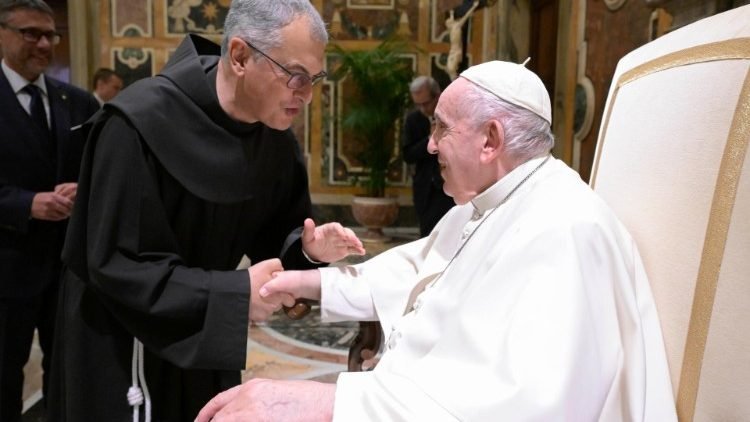
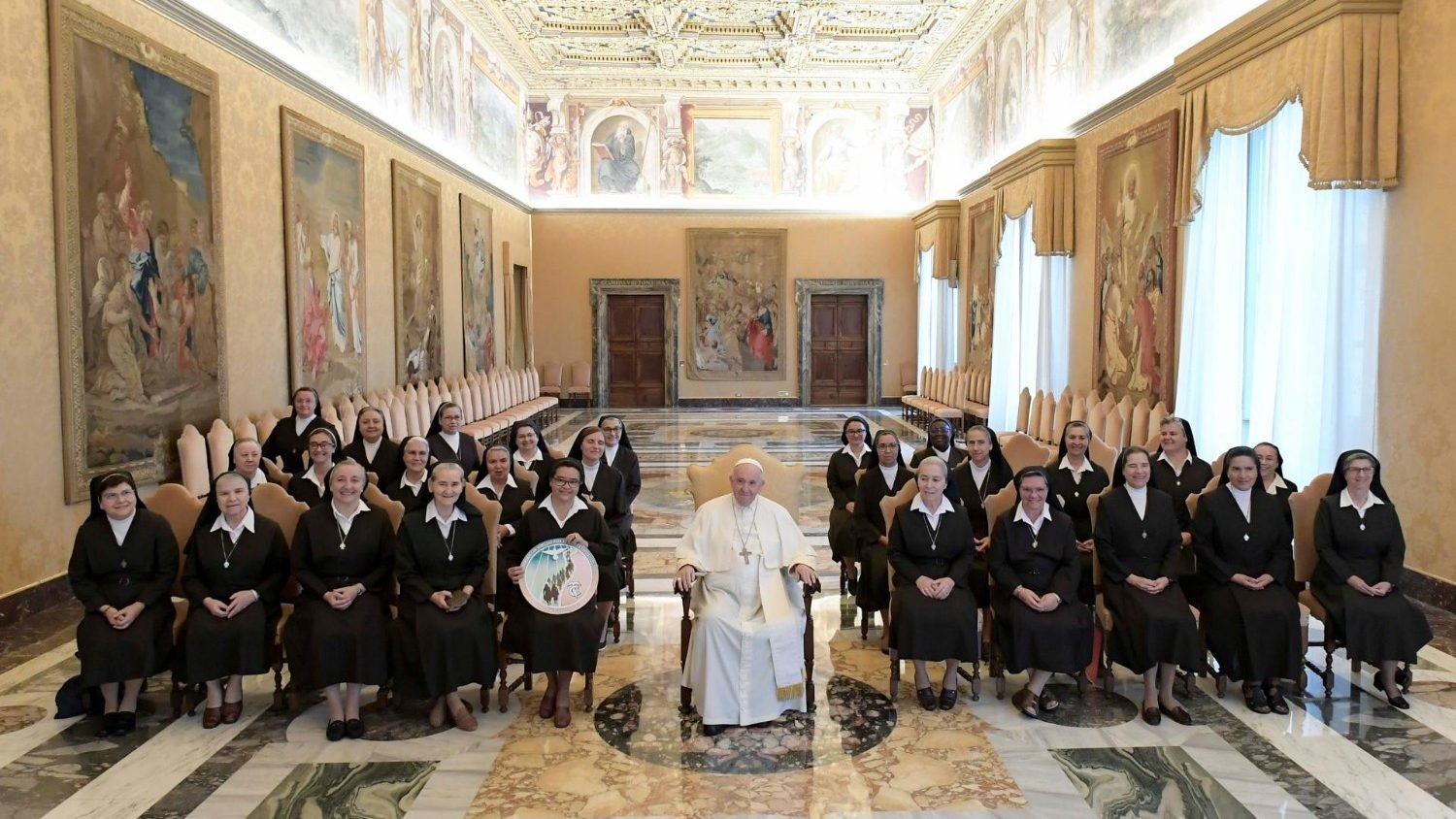
Pope Francis to the Capuchin Tertiary Sisters: Be prophets of listening

On Monday morning, September 26, the Holy Father received in audience the participants in the XXIII General Chapter of the Congregation of the Capuchin Tertiary Sisters of the Holy Family. The Pontiff encouraged the religious to «always be a prophecy of that school of the Gospel which is the way of salvation for the world».

“…that the silence of Nazareth, which cultivated the Holy Family, teach you, in your specific vocation as religious “contemplation and interiority, always being willing to listen to the good inspirations and doctrine of the true teachers, the necessity and value of proper formation, study, meditation, an intense interior life, personal prayer that only God sees”, said Pope Francis in his address to the Chapter Sisters of the Congregation of the Capuchin Tertiary Sisters of the Holy Family, whom he received in audience in the Vatican Apostolic Palace.

Humble listening and synodality

In his address, the Holy Father highlighted the spirit of welcome and universal sisterhood of the religious. “I see with satisfaction that you come from every corner of the world, and it is a good thing because it indicates that you truly live a spirit of welcome and universal sisterhood, in accordance with your special relationship with the “Holy Family”. The Pontiff also highlighted the motto of the General Chapter, which revolves around two ideas: humble listening and synodality. «They are inspiring words, which have a deep root in religious life. To listen, the first thing that is needed is silence, deep silence, inner silence, that which we find in prayer”.                      

Our lifestyles are «full of noise»

In this sense, Pope Francis, recalling the well-known discourse in Nazareth of St. Paul VI, said that our own ways of life are «full of noise». “It seems that the noise important thing is to find that stimulus able to attract the attention of the other, that produces the most immediate response possible. For many, raising the voice, physically or morally, presents itself as the solution to coax the deafened mass to opt for their idea or opinion, always looking for a way to ensure that their signal is heard more, that it is more attractive or surprising, to assert themselves. To one’s dismay, one usually finds that those who had been called almost immediately turn away to flock to the call of a cry that is even more impactful. From one shout to another. This brutalizes, brutalizes, be afraid of the word, this going from one cry to another, this brutalizes humanity, limiting our freedom to the point of making us slaves to those who have the ability to condition those signals, through the media, education, public or political opinion, thus imposing their agendas, in this way, with petulance, with complacency”.

Go against the current, seek silence

Faced with this world «full of noise,» the Holy Father said that the prophecy that Jesus asks of us is indeed to go against this current, to seek out silence, to detach ourselves from the world, from noise. This permits us to pay attention and, with artisanal patience, to identify the different sounds, to weigh them up and to distinguish them. In such a way, that initial clamour begins to take shape; what seemed dissonant will be understood and situated, it will have a name, it will have a face. No note will be too high or too low, and no sound will be strident to our ears if we find the harmony that only our silence can give. And I say that only our silence can give, because harmony is found, not imposed. How many times we meet people who seem good, but are not harmonious people, people who do not have an inner unity that inspires them to go forth. That harmony that is born, that is not imposed.

From our prophetic silence, we combat with humility

And on this path of seeking silence, Pope Francis warned that the temptation is to have a beautiful melody in mind, and to reject or try to silence what is not in tune with it. I have my tune, I have my rhythm here, and all the rest is out. Temptation. But this is judging the other, placing oneself in God’s place, deciding who deserves and who does not deserve to be there. It is a great arrogance, that must be combatted with the humility of our prophetic silence. If I am capable of listening in this way, I will be able to hear all the voices clearly, all of them, understand their order, what they respond to, what they want to say, and why they say so in that way, at times in a way that is so disjointed and so unusual.”

«Be prophets of listening»

This is the origin of the Holy Father’s invitation to women religious to “be prophets of listening, first of all listening to the voice of God, who calls to you to love all without distinction, to love creation as a gift, to see its greatness in all, as Saint Francis teaches us in his Canticle of the creatures. This is the melody that is imposed in a natural way, because it is the proper essence of all things. In this melody, even pain, darkness, death, find their meaning, and they also find the brother in difficulty, those who are in need of forgiveness, in need of redemption, in need of a second chance; we can understand the reasoning of those who think differently from us, of those who contradict us, and even of our own limits”.

From cacophony to symphony

It is precisely from this silence, from this silent listening to God, this silence in which man encounters God, that we can pass from cacophony to symphony, Pope Francis affirmed.  To the ‘sin’ (συν-) of synodality or, and this is the same thing, of walking together (συν -ὁδος), to being a choir with one heart and one soul, even though we are in different times and situations. It is not a utopia, if we truly convince ourselves that raising our voices is not the path, that the only path is Jesus. I will not hide from you that it is the path of the cross, of humility, of poverty, of service. It is the path chosen by Saint Francis, and by your venerable founder, Luis Amigó, who meditated daily on the Passion, inviting you to embrace the style of littleness and mortification as the path of heaven. 

Always be a prophecy of this school of the Gospel

Finally, the Holy Father encouraged the women religious, if, before the overwhelming silence of the Passion, the way is questioned like Pilate, and placed before the naked Truth, we ask, in the words of Saint Paul VI, that the silence of Nazareth, which cultivated the Holy Family, teach you, in your specific vocation as religious “contemplation and interiority, always being willing to listen to the good inspirations and doctrine of the true teachers, the necessity and value of proper formation, study, meditation, an intense interior life, personal prayer that only God sees” (cf. Saint Paul VI, Speech in Nazareth, 5 January 1964) – this last part of from Saint Paul VI, all of it. And this in such a way that you may always be prophecy of that school of the Gospel which is the path of salvation for the world. 

Renato Martinez – Vatican City

SOURCE: Vatican News

Categorías
Últimas Noticias

The martyrs, the greatest testimony of faith …

Rocio Romero, writes that the testimonies of the martyrs of the 30’s do not speak of fear or hatred but of forgiveness; this high school teacher has just promoted «Heaven was their answer», a digital space where she recovers the memory of the martyrs of the civil war, a website where Rocio Romero Aguilera, a high school teacher in the community of Madrid, recovers the testimonies of many martyrs of the civil war who were killed and died forgiving; a tribute from the heart and in which a grateful soul emerges.

In her personal testimony she writes on her website: «Since I started writing about the Spanish martyrs of the thirties, many ask me why I do it …. It is very simple: for Love. There is nothing more beautiful than to find a love story and I, every time I walk along the paths that the martyrs traced with their blood, find it.

… And Heaven was their answer.

The martyrs of the thirties in Spain died for the hatred of religion of those who condemned them; there were no other reasons. That is to say, they died for Love; for the salvation of all. If Christ gave his life to save all humanity, the martyrs, firm in their faith, renew that sacrifice with their blood, strengthened by the presence of Mary, Our Mother.

It is difficult to find something valuable and not share it. Those of us who are Catholics have true treasures of faith and sometimes we do not know it; history and events go against us and what is considered «dangerous» is silenced? In this sense, those who say this are not wrong, because Love (the one with a capital letter) taken to its ultimate consequences, it can do all things; in God, all things are possible.

May not a single life be lost….

ROCIO ROMERO

SOURCE: Blogger: el cielofuesurespuesta.com